Best Practice Routines by Handicap Level
Many golfers practise the wrong things for their level. Practice routines for beginners, mid and low handicappers, with strokes-gained time splits.

Quick Summary
- Know where your shots really go: in Mark Broadie's strokes gained research, the long game (shots from 100+ yards) accounts for most of the gap to scratch. Putting, chipping and bunker play still make up roughly 40-45% of it
- Each handicap tier gets its own routine: beginners (30+), mid-handicappers (15-30) and low-handicappers (under 15) lose shots in different places
- Time splits matter more than total hours: in my view, a 45-minute session with the right balance beats 2 hours of aimless range balls
- Log each session by category in the free Green Streak app to see where your practice time goes
A 30-handicapper and a 10-handicapper walk into a driving range. They both grab a bucket, smash drivers for an hour, then leave. One of them just wasted 60 minutes. The other one wasted 60 minutes too.
Quick Answer: The best practice routine depends on your handicap. Beginners (30+) should give about 60% of their time to short game and putting, which cost them more than 13 shots a round. Mid-handicappers (15-30) do well with a 50% short game, 30% full swing and 20% course management split. Low-handicappers (under 15) need about 40% short game, with a focus on distance control and pressure putting. Strokes gained research shows where those shots go.
Table of Contents
- Why Most Golfers Practise the Wrong Things
- How Strokes Gained Data Should Shape Your Practice
- Beginner Practice Routine (30+ Handicap)
- Mid-Handicapper Practice Routine (15-30 Handicap)
- Low-Handicapper Practice Routine (Under 15 Handicap)
- How Do I Know When to Move to the Next Level
- What Equipment Do I Need for These Routines
- The Practice Ratio That Actually Works
- Building the Habit That Makes Routines Stick
- Sources & Further Reading
- Related Articles
- Frequently Asked Questions
Why Most Golfers Practise the Wrong Things
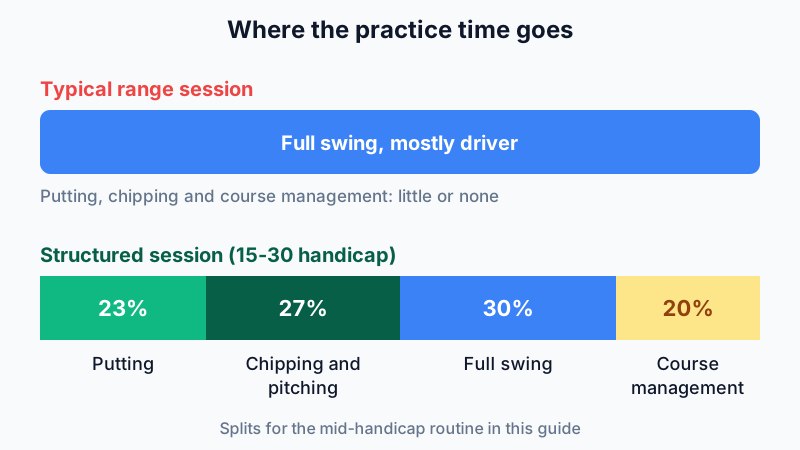
Walk past any driving range and you'll see where a lot of amateur practice goes: full swings, usually with a driver. Yet in Mark Broadie's shot-by-shot data, golfers who typically score 84-97 lose around six shots a round to scratch from putting, chipping and bunker play alone.
That mismatch is one reason handicaps don't move. Many golfers pour their effort into one part of the game and neglect the parts that quietly cost them shots every round.
It's a familiar pattern. You hit driver after driver at the range and feel great about a few flushed 7-irons. Then you three-putt four greens and shoot the same score as last week. Nothing changes until you take a hard look at where your shots are going.
More practice alone won't fix it. You need to practise differently, in the areas your level calls for.
How Strokes Gained Data Should Shape Your Practice
Strokes gained is a statistical method that measures how each shot affects your score compared with a benchmark golfer. It was developed by Columbia professor Mark Broadie and adopted by the PGA Tour. The idea is simple: every shot either gains or loses strokes compared with what the benchmark golfer would do from the same spot.
For amateur golfers, strokes gained data shows clear patterns. Broadie's Golfmetrics study measured how many shots per round amateurs of different scoring levels lose to a scratch golfer in each part of the game.
| Typical Score (Closest Tier) | Strokes Lost: Putting | Strokes Lost: Short Game (under 100 yds) | Strokes Lost: Sand | Strokes Lost: Long Game (over 100 yds, incl. tee shots) | Total vs Scratch | |---|---|---|---|---|---| | 97-120 (Beginner) | 5.1 per round | 7.3 per round | 1.1 per round | 17.5 per round | 31.0 | | 84-97 (Mid) | 2.3 per round | 3.4 per round | 0.6 per round | 9.3 per round | 15.5 | | 70-83 (Low) | 0.8 per round | 0.8 per round | 0.2 per round | 2.2 per round | 4.0 |
Data from Broadie (2008), "Assessing Golfer Performance Using Golfmetrics", Table 4. Scoring groups are Broadie's and map only roughly onto this guide's handicap tiers.
As scores drop, every category improves. In Broadie's data, the long game (shots from more than 100 yards) accounts for most of the scoring difference between golfers, at every level in the table. Putting, chipping and bunker play together still make up roughly 40-45% of the shots lost to scratch. They're also the cheapest shots to practise: there are no range fees, and much of the work can be done at home.
Use this data to set your time splits. If you're losing five shots on the greens and seven around them, those areas deserve time in every session. Keep a block for the full-swing work that tackles the long game, too.
Building a new practice habit? The hardest part is showing up. Use the free Green Streak app to log your sessions by category and build a streak that keeps you coming back.
Beginner Practice Routine (30+ Handicap)
If you're regularly scoring over 100, your priorities are fundamentals and short game. A lovely driver swing won't help much when you're four-putting from 20 feet.
Where Beginners Lose Strokes
In Broadie's data, golfers who typically score between 97 and 120 lose about 31 shots per round to a scratch golfer. Here's the breakdown:
- Putting: 5.1 strokes lost (more than three times as many from 3-6 feet as from beyond 22 feet)
- Short game (under 100 yards): 7.3 strokes lost (chunked chips, skulled pitches, poor distance control)
- Sand: 1.1 strokes lost
- Long game (over 100 yards, including tee shots): 17.5 strokes lost (topping, fat shots, penalties, wrong club selection)
So roughly 44% of the strokes lost happen within 100 yards of the green, where practice is cheap and easy to fit in. The long game is still the biggest single leak, which is why full-swing fundamentals get a block in every session.
The Beginner Time Split
| Area | Time (45-min session) | Time (60-min session) | Focus | |---|---|---|---| | Putting | 15 min (33%) | 20 min (33%) | Distance control, eliminating three-putts | | Chipping and Pitching | 12 min (27%) | 16 min (27%) | Basic bump-and-run, consistent contact | | Full Swing Fundamentals | 10 min (22%) | 14 min (23%) | Grip, setup, one or two clubs only | | Grip and Setup Drills | 8 min (18%) | 10 min (17%) | Mirror work, alignment checks |
The 45-Minute Beginner Session
Putting (15 minutes):
- Spend 5 minutes on 3-foot putts. Set up a gate drill with two tees slightly wider than your putter head, 3 feet from the hole. Make 10 in a row before moving on.
- Move to 10-foot putts for 5 minutes. Aim to get the ball within a 3-foot circle of the hole. Distance control matters more than holing the putt.
- Finish with 5 minutes of lag putting from 20-30 feet. Success means finishing within a putter-length of the hole.
If you want more putting structure, see the best putting drills at home guide. Many of those drills work just as well on a practice green.
Chipping and Pitching (12 minutes):
Pick one club. A pitching wedge or 9-iron is ideal. Use the bump-and-run only: ball back in your stance, hands forward, weight on your lead foot. Then make a putting stroke.
Hit 20-30 chips to a single target, and don't change the target until you've hit at least 10 balls. Repetition builds consistency. For more on short game technique, the golf chipping tips guide walks through every step.
Full Swing (10 minutes):
Grab a 7-iron and nothing else. Hit 20-25 balls at 75% effort. Your goal is solid contact, not distance. If you're topping the ball, the stop topping drills are a good place to start.
Grip and Setup (8 minutes):
Stand in front of a mirror or phone camera. Check your grip, with two knuckles visible on your lead hand. Check your posture: bend from the hips, flex your knees slightly and let your arms hang naturally. Repeat 10 times. It feels tedious, but a proper setup heads off many of the swing faults beginners fight.
When to Graduate
You're ready for the mid-handicapper routine when you consistently score below 100. By then you'll be keeping the ball in play and rarely four-putting. If you're working towards that milestone, the break 100 guide sets out the scoring strategy alongside the practice.
Mid-Handicapper Practice Routine (15-30 Handicap)
You can break 100, and you sometimes break 90. Consistency is the problem. One round you shoot 88, the next you blow up to 97. The gap between your best and worst rounds is where the work lies.
Where Mid-Handicappers Lose Strokes
In Broadie's data, golfers who typically score between 84 and 97 lose about 15.5 shots per round to scratch. Here's how it breaks down:
- Putting: 2.3 strokes lost (inconsistent speed control, missed short putts)
- Short game (under 100 yards): 3.4 strokes lost (poor club selection, inconsistent strike)
- Sand: 0.6 strokes lost
- Long game (over 100 yards, including tee shots): 9.3 strokes lost (distance control, penalty strokes, missing greens on the wrong side)
The long game makes up about 60% of the gap to scratch, so iron consistency and course management earn a bigger slice of your time. Putting and chipping still cost around six shots a round, though, and your practice needs to reflect that balance.
Ready to lock in this routine? It works best when you do it regularly. Use the free Green Streak app to log each session and keep your streak going.
The Mid-Handicapper Time Split
| Area | Time (45-min session) | Time (60-min session) | Focus | |---|---|---|---| | Putting | 10 min (22%) | 14 min (23%) | Speed control, 5-8 foot putts, green reading | | Chipping and Pitching | 12 min (27%) | 16 min (27%) | Shot selection, multiple clubs, lies | | Full Swing | 13 min (29%) | 18 min (30%) | Iron consistency, pre-shot routine | | Course Management | 10 min (22%) | 12 min (20%) | Shot planning, on-course decision drills |
The 60-Minute Mid-Handicapper Session
Putting (14 minutes):
- Start with the clock drill. Place four balls 3 feet from the hole at 12, 3, 6 and 9 o'clock. Hole all four, and repeat twice.
- Move on to the ladder drill for speed control. Place tees at 10, 20, 30 and 40 feet. Putt to each distance without going past the next tee. This builds the touch that cuts down three-putts.
- Finish with 5 pressure putts from 5-8 feet. These are the putts that decide bogey or par. The golf putting drills article covers 10 drills for this range.
Chipping and Pitching (16 minutes):
Stop using one club for every chip. At this level, rotate between three options:
- Bump-and-run (8-iron or 9-iron) for flat lies with green to work with
- Standard chip (pitching wedge) for moderate loft over fringe
- Lob or flop (sand wedge or lob wedge) only when you must carry a bunker
Hit 5 chips with each club and vary the lie. Practise from tight lies, rough, and uphill and downhill slopes. You're building confidence in club selection rather than perfect mechanics.
Full Swing (18 minutes):
Split this into two blocks. For the first 9 minutes, pick three irons (say 7, 5 and 9) and hit 5 balls with each, focusing on consistent contact and your target. For the second 9 minutes, play 3 imaginary holes: hit a driver, then an approach iron, then a wedge. This trains you to switch between clubs the way you do on the course.
For a complete range structure, the driving range practice routine guide shows how to make every bucket count.
Course Management (12 minutes):
Mid-handicappers often neglect this, and it can save shots without changing your swing. Sit down with the scorecard from your last round and ask:
- Where did penalty strokes happen? Could a different club off the tee have avoided them?
- How many greens did you miss on the short side (the side with trouble)? Aiming at the centre could have saved shots.
- How many three-putts came from lag putts that finished 6+ feet past or short?
This review costs nothing and helps you make better decisions. It's the practice golf effectively principle in action: thoughtful review is worth more than mindless repetition.
When to Graduate
You're ready for the low-handicapper routine when you consistently score below 85 and average fewer than 3 three-putts a round. If you're close but not there yet, the break 90 practice plan can help bridge the gap.
Low-Handicapper Practice Routine (Under 15 Handicap)
At this level, the margins are thin. You're not losing five shots on the greens any more. You're losing about one. But every shot is the difference between a 78 and a 74, or between holding your handicap and watching it drift up.
Where Low-Handicappers Lose Strokes
In Columbia professor Mark Broadie's Golfmetrics data, golfers who typically score between 70 and 83 lose only about four shots per round to scratch, in smaller, more specific areas:
- Putting: 0.8 strokes lost (makeable birdie putts and pressure par saves)
- Short game (under 100 yards): 0.8 strokes lost (distance control on wedge shots, up-and-down conversion)
- Sand: 0.2 strokes lost
- Long game (over 100 yards, including tee shots): 2.2 strokes lost (iron dispersion, missing greens by small margins, occasional penalties)
The game becomes about precision, and your practice should reflect that.
The Low-Handicapper Time Split
| Area | Time (45-min session) | Time (60-min session) | Focus | |---|---|---|---| | Putting | 10 min (22%) | 14 min (23%) | Pressure putting, read practice, 6-12 foot conversion | | Wedge and Short Game | 8 min (18%) | 10 min (17%) | Distance control (30-60 yards), varied lies | | Full Swing | 12 min (27%) | 16 min (27%) | Shot shaping, dispersion reduction, stock yardages | | Scoring Shots | 8 min (18%) | 10 min (17%) | 100-yard-and-in wedge distances, partial swings | | Pressure Simulation | 7 min (15%) | 10 min (16%) | On-course mental reps, consequence drills |
The 60-Minute Low-Handicapper Session
Putting (14 minutes):
- Spend 4 minutes on the make-everything circle. Place 8 balls 4 feet from the hole, spaced around it. Hole all 8 in a row, and if you miss one, start again. This puts some pressure on every short putt.
- Spend 4 minutes on lag putting. Putt to a tee 30 feet away and try to stop 5 putts in a row within 3 feet of it. That's the lag standard that keeps three-putts rare.
- Finish with 6 minutes of green reading on 8-12 foot putts. Pick breaking putts, read the line, commit to it and hit it. Note your make percentage so you can compare next time.
Wedge and Short Game (10 minutes):
Your focus here is distance control on partial wedge shots. Broadie found that amateurs' distance errors on short-game shots are about three times larger than their direction errors. Length, not line, is where the shots go.
Use your sand wedge or lob wedge. Hit 5 shots at each of these distances: 30, 40, 50 and 60 yards, to a measured target. Vary your swing length to control the distance, and count how many finish within 10 feet.
Full Swing (16 minutes):
Work on stock yardages, because every iron should have a number you trust. Hit 3 balls each with your 7-iron, 5-iron and 9-iron, and note the carry distances. If you have access to a launch monitor, track your dispersion (the spread of your shots). Tighter dispersion means more greens in regulation.
Spend the rest of the time on shot shaping. Hit 3 draws and 3 fades with a mid-iron. You don't need big curves. A 5-yard shape either way lets you attack flags that straight hitters can't safely go at.
Scoring Shots (10 minutes):
This block is about the wedge game from 100 yards and in. Pick specific distances, such as 70, 80, 90 and 100 yards, and hit 2-3 balls at each. Note how close you finish to the pin. Every few feet closer makes the next putt more makeable. Even PGA Tour players, in Broadie's data, hole only about half their 8-foot putts.
Pressure Simulation (10 minutes):
The practice green and the 18th hole can feel like different planets. Often the technique is there but the nerve isn't. The answer is to build consequences into practice: miss the 5-footer and restart the whole drill. It feels silly at first, but practising under pressure helps you stay calm on the course.
Play the "par 18" game. Pick 9 holes on a mental scorecard. For each, hit one tee shot, one approach and one chip or putt, then score it without any gimmes. If you shoot over par, start over. Squeezing it into 10 minutes mimics the rushed feeling of a competitive round.
How Do I Know When to Move to the Next Level
Your handicap number is only part of it. What matters more is how consistently you hit the performance markers below.
| Moving From | Moving To | Signs You're Ready | |---|---|---| | Beginner (30+) | Mid (15-30) | Consistently break 100, rarely four-putt, keep the ball in play off the tee more than 60% of the time | | Mid (15-30) | Low (under 15) | Consistently break 85, three-putt rate under 3 per round, hit 6+ greens in regulation, up-and-down conversion above 30% | | Low (under 15) | Single digits | Consistently break 80, three-putt rate under 1 per round, hit 10+ greens, scrambling percentage above 50% |
The 19th Hole: My own numbers show how the handicap label can mislead you here. My official index is 12.7, which puts me in this guide's "under 15" tier. But my average round in 2026 has been 89.6, about 20 over par. That's because a World Handicap System index is built from your best recent scores, not your typical one. By the markers in the table above, I'm still a mid-handicapper working on breaking 90 consistently, so that's the routine I'd follow. Check your average score before you check your index.
Don't rush the move. A golfer who switches to the low-handicapper routine too early will neglect fundamentals that aren't automatic yet. If you're a 22-handicapper who sometimes shoots 84, you're not ready for the advanced routine. Your average round decides your level, not your best one.
Keep a record of 10 rounds in a row and use the average. If it falls within the target range, move your practice up to the next tier.
What Equipment Do I Need for These Routines
The good news is you don't need much. Every routine in this guide works with basic kit.
| Item | Beginner | Mid-Handicap | Low-Handicap | |---|---|---|---| | Putter and a few balls | Yes | Yes | Yes | | Alignment sticks (or two clubs on the ground) | Yes | Yes | Yes | | Tees for gate drills | Yes | Yes | Yes | | Wedge set (PW, SW, LW) | Optional | Yes | Yes | | Launch monitor or rangefinder | No | Optional | Recommended | | Practice journal or app | Recommended | Yes | Yes |
A putting mat at home gives you extra reps without leaving the house. The best putting drills at home guide covers what to practise on carpet and how to make it count.
Keep every session on record. Log your practice by category in the free Green Streak app. You'll see where your time goes over weeks and months.
The Practice Ratio That Actually Works
Forget generic advice to "practise more". Strokes gained shows you where your own shots go, so your practice time can follow them.
Here's the comparison across all three levels:
| Practice Area | Beginner (30+) | Mid (15-30) | Low (Under 15) | |---|---|---|---| | Putting | 33% | 23% | 23% | | Chipping and Pitching | 27% | 27% | 17% | | Full Swing | 22% | 30% | 27% | | Course Management | 18% | 20% | - | | Scoring Shots | - | - | 17% | | Pressure Simulation | - | - | 16% |
As you improve, the short game share drops a little while precision and pressure training grow. At every level, putting and chipping together get the largest block of time. That's a deliberate choice. The long game costs more shots overall, but short-game practice is quicker to set up, easy to do at home and something you can fit in almost any day.
Consistency matters most. I'd take a focused 20-minute session five days a week over a two-hour Saturday marathon, and research on spacing practice across days backs that up. The Seinfeld Strategy explains why showing up daily helps.
Building the Habit That Makes Routines Stick
The best practice routine in the world is useless if you do it once and forget about it. You'll often see it on r/golf: someone posts a detailed practice plan, it gets plenty of upvotes, and the comments fill up with "saving this for later". Later rarely comes.
The fix is to build practice into your day, like brushing your teeth. Fifteen minutes before dinner, ten minutes at lunch, or twenty on the way home from work if you pass a putting green.
I built Green Streak for exactly this problem. Log each session, watch your streak grow, and let the "don't break the chain" idea carry you through the days when motivation dips. Your logged sessions also show whether your time splits match the targets in this guide. If you've been logging 80% full swing and 10% putting, you'll see it straight away and can correct course.
The routine changes as your handicap changes. The habit doesn't.
Sources & Further Reading
- Broadie (2008), "Assessing Golfer Performance Using Golfmetrics," Science and Golf V: Shot-by-shot data on where amateurs of different levels lose strokes to scratch
- Mark Broadie's "Every Shot Counts": The foundational book on strokes gained for amateur golfers
- Shot Scope: How Often Do Golfers Three-Putt?: Three-putt frequency by handicap
- Shea et al. (2000), "Spacing Practice Sessions Across Days Benefits the Learning of Motor Skills," Human Movement Science: Why frequent sessions beat one long session
- PGA of America Teaching Resources: Professional instruction methodology
Related Articles
- How to Practice Golf Effectively: The Complete Guide: The foundational principles behind structured practice
- How to Break 100 in Golf: The Strategy Guide: Scoring strategy for beginners working through the first tier
- How to Break 90: A Step-by-Step Practice Plan: The bridge between mid-handicap and low-handicap play
- Driving Range Practice Routine: How to structure your full swing sessions so they carry over to the course
- Building a Consistent Golf Practice Habit: The science of showing up daily
- Golf Putting Drills: 10 Drills to Eliminate Three-Putts: Detailed putting drills referenced throughout this guide
Frequently Asked Questions
How long should a golf practice session be?
For many amateur golfers, 30-60 minutes works well. Beyond that, fatigue and fading focus start to eat into the quality of each rep. A focused 45-minute session with sensible time splits beats a 2-hour unfocused one. Consistency matters more than duration, so I'd take 5 sessions of 30 minutes over 1 session of 3 hours.
Should beginners spend time at the driving range?
Yes, but limit it. I'd keep full shots to about 20-25% of a beginner's practice time. The range builds confidence, but short game and putting drills tackle more of the shots beginners drop around the green. Bring alignment sticks and a specific plan rather than just hammering drivers.
How often should I change my practice routine?
I'd stick with the same routine for 6-8 weeks before adjusting it. Motor skills need repetition to become automatic, and switching routines every week makes that harder. Swap in new drills within the routine as they become easy, but keep the time splits steady.
Can I improve my golf with only 15 minutes a day?
Yes. Fifteen minutes of focused practice a day is more effective than occasional longer sessions. Putting drills, grip checks and short game work all fit into 15 minutes. Research on motor learning shows that spreading practice across days produces better learning than cramming it into one session.
What is strokes gained and why does it matter for practice?
Strokes gained is a statistical method that compares each shot with what a benchmark golfer would do from the same position. It matters for practice because it shows where you lose the most shots. Instead of guessing what to work on, you can see which part of your game costs you most per round.
Should I practise with a purpose or just hit balls?
Always practise with a purpose. Random ball-hitting reinforces your existing habits, good and bad. Give every session a specific focus (putting speed control, 50-yard wedge shots, tee shot accuracy) and a measurable target. Keep track of what you practise and how you perform, so you can spot patterns over time.
How do I know if my practice is working?
Keep a note of three things from your rounds, using a 10-round rolling average: putts per round, greens in regulation and scoring average. If your scoring average falls by 2 or more shots over 8-12 weeks of steady practice, that's a good sign the routine is working. If not, check whether your time splits match the strokes gained data for your level.
Is putting practice really that important?
The data suggests so. In Shot Scope's data, a 25-handicapper three-putts once every 7.6 holes and a 15-handicapper once every 9.7 holes, so two or so three-putts a round is normal. Broadie's research found that high handicappers lose more than three times as many shots from 3-6 feet as from beyond 22 feet. Short putts and speed control are cheap to practise, and you can work on both at home.
Disclaimer: This article is for informational purposes only and does not replace professional golf instruction. Individual results will vary based on ability, practice consistency, and physical condition. Consult a PGA professional for personalised swing advice.
Ready to build your practice streak?
Track your sessions, set goals, and improve with Green Streak — completely free.
Get Started Free