Best Putting Drills at Home: 10 Drills for Speed and Start Line
Three-putts are usually a speed problem. These 10 home putting drills work on speed, alignment and nerve in 15 minutes a day on your carpet.
Quick Summary
- Putting accounts for around 40% of your strokes: Dave Pelz puts it at 43%, yet it rarely gets that share of practice time
- The Gate Drill is a great place to start: it trains your start line with instant pass-or-fail feedback
- Speed control is the big three-putt culprit: Shot Scope data names leaving putts short as one of the biggest causes, so distance drills matter most
- Track your progress: log your practice sessions in the free Green Streak app to build consistency
You've just three-putted from 25 feet. You didn't miss the line. Your first putt finished 8 feet past the hole, and then the one coming back lipped out.
Quick Answer: The best putting drills at home train two skills: speed control and start line. The Gate Drill (roll putts through two tees about 2 feet ahead of the ball) builds your start line. The Ladder Drill (targets at 3, 6, 10 and 15 feet) builds distance control. Fifteen minutes a day on your living room carpet is plenty. Shot Scope data shows a 15-handicapper three-putts roughly once every 10 holes. Log your sessions in Green Streak.
Table of Contents
- Why Do I Keep Three-Putting
- What Do I Need to Practise Putting at Home
- The 10 Best Putting Drills at Home
- Drill Comparison Table
- How Long Should I Practise Putting Each Day
- Equipment for Home Putting Practice
- The Weekly Putting Practice Plan
- How to Track Your Putting Improvement
- Sources & Further Reading
- Related Articles
- Frequently Asked Questions
Why Do I Keep Three-Putting
Three-putts are more often a speed problem than a line problem.
Think about your last round. When you three-putted, was the first putt offline, or was it 6-10 feet long or short? For many amateurs, the answer is distance. You left yourself a second putt too long to be a tap-in and too short to feel comfortable.
Shot Scope data shows that a 15-handicapper three-putts about once every 9.7 holes, and a 25-handicapper about once every 7.6 holes. PGA Tour players average around half a three-putt per round. The difference is rarely a more expensive putter. It's mostly speed control.
The same Shot Scope analysis found that the average golfer leaves 55% of their putts short of the hole. It names leaving putts short as one of the biggest contributors to three-putts. The good news is that speed is trainable. You don't need talent, you need reps.
Ask a group of club golfers to replay their last three-putt and many will describe the same thing. The first putt finished well past or well short; it didn't miss the line. Once you accept that speed is usually the problem, it changes how you practise.
What Do I Need to Practise Putting at Home
Almost nothing, which is what makes putting such good home practice.
The Bare Minimum (Free)
- A putter
- A golf ball
- A flat surface (carpet, tile, hardwood)
- A target (a coin, a mug, a strip of tape)
Your carpet isn't a perfect putting green. It rolls at a different speed from most greens and has no break. But the stroke itself (grip pressure, tempo, face angle, acceleration) is the same, so what you groove on carpet carries over to grass.
Better Setup (£-££)
- A putting mat with a target hole (£15-£60)
- Two tees or alignment sticks for gate drills
- A measuring tape or pre-marked distances on the mat
Best Setup (££-£££)
- A premium putting mat with stimp-speed options (£100-£250)
- A putting mirror for eye position and alignment (£20-£35)
- A putting alignment rail or training arc (£25-£50)
My honest take: a £15 putting mat and two tees get you most of the training benefit. Premium gear makes practice more enjoyable, which may mean you do it more often. Either way works.
Ready to build the habit? A drill does nothing if you try it once and forget it. Log every putting session in the free Green Streak app and turn 15 minutes a day into a habit.
The 10 Best Putting Drills at Home
There are hundreds of putting drills out there. These 10 are the ones I'd recommend, because each has a clear pass-or-fail target. Each works on a specific skill, takes about 5 minutes or less and needs nothing beyond a putter, balls and a few markers.
Drill 1 - The Gate Drill (Alignment)
What it trains: A square face at impact and a consistent stroke, so the ball starts on your line.
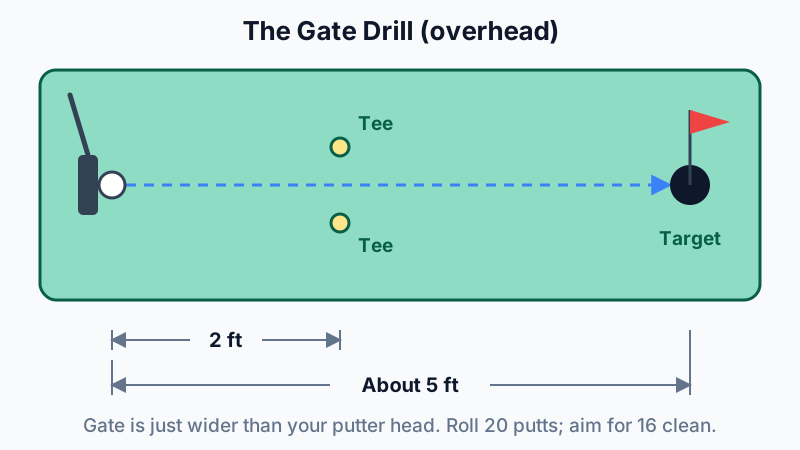
Setup: Push two tees (or lay two coins) just wider than your putter head, about 2 feet in front of your ball. Set a target roughly 5 feet away.
How to execute: Roll 20 putts through the gate without the ball clipping either tee. If it clips one, the ball started off line. Start direction comes mostly from where the face points at impact, so a clipped tee usually means the face was open or closed.
Success criteria: Aim for 16 out of 20 clean passes. If you manage fewer than 6 in 10, widen the gate slightly and rebuild.
Time: 3-5 minutes (20 putts).
This is one of the best-value putting drills there is. The feedback is instant: the ball either goes through cleanly or it doesn't, so you can't kid yourself about whether the putt was good.
Drill 2 - The Ladder Drill (Speed Control)
What it trains: Distance control across several lengths.
Setup: Mark targets at 3, 6, 10 and 15 feet from your starting spot. Use coins, tape or the edges of a rug.
How to execute: Putt one ball to each target in order, shortest to longest. Then work back down the ladder: 10, 6, then 3 feet. Your goal is to stop each ball within 6 inches of its mark.
Success criteria: Stop 5 out of 7 putts within the 6-inch zone.
Time: 5 minutes (2-3 rounds of the ladder).
Speed control is the skill that keeps three-putts off your card. This drill teaches your hands to judge distance as well as direction.
Drill 3 - The Clock Drill (Pressure From All Angles)
What it trains: Short putts under pressure from different positions.
Setup: Place 4-8 balls in a circle around your target at 3 feet, like the numbers on a clock face.
How to execute: Hole every putt, moving clockwise. If you miss one, restart from the beginning.
Success criteria: Complete the full circle without a miss. Start with 4 balls and build up to 8.
Time: 3-5 minutes.
The restart penalty creates real pressure. Your hands tighten on putt 7 of 8, just as they do on the course when you need a 3-footer to save par.
Drill 4 - The Coin Drill (Precision)
What it trains: Stroke accuracy and focus on a tiny target.
Setup: Place a coin on the carpet 5 feet away.
How to execute: Try to roll the ball directly over the coin. Don't aim at a cup; aim at the coin itself.
Success criteria: Hit the coin 5 out of 20 times. Roll within a ball's width of it 12 out of 20 times.
Time: 3 minutes.
After aiming at a coin, a 4.25-inch hole looks enormous. Shrinking the target sharpens your focus on the line.
Drill 5 - The Eyes Closed Drill (Feel and Tempo)
What it trains: Stroke tempo and distance feel without relying on your eyes.
Setup: Set a target 6-8 feet away and take your normal address position.
How to execute: Close your eyes before you start the stroke, then putt. Open them after you hear the ball stop, and see how close it finished.
Success criteria: Stop 5 out of 10 putts within 12 inches of the target.
Time: 3 minutes (10 putts).
This drill makes you rely on feel. You can't steer the putter when you can't see, so the stroke tends to become smoother and more repeatable.
Tracking your drills? Log which drills you did and your scores in the free Green Streak app. After a month, you'll see which skills have improved and which need more work.
Drill 6 - The 21 Game (Competitive Pressure)
What it trains: Pressure putting and handling consequences.
Setup: Set a target at 3 feet.
How to execute: A make scores 1 point and a miss loses 3. First to 21 wins. Play against yourself or a partner.
Success criteria: Reach 21 without going negative.
Time: 5-7 minutes.
The 3:1 penalty makes every short putt feel like it matters, which is how they feel on the course. You get used to that pressure at home before you face it on a Saturday.
Drill 7 - The Metre Drill (Speed Calibration)
What it trains: Consistent pace on mid-range putts.
Setup: Mark a target 10 feet away. Then mark a "dead zone" running from the target to 12-18 inches past it.
How to execute: Hit 10 putts. Only balls that stop inside the zone count, and short and long putts are equal failures.
Success criteria: 7 out of 10 in the zone.
Time: 3 minutes.
It teaches a useful principle for makeable putts: the ball should have enough pace to finish a little past the hole, around 12-18 inches. A putt that doesn't reach the hole has no chance of going in. One that finishes a foot past leaves you a tap-in.
The 19th Hole: Remember the Shot Scope figure from earlier: the average golfer leaves more than half of their putts short. Now think about how many golfers practise putting at home. It's usually a straight 4-footer at a mug or a gate, over and over. That builds your start line, which was rarely the problem. A pattern you see constantly on golf forums is the golfer who holes everything on the carpet and still three-putts every other green on Saturday. The home drills never asked their hands to judge distance. If three-putts are your issue, flip the ratio. Spend most of your session on the Ladder, Metre and Random drills, and treat the Gate Drill as the warm-up rather than the main event.
Drill 8 - The Par 2 Challenge (Make-Percentage Tracking)
What it trains: Confidence from mid-range distances.
Setup: Set up 9 putts from 6-8 feet, a common distance for par-saving putts.
How to execute: Each putt is a "hole". Hole it for a birdie (1 point) or miss for a par (0 points). There are no bogeys. Score your round out of 9.
Success criteria: Score 5 or better out of 9.
Time: 5 minutes.
Shot Scope data shows 15- and 20-handicappers hole only around 38-40% of putts from 6-12 feet. This drill gives you repetitions at that make-or-miss par-saving distance.
Drill 9 - The Line Drill (Straight-Back-Straight-Through)
What it trains: Start line and stroke consistency.
Setup: Lay a piece of tape or string in a straight line on the carpet, 4 feet long. Place your ball at one end.
How to execute: Putt along the line. The ball should track directly over the tape for its full length. If it drifts off, check your face angle first, since the face has the biggest say in where a putt starts. Then check your path.
Success criteria: 8 out of 10 putts stay on the line for the full 4 feet.
Time: 3 minutes.
The line gives you visual feedback that you can't get from aiming at a hole. It shows you straight away whether the ball started where you meant it to.
Drill 10 - The Random Challenge (Course Simulation)
What it trains: Adaptability and on-course transfer.
Setup: Set up 5 targets at different distances and angles across the room, such as 3 feet, 7 feet and 12 feet, some left, some right and some straight.
How to execute: Putt to each target in sequence, never hitting the same distance or angle twice in a row. Give each putt a full pre-shot routine: read the line, set up, take one practice stroke and hit it.
Success criteria: Stop 3 out of 5 putts within 12 inches of the target.
Time: 5 minutes.
This is the putting version of random practice. On the course you never hit the same putt twice, so this drill makes you recalibrate for every putt, just as you have to during a round.
Drill Comparison Table
| Drill | Skill Trained | Difficulty | Time | Equipment | Best For | |-------|--------------|------------|------|-----------|----------| | Gate Drill | Alignment | Easy | 3-5 min | 2 tees | Everyone | | Ladder Drill | Speed control | Medium | 5 min | Distance markers | Three-putt fixers | | Clock Drill | Short putt pressure | Medium | 3-5 min | 4-8 balls | Missed short putts | | Coin Drill | Precision | Hard | 3 min | 1 coin | Advanced feel | | Eyes Closed | Tempo and feel | Medium | 3 min | Nothing extra | Jerky stroke fixers | | 21 Game | Competitive pressure | Hard | 5-7 min | Nothing extra | Nerves under pressure | | Metre Drill | Speed calibration | Medium | 3 min | Distance marker | Lag putting | | Par 2 Challenge | Make percentage | Medium | 5 min | Target at 6-8 ft | Par-saving putts | | Line Drill | Start line | Easy | 3 min | Tape or string | Inconsistent start line | | Random Challenge | Course simulation | Hard | 5 min | Multiple targets | On-course transfer |
How Long Should I Practise Putting Each Day
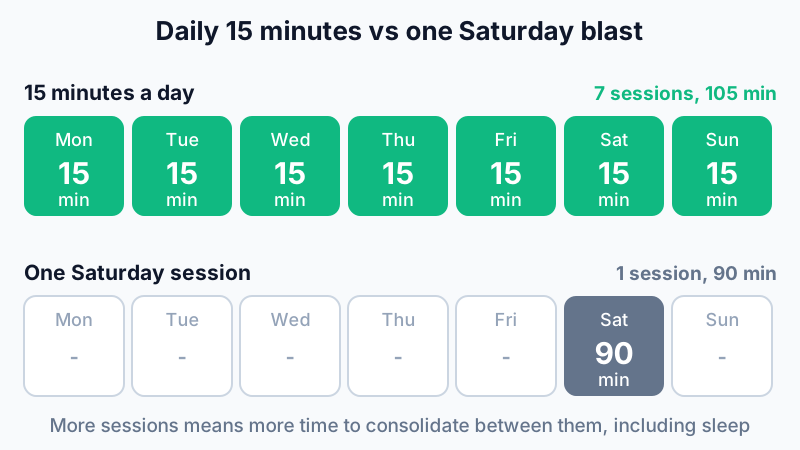
Fifteen minutes is the sweet spot. Beyond 20-30 minutes, concentration tends to drop for most people, stroke quality slips and you start grooving sloppy habits.
In 15 minutes you can get through 2-3 drills from the list above, which is plenty for one session.
Frequency matters more than duration, so fifteen minutes a day should do more for you than 90 minutes on a Saturday. Motor learning research suggests skills consolidate between sessions, including during sleep, so short daily sessions give you more of those consolidation periods.
It also fits real life better. Fifteen minutes before work is easy to protect, while a 90-minute Saturday block is the first thing to go when the week gets busy. The total minutes look the same on paper, but only one plan actually happens every week.
Equipment for Home Putting Practice
| Equipment | Price Tier | What It Adds | Worth It? | |-----------|-----------|--------------|-----------| | Carpet + coin | Free | Basic stroke practice | Start here | | Basic putting mat | £ | Consistent surface, target hole | Yes, after 14 days of carpet | | Putting mirror | £ | Eye position and shoulder alignment check | Yes for alignment issues | | Premium putting mat | ££ - £££ | Distance markers, speed options | If you putt daily | | Putting alignment rail | ££ | Forces straight-back-straight-through path | If path is your issue | | Pressure putt trainer | £ | Reduced hole size for precision | Good for advanced players |
Start with the free setup and upgrade once you've shown the habit sticks. A putting mat that gathers dust helps nobody.
The Weekly Putting Practice Plan
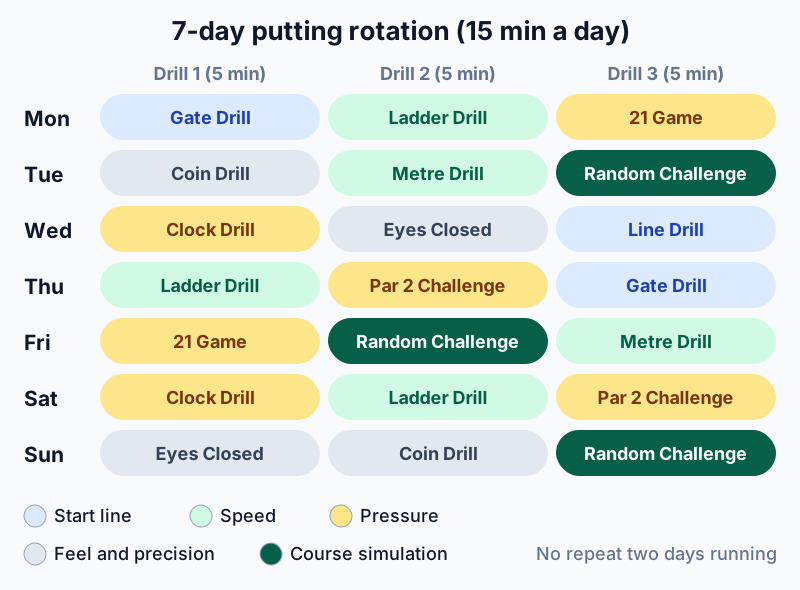
Use this 7-day rotation. Each day takes 15 minutes, and every session counts toward your streak.
| Day | Drill 1 (5 min) | Drill 2 (5 min) | Drill 3 (5 min) | |-----|-----------------|-----------------|-----------------| | Monday | Gate Drill | Ladder Drill | 21 Game | | Tuesday | Coin Drill | Metre Drill | Random Challenge | | Wednesday | Clock Drill | Eyes Closed | Line Drill | | Thursday | Ladder Drill | Par 2 Challenge | Gate Drill | | Friday | 21 Game | Random Challenge | Metre Drill | | Saturday | Clock Drill | Ladder Drill | Par 2 Challenge | | Sunday | Eyes Closed | Coin Drill | Random Challenge |
The rotation means you never do the same combination two days in a row. It's random practice applied to drill selection, which keeps your brain engaged.
If you're working toward breaking 100, cutting out three-putts is one of the quickest ways to save shots. A daily streak of 15-minute putting sessions, built with the Seinfeld Strategy, is a simple way to get there. For more on building a consistent practice habit, the minimum viable session idea makes this sustainable long term.
How to Track Your Putting Improvement
Keep an eye on these three numbers each week:
- Make percentage from 5 feet. Start by setting your baseline on the carpet, then push it up week by week. For reference, Shot Scope data has 15- and 20-handicappers holing about 84% of putts from inside 6 feet on real greens.
- Proximity from 20 feet. Measure how close your first putt finishes to the hole and note the average distance left. Aim to get it under 3 feet.
- Three-putts per round. Note these on your scorecard. If the number drops, your practice is working.
These numbers tell you whether your practice is carrying over to the course. If they stall after 4 weeks, change your drill mix. If they improve, keep going.
Sources & Further Reading
- Shot Scope: How Often Do Golfers Three-Putt?: Three-putt frequency by handicap and how often golfers leave putts short
- Shot Scope: Putting Make Percentages by Handicap: Make rates by distance for scratch to 25-handicap golfers
- The Left Rough: The Truth About Greens in Regulation: PGA Tour putting benchmarks, including three-putts per round
- Pelz, D., "Dave Pelz's Putting Bible" (2000): Data-driven analysis of putting mechanics, speed control, and practice methods
- Dave Pelz's Putting Bible (Penguin Random House): Source of the 43% putting figure
- Broadie, M., "Every Shot Counts" (2014): Strokes gained methodology showing the value of putting improvement
Related Articles
- The Complete Guide to Practicing Golf at Home
- How to Practice Golf Effectively: The Complete Guide
- Building a Consistent Golf Practice Habit
- The Seinfeld Strategy: Why "Don't Break the Chain" Works for Golf
- How to Break 100 in Golf: A Step-by-Step Guide
Frequently Asked Questions
How long should I practise putting at home each day?
Fifteen to twenty minutes is the sweet spot. Concentration tends to fade in longer sessions, and 15 minutes allows 2-3 quality drills. Short daily sessions should serve you better than one long weekly session, because research favours spacing practice out.
Can I improve my putting on carpet?
Yes. Carpet doesn't copy green speed or break, but the stroke (grip pressure, face angle, tempo and acceleration) is the same. The surface matters less than the repetitions.
What is the most effective putting drill?
The Gate Drill is a great all-rounder. It checks your start line with instant feedback: the ball either passes cleanly through the gate or it doesn't. Start with a gate just wider than your putter head and narrow it as you improve.
How many putts should I hit in a practice session?
Aim for 40-60 putts in a 15-minute session. Spread them across 2-3 drills rather than rolling balls at one target on autopilot. Attention matters more than the number of putts, so give each putt a specific target.
Do putting mats help with improvement?
A putting mat gives you a consistent, repeatable surface with built-in targets and alignment aids. That consistency takes surface variation out of the picture so you can focus on the stroke. A budget mat (£15-£30) gets you most of the benefit. Upgrade to a premium mat once you've proved the daily habit and want something more realistic.
How do I know if my putting is improving?
Track three numbers: make percentage from 5 feet (aim to beat your baseline), average proximity from 20 feet (aim for under 3 feet left) and three-putts per round. If all three trend the right way over 4-6 weeks, your practice is working.
Is speed control or alignment more important for putting?
Speed control, for most of the putts that cost you shots. Shot Scope's analysis names leaving putts short as one of the biggest contributors to three-putts, and the average golfer leaves 55% of their putts short. A putt that finishes 8 feet past with perfect aim still leaves a tricky second putt. One that finishes 18 inches past with slightly imperfect aim leaves a tap-in.
What is the best putting drill for beginners?
The Ladder Drill. It teaches speed control across several distances without any pressure element. Set targets at 3, 6, 10 and 15 feet, roll one putt to each and focus only on stopping the ball close to the target. Once you're comfortable, add the Gate Drill for your start line. Together they cover the fundamentals.
Disclaimer: This article is for informational purposes only and does not replace professional golf instruction. Individual results will vary based on ability, practice consistency, and physical condition. Consult a PGA professional for personalised swing advice.
Ready to build your practice streak?
Track your sessions, set goals, and improve with Green Streak — completely free.
Get Started Free