Building a Consistent Golf Practice Habit: The Science of Showing Up
66 days to form a habit, 10 minutes to keep it alive. The science of a consistent golf practice habit, and a system that makes quitting harder than showing up.

Quick Summary
- Habit formation takes around 66 days, not 21: that was the median in Dr Phillippa Lally's research at University College London
- 10 minutes counts as a full session: a minimum viable session keeps the habit alive on your worst days
- Systems beat motivation: a fixed time, a tiny minimum and simple tracking keep you practising when motivation disappears
- Track your progress: log your practice sessions in the free Green Streak app to build consistency
Last January you told yourself this would be the year you finally committed to practising. It's now February, and you haven't touched a club since the 4th.
Quick Answer: A consistent golf practice habit depends on systems rather than willpower. Research from University College London found habits took a median of 66 days to become automatic. Start with a minimum viable session, as little as 10 minutes of putting on carpet, tied to a fixed time of day. Log every session so you can see the chain building. Thinking of yourself as "someone who practises daily" helps too. Track it all in Green Streak.
Table of Contents
- Why Does Talent Not Predict Improvement
- The Habit Loop for Golf Practice
- How Long Does It Really Take to Build a Practice Habit
- Identity-Based Habits and Golf
- The Minimum Viable Session
- How Do You Remove Friction From Practice
- Why Tracking Changes Everything
- What Do You Do When Motivation Disappears
- How Streaks Create Psychological Ownership
- Recovering From a Broken Streak
- Sources & Further Reading
- Related Articles
- Frequently Asked Questions
Why Does Talent Not Predict Improvement
The golfer with the prettiest swing at your club isn't always the one dropping shots fastest. More often it's the one who shows up every day.
A meta-analysis published in Psychological Science found that deliberate practice explained only 18% of the variance in sports performance. Practice isn't the whole story, but how often you show up is the part you control. Talent may set a ceiling. Showing up decides how close you get to it.
Most clubs have a naturally gifted player who never seems to improve. They hit lovely 7-irons on the range once a month, then wonder why their handicap stays put. Most clubs also have someone with an ordinary-looking swing who keeps chipping shots off their handicap year after year. The difference is rarely talent. It's usually frequency.
Compare two golfers. One practises once a week for 90 minutes, the other 15 minutes a day for six days. They get the same total time, but the second golfer's is spread in a way that tends to stick better. A meta-analysis of 63 studies on distributed practice (spacing repetitions across sessions rather than cramming) found spaced practice produced significantly better performance than massed practice.
The golf industry sells lessons, swing aids and biomechanics videos, all of which assume the problem is knowledge or ability. For many amateur golfers the problem is simpler. They don't practise often enough, and that's usually down to the lack of a system rather than a lack of time.
The Habit Loop for Golf Practice
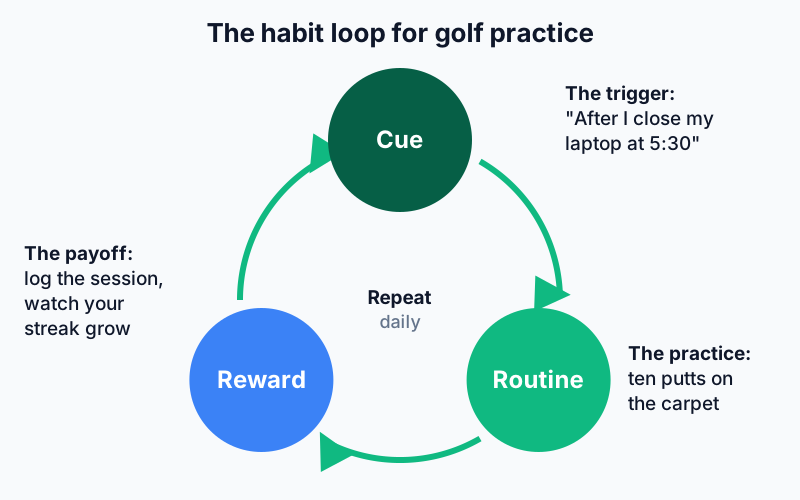
Charles Duhigg's habit loop from The Power of Habit breaks every habit into three parts: cue (the trigger), routine (the behaviour) and reward (the payoff). To build a consistent golf practice habit, you need to design all three.
The Cue
Your cue is an existing event that triggers practice. It should be something that happens every day without fail.
- After your morning coffee
- When you get home from work and change shoes
- After putting the kids to bed
- During your lunch break
The cue must be specific. "Sometime in the evening" doesn't work, but "After I close my laptop at 5:30" does. James Clear calls this habit stacking: attaching a new behaviour to an established one. It removes the decision about when to practise.
The Routine
This is the practice itself. Keep it very small at the start. Think ten putts on the carpet, five minutes of grip work in front of a mirror or a few chips into a towel in the garden.
Make the routine so small that "I don't have time" stops being believable. Two minutes of putting is barely a dent in your day. If you need drills for those minutes, the best putting drills for home practice gives you 10 options that take 3-5 minutes each.
The Reward
Your brain needs a payoff. Intrinsic rewards, like the satisfaction of a good stroke, develop over time. Early on you need something immediate: ticking off a session, watching a streak counter go up, seeing a calendar fill with completed days.
That's where tracking comes in, because logging a session becomes the reward. The cue triggers the routine, the routine earns the reward, and the reward makes you more likely to respond to the cue tomorrow.
How Long Does It Really Take to Build a Practice Habit
The popular claim is 21 days. The research doesn't support it.
Dr Phillippa Lally's research at University College London, published in the European Journal of Social Psychology, followed 96 participants forming new habits. The median time to automaticity (the point where the behaviour feels automatic rather than forced) was 66 days. The range was 18 to 254 days.
That number matters. If you expect to feel comfortable at day 21 and you're still forcing it, you might quit. Knowing the real timeline resets your expectations.
| Phase | Timeline | What It Feels Like | What to Do | |---|---|---|---| | Forced compliance | Days 1-14 | Hard. You forget. You bargain. | Set phone alarms. Keep the minimum tiny. | | Early momentum | Days 15-30 | Easier. Some days feel natural. Others do not. | Track your streak. Let the chain motivate you. | | The messy middle | Days 31-50 | Progress stalls. Boredom creeps in. | Vary the drills. Add a putting game. | | Approaching automaticity | Days 51-66 | Missing a day feels wrong. You just do it. | Increase session length or complexity. | | Identity shift | Days 67+ | "I am someone who practises daily." | Maintain and build on the foundation. |
The study also found that missing a single day did not reset progress. Automaticity built gradually, and missing one opportunity didn't materially affect the process. That's worth remembering: a missed day isn't a broken habit.
Building your first streak? The free Green Streak app logs your daily practice sessions and shows your streak length at a glance. Watching that number climb is a simple reward that reinforces the habit loop.
Identity-Based Habits and Golf
James Clear's Atomic Habits changed how I think about practice. Many golfers set outcome goals, like "I want to break 80" or "I want to drop 5 shots." Those goals give you direction, but they don't drive daily behaviour.
Identity-based habits turn this around. Instead of "I want to practise more," the statement becomes "I am someone who practises every day." The behaviour comes from the identity rather than from a distant goal.
This suits golf well. Outcome goals create a pass/fail dynamic: if you don't break 80 this month, you failed, and that failure drains motivation. An identity statement is judged daily instead. You either practised today or you didn't, and every day you practise is a vote for being someone who practises daily.
Clear argues that the best way to change behaviour is to decide the type of person you want to be, then prove it to yourself with small wins. Each 10-minute putting session is one of those votes. After 30 of them in 30 days, you have plenty of evidence that you're a person who practises daily.
The Identity Ladder for Golfers
- Level 1: "I play golf sometimes." (no practice habit)
- Level 2: "I try to practise when I can." (intention without system)
- Level 3: "I practise most days." (emerging habit)
- Level 4: "I am someone who practises every day." (identity shift)
- Level 5: "Missing a day feels like skipping a meal." (automaticity)
Many golfers trying to break 100 are stuck at Level 2. Getting from Level 2 to Level 4 is less about finding more time and more about a system that makes the behaviour automatic. The complete guide to practising at home shows you how to set that system up.
The Minimum Viable Session
If you take one idea from this article, make it this. The minimum viable session is the smallest amount of practice that still counts toward your streak.
A good example is 10 putts on the hallway carpet, which takes under two minutes. On your best days you might practise for 30-45 minutes, with full short game work, mirror drills or a range session. If you have the space, add net work in the garage. On your worst days (sick, exhausted, stuck late at work) you roll 10 putts before bed and the streak survives.
The minimum must meet three criteria:
- It takes less than 5 minutes. Anything longer and busy days will kill it.
- It needs no travel. Driving to the range isn't minimum viable.
- It uses equipment you already own and keep to hand. A putter and a ball are enough.
BJ Fogg's Tiny Habits research at Stanford backs this up. Fogg found that making a behaviour very small reduces how much motivation you need. You don't have to feel like practising, you just have to do the tiny thing. Once you start, you often do more than the minimum anyway.
That's the quiet benefit of a tiny minimum. An evening that starts as "just 10 putts" can easily turn into 15 or 20 minutes. The minimum gets you started and momentum does the rest.
Every session counts. Log your 10-minute putting session in the free Green Streak app and it counts toward your streak just like a 2-hour range day. The streak cares about showing up, not about duration.
How Do You Remove Friction From Practice
The biggest threat to a practice habit is friction: the effort needed to get started. Every barrier between you and your session is a chance for your brain to talk you out of it.
Prep the Night Before
Leave your putter and a ball by the door, or wherever you practise. When you wake up or get home from work, the kit is waiting for you. There's no searching the garage or unpacking bags, so the decision is already made.
Create a Permanent Practice Station
If you have a practice net in the garage or a putting mat in the hallway, leave it set up. A permanent station removes setup time entirely. A putting mat left unrolled in the hallway is something you step over several times a day, and it becomes a visual reminder to roll a few putts.
Anchor to an Existing Habit
Habit stacking works because it borrows a routine you already have. Choose an anchor that happens every day:
- Morning coffee anchor: While the kettle boils, roll 10 putts.
- Post-work anchor: Before you change clothes, do 5 minutes of mirror work.
- TV anchor: During the first ad break, practise your grip.
- Bedtime anchor: 10 putts before brushing your teeth.
The anchor removes the need to decide when. It just happens.
Remove Digital Friction
If you track practice on paper, you'll eventually forget. If you track it in a spreadsheet, opening the file becomes a barrier of its own. The best tracking tools let you log a session in under 10 seconds.
The 19th Hole: My own scorecards are a useful reality check here. I've logged my rounds in a scoring app since January 2023. My average went from 25.6 over par in 2023 to 22.2 over in 2024, then 22.1 over in 2025. That's a whole year with essentially no change. The drop came in 2026, to 19.9 over par so far. Improvement in golf rarely arrives in a straight line. It tends to come in steps, often after long flat stretches where nothing seems to be happening. That's why the habit has to survive without visible results. If your practice only lasts while your scores keep falling, it won't make it through the flat year.
Why Tracking Changes Everything
"What gets measured gets done" is an overused phrase, but there's evidence behind it.
A meta-analysis of 138 studies in Psychological Bulletin found that monitoring progress towards a goal makes people more likely to reach it. The effect was larger when progress was physically recorded. Recording creates accountability, even when nobody else sees the data.
For golf practice, tracking does three things.
It Creates an Honest Record
Memory is unreliable. You think you practised four times last week, but the log says twice. Without a record, it's easy to overestimate your effort and misjudge why results aren't coming. A practice log shows you where the gaps are.
It Reveals Patterns
After a month of tracking, you'll spot patterns you never noticed. Maybe you always skip Wednesdays, or your longest streaks start after a bad round. Maybe you practise putting three times as often as chipping, when chipping is the part of your game that needs the work.
It Turns Practice Into a Game
Streaks are a game in their own right. A 15-day streak has weight, and you don't want to break it. That taps into loss aversion, the principle that losing something feels worse than gaining the same thing feels good. Your 30-day streak feels more valuable than the 30 days it took to build, so breaking it feels like losing something real.
| Approach | How It Works | What Tends to Happen | |---|---|---| | Motivation-based practice | "I'll practise when I feel like it" | Occasional sessions, easily skipped | | Goal-based practice | "I want to drop 5 strokes by June" | Strong start, often fades within weeks | | System-based practice | "I practise at 7am every day, minimum 10 putts" | Frequent sessions, sustained | | System + tracking | "I practise daily and log every session" | Near-daily sessions, compounding |
I'd aim for the bottom row. It doesn't need more talent or more time. The system removes the daily decision, and the tracking protects the system.
What Do You Do When Motivation Disappears
Motivation isn't reliable. It spikes after a great round or an evening of YouTube lessons, and it crashes after a bad round or a stressful week at work. If your practice habit depends on it, the habit will collapse every time life gets hard.
The answer is a system. James Clear puts it simply: "You do not rise to the level of your goals. You fall to the level of your systems."
Here's what that looks like in practice.
Design for Your Worst Day
Your system has to work when you're tired, stressed, ill or unmotivated. That's why the minimum viable session exists. On your worst day, can you roll 10 putts? If so, the system holds.
Separate the Decision From the Action
The riskiest moment is the few seconds when your brain decides whether to practise, so remove that moment. Habit stacking handles the "when", the permanent practice station handles the "where" and the minimum viable session handles the "how long". That leaves nothing to decide.
Use the 2-Minute Rule
This is another idea from James Clear. If starting feels hard, commit to 2 minutes. Anyone can do anything for 2 minutes, and once you've started, stopping often feels stranger than carrying on.
Reframe Bad Sessions
A bad practice session still counts. Twenty putts that all miss still reinforce the habit loop, keep the streak alive and count as a vote for being someone who practises daily. Your skill level will go up and down, but the habit keeps building.
The Seinfeld Strategy works because it doesn't care about the quality of any single session. It only cares whether you showed up.
How Streaks Create Psychological Ownership
Behavioural economics has a concept called the endowment effect: people value things they own more than identical things they don't. A coffee mug you own is worth more to you than the same mug on a shop shelf.
Streaks seem to work the same way. Once you own a 20-day streak, it feels like an asset and breaking it feels like a loss. That sense of ownership becomes a shield around the habit.
In my experience, the pull of a streak grows as it gets longer. A 5-day streak feels nice, a 30-day streak feels important and a 100-day streak starts to feel like part of who you are. At that point, "I don't feel like it" isn't enough of a reason to break it, any more than it's a reason to skip brushing your teeth.
This is the engine behind the Seinfeld Strategy, and it's the same idea Green Streak is built on. The longer the chain, the harder it is to break.
Recovering From a Broken Streak
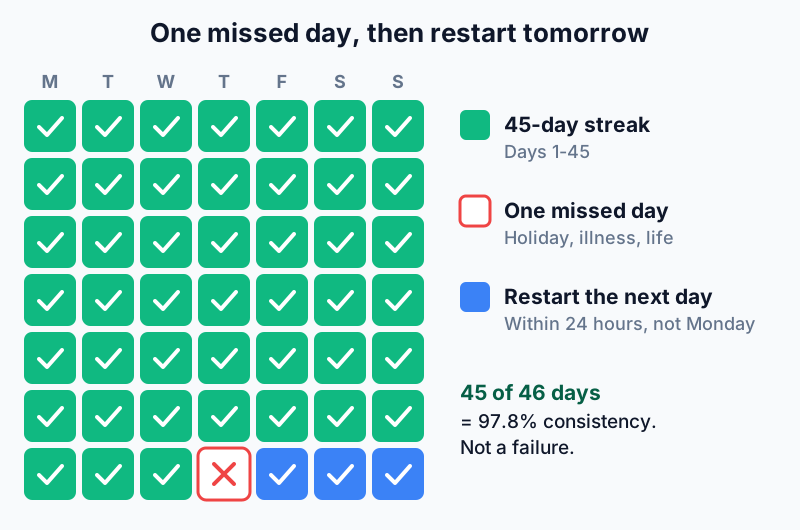
Every streak breaks eventually. A holiday, an illness or a day with no opportunity at all will get you sooner or later. What matters is what you do next.
The 24-Hour Rule
Restart within 24 hours. Not Monday, and not "next week when things settle down", but tomorrow. The riskiest moment in habit formation is the day after a break. If you skip that day too, the habit starts to unravel.
It also helps to plan for days off. Green Streak lets you log up to two rest days a week without breaking your streak, so a planned day off doesn't cost you the chain.
Reframe the Break
A 45-day streak, a 1-day break and a new streak isn't a failure. It's 45 out of 46 days, or 97.8% consistency. Nobody keeps a perfect record forever, so how quickly you restart matters more than never missing.
Do Not Punish Yourself
After a break, the instinct is to "make up for it" with a longer session. Resist it. Start with the minimum viable session, because the goal is to restart the loop rather than overcompensate. Punishing sessions make practice feel like a chore, while gentle restarts rebuild momentum.
Track Total Days, Not Just Current Streak
Your total practice days matter more than any single streak. Practising 280 out of 365 days in a year is excellent consistency, however many streaks you started and stopped along the way. The current streak keeps you going day to day, and the total keeps you going across months and years.
A 5-minute warm-up routine the morning after a break is enough to restart. Don't overthink it. Just show up.
Sources & Further Reading
- Lally et al. (2010), "How Are Habits Formed," European Journal of Social Psychology: The 66-day habit formation study from University College London
- James Clear, Atomic Habits (2018): Identity-based habits, systems over goals, and the 2-minute rule
- Macnamara et al. (2014), "Deliberate Practice and Performance," Psychological Science: Deliberate practice explained 18% of the variance in sports performance
- BJ Fogg, Tiny Habits (2020): The Tiny Habits method and behaviour design research from Stanford
- Harkin et al. (2016), "Does Monitoring Goal Progress Promote Goal Attainment?", Psychological Bulletin: Meta-analysis of 138 studies on progress monitoring and goal attainment
- Donovan & Radosevich (1999), "A Meta-Analytic Review of the Distribution of Practice Effect," Journal of Applied Psychology: Spaced vs massed practice across 63 studies
- Charles Duhigg, The Power of Habit (2012): The cue-routine-reward habit loop model
Related Articles
- The Seinfeld Strategy: Why "Don't Break the Chain" Works for Golf
- The 5-Minute Golf Warm-Up Routine
- How to Practice Golf Effectively: The Complete Guide
- The Complete Guide to Practicing Golf at Home
- Best Putting Drills at Home: 10 Drills for Speed and Start Line
- Green Streak vs Other Golf Practice Apps: Honest Comparison
Frequently Asked Questions
How long does it take to build a consistent golf practice habit?
Research from University College London found habits took a median of 66 days to become automatic, with a range of 18 to 254 days. Expect the first two weeks to feel forced. By day 30 it usually feels easier, and by day 66 missing a day feels uncomfortable rather than tempting.
Does 10 minutes of practice actually make a difference?
Yes. Research on distributed practice shows that spreading practice across sessions produces better results than cramming it into one long session. Ten minutes of focused putting a day builds more consistency than one long range session a week, and the minimum viable session keeps the habit alive.
What should I practise during a 10-minute golf session?
Pick one skill per session. You could roll 20-30 putts on carpet for feel or chip 15 balls to a towel in the garden. Mirror work on your address and backswing positions is another good use of the 10 minutes. For many amateur golfers, short game practice at home is the quickest route to lower scores.
How do I stay consistent when I lose motivation?
Replace motivation with a system. Set a specific time, anchor practice to an existing habit and keep your minimum session very small. The system works on low-motivation days because it removes the decision. You don't decide whether to practise, you just do the next tiny thing.
What if I break my practice streak?
Restart within 24 hours. Research shows that missing a single day doesn't reset habit formation. The danger is letting one missed day become two, then a week. Do the minimum viable session the next day. A 45-day streak, a 1-day break and a new streak is 97.8% consistency, not failure.
Is tracking practice really necessary?
It helps. A meta-analysis of 138 studies in Psychological Bulletin found that monitoring progress makes people more likely to reach their goals, especially when progress is physically recorded. Tracking gives you accountability, shows patterns in your behaviour and turns practice into a streak you don't want to lose.
Can I build a practice habit without any equipment?
Almost. A putter and a flat surface are enough for putting, and a mirror is enough for swing position checks. Bodyweight mobility exercises need nothing at all. Your minimum viable session should use kit you already own and can reach in seconds.
How does streak tracking improve my golf?
Streaks create a sense of ownership, a bit like the endowment effect. The longer your streak, the more protective of it you become. That drives daily consistency, and consistent practice builds on itself over time.
Disclaimer: This article is for informational purposes only and does not replace professional golf instruction. Individual results will vary based on ability, practice consistency, and physical condition. Consult a PGA professional for personalised swing advice.
Ready to build your practice streak?
Track your sessions, set goals, and improve with Green Streak — completely free.
Get Started Free