The Complete Guide to Practicing Golf at Home: Every Skill, Any Budget
The golf skills you can train at home, from putting and chipping to mobility and the mental game, with gear tiers from free to £1,200.
Quick Summary
- Home practice removes a big barrier: no travel and no bucket fees, so short daily sessions actually happen
- You can train most skills at home: putting, chipping, full swing, flexibility and the mental game all have home drills at every budget level
- Free-tier practice works: a putter, a golf ball and your living room carpet are enough to start tonight
- Track your progress: log your practice sessions in the free Green Streak app to build consistency
You have 15 minutes before dinner and the range is a 20-minute drive away, so you do nothing. Again. That gap between wanting to practise and actually practising stops a lot of golfers improving.
Quick Answer: Practising golf at home removes two big barriers to improvement: travel time and cost. Research on distributed practice shows that spreading practice across short sessions beats cramming the same time into one long one. At home you can putt on carpet, chip foam balls in the garden, rehearse swing positions in a mirror and work on flexibility. A setup can cost £0 (a putter and a ball) or up to £1,200. The habit matters more than the gear.
Table of Contents
- Why Practise Golf at Home
- What Can I Actually Practise at Home
- Putting at Home
- Chipping at Home
- Full Swing at Home
- Flexibility and Fitness at Home
- Mental Game at Home
- Home Practice Setup by Budget
- Equipment Recommendations by Category
- How Much Space Do I Need to Practise at Home
- Skill-by-Skill Home Practice Options
- Sources & Further Reading
- Related Articles
- Frequently Asked Questions
Why Practise Golf at Home
The research backs up little-and-often practice. A meta-analysis of 63 studies in the Journal of Applied Psychology looked at distributed practice (spreading repetitions across several short sessions). It produced significantly better performance than massed practice (cramming it into one long session).
Golf is a motor skill, and motor skills respond well to frequent, short repetitions. Fifteen minutes a day, six days a week, tends to beat a 90-minute Saturday range session, even though the total time is the same.
Here's why home practice makes such a difference:
- No travel time. The range is 20 minutes away. Your living room is 10 seconds away.
- No cost per session. No bucket fees, no parking and no coffee-shop detour that turns a 30-minute trip into 90 minutes.
- A lower barrier to starting. When practice means grabbing a putter and rolling 20 balls on the carpet, "I don't feel like it" stops being much of an excuse.
- Better-quality repetitions. At the range, fatigue and boredom creep in long before the bucket is empty. At home, sessions are short, so you're fresh for every rep.
It's a pattern plenty of golfers recognise. In the weeks when practice means driving to the range, it happens once. In the weeks when a putter and ball sit ready at home, it can happen five or six times. The intent is the same, but the output is completely different.
The Seinfeld Strategy fits home practice well. Make the daily action so small and easy that skipping it feels silly: ten putts before bed, two minutes, and the chain stays alive.
What Can I Actually Practise at Home
Not everything translates equally well to home practice. Here's my honest breakdown.
| Skill | Home Practice Effectiveness | What You Need | Space Required | |-------|---------------------------|---------------|----------------| | Putting | Excellent | Putter, ball, flat surface | Any room | | Chipping | Very good (with foam balls) | Wedge, foam balls, target | Garden or large room | | Full swing | Good (with net or mirror) | Net, mat, or mirror | Garage or garden | | Flexibility/fitness | Excellent | Floor space | Any room | | Mental game | Excellent | Nothing | Anywhere | | Bunker play | Poor | Requires sand | Not practical | | Course management | Good | Phone/tablet | Anywhere |
The short game and mental game translate best to home practice. That's handy, because the short game is also where many golfers drop the most shots. Dave Pelz's research found that more than 60% of golf shots are played from within about 100 yards of the hole. You can train a large share of that from home.
Putting at Home
Putting is the most productive thing you can practise at home. Dave Pelz puts it at 43% of all the strokes golfers make, and you can train it on any flat surface with no special equipment.
Carpet Putting Drills
Your living room carpet works as a putting green. It isn't perfect, because carpet rolls differently from most greens and the surface isn't manicured. But the stroke is the same, so you're still grooving it. For 10 specific drills with setup instructions, see the best putting drills for home practice.
The Gate Drill. Place two tees (or coins) just wider than your putter head, about 2 feet in front of your ball, with a target around 5 feet away. Roll putts through the gate. This trains alignment and a square face at impact. Do 20 putts and count how many pass through cleanly.
The Distance Ladder. Set targets at 3, 6, 10 and 15 feet. Putt one ball to each, shortest to longest, then work back down to 10, 6 and 3 feet. Score each putt that stops within 6 inches of its mark. This trains speed control, which is what keeps you away from three-putts.
The Pressure Game. Make 5 putts in a row from 3 feet. If you miss, restart the count. Note your best streak. This adds a bit of self-imposed pressure. Once 5 feels easy, raise the target to 10.
Putting Mats
A dedicated putting mat adds consistency. Carpet varies in speed and texture from room to room, while a mat gives you a repeatable surface with built-in targets and alignment guides.
Budget mats (under £30) work fine for basic stroke practice. Mid-range mats (£30-£100) add distance markers and stimp speed adjustments. Premium mats (£100-£250) replicate true green speeds with break features.
My honest take is that a budget mat gets you most of the training benefit. A premium mat makes practice more enjoyable, which may mean you do it more often. Either is a good outcome.
Want to make this stick? Home putting practice works best when you do it daily. Log every session in the free Green Streak app and build a habit that makes the putting mat worth having.
Chipping at Home
Chipping is a big part of the short game, and it's entirely practical at home with the right setup.
Foam Ball Chipping Indoors
Foam practice balls and limited-flight balls take care of the safety worries. They feel similar to real balls off the clubface but travel only a fraction of the distance. You can chip them into a wall, a net or a target without risking a window.
The Towel Target Drill. Lay a towel on the floor 10-15 feet (3-4.5 m) away and chip foam balls onto it. Rotate between pitching wedge, sand wedge and 9-iron to learn how trajectory changes with loft. Hit 10 balls with each club.
The Landing Zone Drill. Set three targets at about 8, 12 and 18 feet. Chip to a different target on every shot, never the same one twice in a row. Hit 15 balls and count how many land on or stop at their target. Switching targets trains adaptability, and random practice tends to transfer to the course better than blocked practice.
Garden Chipping
If you have any outdoor space, such as a garden, balcony or patch of grass, you can chip real or foam balls to targets. A chipping net with target zones gives you feedback on accuracy. The Callaway Tri-Ball net has three target areas and costs under £35.
If you're working on eliminating topped chips, the back garden is a good place for it. Nobody is watching and there's no pressure, so you can just get the repetitions in.
Full Swing at Home
Full swing practice at home needs more space and equipment, but it's very doable.
Mirror Work
A full-length mirror is one of the most underrated training aids in golf. Stand in front of it with a club and check your key positions:
- Address: Feet shoulder width apart, slight knee bend, arms hanging naturally.
- Top of backswing: Lead arm fairly straight, weight loaded into the trail side and, on a full swing, the shaft roughly pointing at the target.
- Impact: Hands ahead of the ball, weight moving onto the lead side, shaft leaning forward.
Ten minutes of mirror work three times a week lets you rehearse these positions until they start to feel familiar. If you're working on fixing a slice, the mirror is where you rehearse the new grip and face position without the distraction of ball flight.
Video Analysis
Many phones now record slow-motion video at 240fps, which is plenty to check your swing plane, club path and body positions. Set up a tripod 8-10 feet behind you on the target line, record 5 swings and review them.
Apps like OnForm let you draw lines, compare positions and track changes over time, and your phone's built-in slow-motion camera covers the basics for free. It won't replace a lesson, but it gives you honest feedback between them.
Hitting Nets
A quality golf net turns a garage or garden into a practice bay. You lose ball flight feedback, but you gain unlimited repetitions at no cost per session.
The trade-off is real. Hitting into a net without data is a bit like putting with your eyes closed: you know you hit it, but not where it went. Pairing the net with video or a launch monitor goes a long way to fixing that. A DIY simulator build takes the idea further, adding ball flight data and virtual courses for under £800.
Building your practice habit? Whether it's 10 putts on the carpet or 50 swings into the net, log it in the free Green Streak app. Then watch your streak grow.
Flexibility and Fitness at Home
Golf fitness doesn't need a gym. Three physical qualities matter a lot for the swing: hip mobility, thoracic spine rotation and core stability. All of them improve with bodyweight exercises on your living room floor.
Golf-Specific Exercises
Hip 90/90 Stretch. Sit on the floor with both knees bent at 90 degrees, one leg in front and one behind. Rotate between positions. This frees up the hip rotation your swing relies on. Hold each position for 30 seconds and do 3 rounds per side.
Thoracic Spine Rotations. Lie on your side with knees stacked. Reach your top arm across your body to the floor on the other side. This opens up the mid-back, where much of your upper-body rotation comes from. Do 10 per side.
Dead Bugs. Lie on your back with arms extended toward the ceiling and knees bent at 90 degrees. Lower the opposite arm and leg toward the floor without letting your lower back lift. This builds core stability, which helps you stay centred rather than swaying. Do 10 per side.
Glute Bridges. Lie on your back, feet flat, and drive your hips toward the ceiling. Your glutes play a big part in the downswing. Do 15 reps, holding the top for 2 seconds.
A 5-minute warm-up routine before any home practice session gets your muscles ready for good-quality reps. Keep that warm-up moving rather than static. A study of young competitive golfers found that a 20-minute static stretching routine before hitting reduced driver clubhead speed, distance and accuracy compared with an active, dynamic warm-up.
Building a Routine
Three 15-minute flexibility sessions a week is a realistic routine to aim for. Mobility improves with little-and-often work, so consistency matters more than intensity.
Mental Game at Home
The mental game is one of the most neglected skills in amateur golf. It's also one of the easiest to train at home, because it needs nothing but your head.
Visualisation
Sit somewhere quiet, close your eyes and play your home course in your head. Picture the tee shot on hole 1: choose a club and see the ball flight. Walk to the ball in your mind and plan the approach. Carry on hole by hole through all 18.
It can sound like pseudoscience, but there's research behind it. A review in Frontiers in Psychology explains that mental rehearsal involves brain mechanisms similar to those used in the real action, and that motor imagery practice can improve skilled performance. Visualisation doesn't replace hitting balls, but it adds something many golfers never try.
Course Management Study
Pull up the scorecard from your last round. Where did the big numbers happen, and what decision led to each blow-up? Could you have laid up instead of going for it, or aimed at the centre of the green instead of the flag?
Ten minutes reviewing your last round can teach you things 100 range balls never will. If you're working toward breaking 100, this kind of review helps you stop repeating the same costly decisions.
The 19th Hole: Reviewing scorecards at home only works if you compare like with like. My lowest ever score is a 75, but it came on a short par-65 course, so it was 10 over par. My 80 in July 2026 was on a longer course and was also 10 over. On paper they're five shots apart, but against par they're the same round. Before you look for patterns in your last ten cards, convert every score to "over par". It's a ten-minute job on the sofa, and it stops a short course or a long one teaching you the wrong lesson.
Home Practice Setup by Budget
Not everyone has the same space or budget. Here are four tiers, from nothing at all to a full home practice bay.
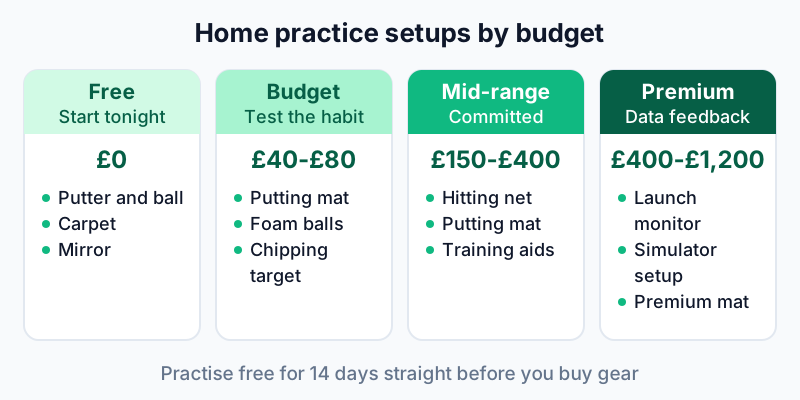
| Tier | Investment | What You Get | Skills Covered | Best For | |------|-----------|--------------|----------------|----------| | Free | £0 | Putter, ball, carpet, mirror | Putting, mirror work, flexibility, mental game | Anyone starting tonight | | Budget | £40-£80 | Basic putting mat, foam balls, chipping target | Putting, chipping, flexibility | Golfers testing the habit | | Mid-Range | £150-£400 | Hitting net, putting mat, training aids | All skills except bunker play | Committed home practisers | | Premium | £400-£1,200 | Launch monitor, simulator setup, premium mat | Everything with data feedback | Dedicated improvement seekers |
Free Tier — No Equipment Needed
This is where I'd start. Before spending anything, prove you'll use a home setup by practising with what you already own.
- Roll putts on the carpet to a mug or coin target
- Stand in front of any mirror and check swing positions
- Do the four flexibility exercises listed above
- Visualise your home course shot by shot
- Review your last scorecard for strategic mistakes
If you do this for 14 days straight, you've earned the right to buy gear. If you stop after 3 days, the gear would have gathered dust anyway.
Budget Tier — £40 to £80
This tier is a basic putting mat and a bag of foam practice balls. It's a sensible way to test your commitment.
The putting mat gives you a consistent surface with a target hole, and foam balls let you chip indoors safely. A door-hanging mirror (under £20) makes your swing position checks easier.
At this tier, you can practise putting, chipping and swing positions 6 days a week without leaving the house.
Mid-Range Tier — £150 to £400
This is where home practice starts to feel like a proper training space. A quality hitting net lets you take full swings, a stance mat protects your clubs and joints, and a putting mat with distance markers adds precision to your putting drills.
Add a phone tripod for video and you have a setup that competes with many range sessions for practice quality. The only thing missing is ball flight feedback.
Premium Tier — £400 to £1,200
A launch monitor fills that gap. Devices like the Garmin Approach R10 (~£430) measure ball speed, spin rate, launch angle and carry distance, so you're hitting into a net with data rather than guessing.
Pair the launch monitor with simulation software and you have a DIY golf simulator that shows your numbers for every club in the bag. Depending on how often you go and what your range charges, this tier can cost less than a year of weekly range sessions.
Equipment Recommendations by Category
Putting Mats
| Product | Price Tier | Best For | Key Feature | |---------|-----------|----------|-------------| | Any basic roll-up mat | £ | Getting started | Low cost, portable | | PUTT-A-BOUT Grassroots Par Three | ££ | Mid-level practice | 9ft length, built-in cup | | WELLPUTT Mat (10ft) | £££ | Serious putting practice | Alignment guides, speed consistency |
Hitting Nets
For a full breakdown of the nets worth buying, see the complete golf net guide.
| Product | Price Tier | Best For | Key Feature | |---------|-----------|----------|-------------| | GoSports Hitting Net | £ | Budget buyers | Lightweight, quick setup | | Spornia SPG-7 | £££ | Daily practice | Auto ball return, 30-second setup | | Net Return Pro V2 | ££££ | Permanent setups | 250,000-shot guarantee |
Training Aids
| Product | Price Tier | Best For | Key Feature | |---------|-----------|----------|-------------| | Foam practice balls (50-pack) | £ | Indoor chipping | Safe for any room | | Alignment sticks (pair) | £ | Swing plane checks | Multiple drill uses | | Orange Whip Trainer | £££ | Tempo and balance | Weighted, flexible shaft | | SKLZ Gold Flex | ££ | Warm-up and tempo | Affordable weighted club |
Launch Monitors
| Product | Price Tier | Best For | Key Feature | |---------|-----------|----------|-------------| | Garmin Approach R10 | £££ | Best overall value | 12+ metrics, E6 Connect included | | Rapsodo MLM2PRO | £££ | Visual learners | Shot tracer video replay | | FlightScope Mevo | £££ | Data-focused golfers | 3D Doppler radar accuracy |
How Much Space Do I Need to Practise at Home
Space is a common excuse for not practising at home. Here's how much you actually need for each activity.
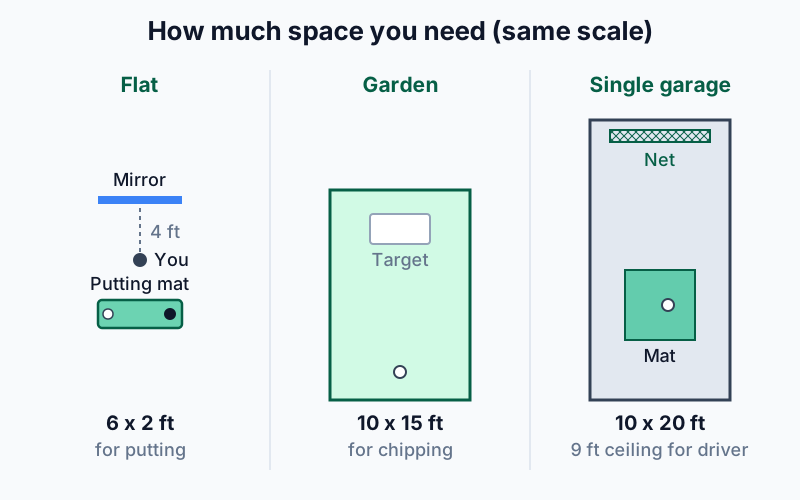
Flat or Apartment (No Outdoor Space)
You need a 6-foot (1.8 m) stretch of floor. That's enough for a putting mat and a full putting stroke. Add a mirror on the wall for swing position work.
- Putting: 6ft x 2ft floor space
- Mirror work: Stand 4ft from a full-length mirror
- Foam ball chipping: 8ft x 6ft (aim into a cushion or net)
- Flexibility: 6ft x 4ft floor space (a yoga mat's worth)
Garden or Patio
Any outdoor space bigger than 10ft x 15ft (about 3 m x 4.5 m) supports chipping with real balls. If your garden is longer than 20ft (6 m), you can pitch to targets at varying distances.
- Chipping: 10ft x 15ft minimum
- Full swing with net: 10ft wide x 16ft deep x 9ft high
- Pitching to targets: 20ft x 10ft
Garage
A standard single garage (about 10ft x 20ft, or 3 m x 6 m) fits a hitting net with room for a full iron swing. Ceiling height is usually the limiting factor. You need at least 9ft (2.7 m) for a full driver swing, and taller golfers may need more. With a lower ceiling, stick to shorter clubs and shorter swings, which is still very productive.
A double garage (20ft x 20ft) supports a complete practice bay with net, mat and space for a launch monitor behind you.
If you have the space and the commitment, a DIY simulator build turns a garage into a full indoor practice bay for under £800.
Skill-by-Skill Home Practice Options
This table maps each golf skill to its home practice options by budget tier.
| Skill | Free | Budget (£40-£80) | Mid-Range (£150-£400) | Premium (£400-£1,200) | |-------|------|-------------------|----------------------|----------------------| | Putting (distance control) | Carpet + coin target | Basic putting mat | Putting mat with markers | Premium mat + alignment laser | | Putting (alignment) | Tape line on carpet | Mat with alignment guides | Gate drill set | Mat + mirror + video | | Chipping (contact) | Wedge + pillow target | Foam balls + towel targets | Chipping net | Net + launch monitor | | Chipping (trajectory) | N/A | Foam balls, vary clubs | Chipping net with zones | Launch monitor tracking | | Full swing (positions) | Mirror, no ball | Mirror + alignment stick | Video analysis + mirror | Video + launch monitor | | Full swing (contact) | N/A | N/A | Hitting net + mat | Net + mat + launch monitor | | Flexibility | Bodyweight stretches | Resistance band set | Yoga mat + foam roller | Full mobility kit | | Mental game | Visualisation | Course management apps | Shot tracking review | Simulator course play | | Tempo and rhythm | Slow-motion rehearsal | Weighted club trainer | Orange Whip | Launch monitor tempo data |
Sources & Further Reading
- Donovan & Radosevich (1999), "A Meta-Analytic Review of the Distribution of Practice Effect," Journal of Applied Psychology: Distributed vs massed practice across 63 studies
- Moran & O'Shea (2020), "Motor Imagery Practice and Cognitive Processes," Frontiers in Psychology: Mental rehearsal and its links to real movement
- Gergley (2009), Journal of Strength and Conditioning Research: Effects of static stretching before hitting on golfers' clubhead speed, distance and accuracy
- Titleist Performance Institute (TPI): Golf-specific fitness research and mobility benchmarks
- Dave Pelz's Putting Bible (Penguin Random House): Source of the 43% putting figure
- Dave Pelz, Short Game Bible (sample chapter, Library of Congress): Summary of Pelz's short game research, including the share of shots played within 100 yards
- MyGolfSpy Equipment Testing: Independent, data-driven reviews of home practice equipment
Related Articles
- Best Golf Nets for Garage Practice
- How to Build a DIY Golf Simulator at Home
- The Seinfeld Strategy: Why "Don't Break the Chain" Works for Golf
- The 5-Minute Golf Warm-Up Routine That Actually Works
- Best Putting Drills at Home: 10 Drills for Speed and Start Line
- Building a Consistent Golf Practice Habit
Frequently Asked Questions
Can I really improve my golf at home?
Yes. Putting, chipping, mirror work, flexibility and mental rehearsal can all be done at home. Research on distributed practice shows that spreading practice across shorter sessions beats cramming it into longer, less frequent ones. The short game accounts for a large share of your score, and it's the easiest part to practise without a range.
What is the best thing to practise at home in golf?
Putting. Dave Pelz puts it at 43% of all strokes, and it needs nothing more than a putter, a ball and a flat surface. Start with the Gate Drill and the Distance Ladder.
How much does a home golf practice setup cost?
A workable setup starts at £0: a putter, a ball and your carpet. A basic putting mat and foam balls cost £40-£80. A fuller setup with hitting net, mat and training aids runs £150-£400. Adding a launch monitor pushes the total to £400-£1,200.
Do I need a hitting net to practise at home?
No. A hitting net is useful for full swing practice but isn't needed for putting, chipping with foam balls, mirror work or flexibility training. Start with the free methods and add a net once you've proven you'll use it. A modest net you use regularly beats an expensive one that gathers dust.
Can I chip golf balls in my garden?
Yes, if you have at least 10ft by 15ft of space. Use foam or limited-flight balls if neighbours or windows are nearby. A chipping net with target zones adds structure to garden sessions. Real golf balls work in larger gardens, but always check for obstacles.
How much space do I need for a hitting net?
At least 10ft wide, 16ft deep and 9ft high for full driver swings. Many standard garages can fit a setup for shorter clubs. If your ceiling is lower than 9ft, stick to wedges and shorter swings, which still covers a lot of useful practice.
Is practicing into a net without a launch monitor useful?
Yes, with caveats. You still get value for swing mechanics, tempo and contact quality. You lose ball flight feedback: direction, distance and spin. Filming your swing on your phone gives you useful feedback on the movement itself. A launch monitor adds data but isn't needed for worthwhile practice.
What golf exercises can I do at home?
Hip 90/90 stretches, thoracic spine rotations, dead bugs, glute bridges and single-leg balance work. They target three physical qualities that matter for golf: hip mobility, rotation and core stability. Three 15-minute sessions a week is a sensible, sustainable starting point.
Disclaimer: This article is for informational purposes only and does not replace professional golf instruction. Individual results will vary based on ability, practice consistency, and physical condition. Consult a PGA professional for personalised swing advice.
Ready to build your practice streak?
Track your sessions, set goals, and improve with Green Streak — completely free.
Get Started Free