Fix Your Slice: The Knuckle Drill That Works in 5 Minutes
Around 60% of golfers fight a slice. Learn the Knuckle Drill, a grip-first way to get control of your clubface without a swing overhaul.

Quick Summary
- Around 60% of golfers slice the ball, and the usual culprit is a clubface that's open to the swing path, often because of a weak grip
- The Knuckle Drill strengthens your grip until you can see 2-3 knuckles at address, then trains the face to close through impact
- Aim straight, not left: aiming left to allow for a slice tends to make it worse and builds bad habits
- Log your drill sessions in the free Green Streak app, which keeps your scores and personal bests for the Knuckle Drill
If you've ever aimed down the left side of the fairway and still watched your ball banana into the trees on the right, you know the frustration.
Quick Answer: A slice happens when the clubface is open to your swing path at impact, which curves the ball right for a right-hander. About 60% of golfers fight this miss, according to GOLFTEC data reported by GOLF.com. My first fix is the Knuckle Drill. Strengthen your grip until you see 2-3 knuckles on your lead hand, then turn those knuckles towards the ground through impact. Log your sessions in Green Streak to make it stick.
Table of Contents
- Why Do I Slice the Golf Ball?
- How to Diagnose Your Slice
- The Fix: The Knuckle Drill Step by Step
- Your Practice Plan to Ingrain the Fix
- Can I Fix My Slice Without a Coach?
- 5 Common Mistakes When Fixing a Slice
- When to Get a Lesson
- Sources & Further Reading
- Related Articles
- Frequently Asked Questions
Why Do I Slice the Golf Ball?
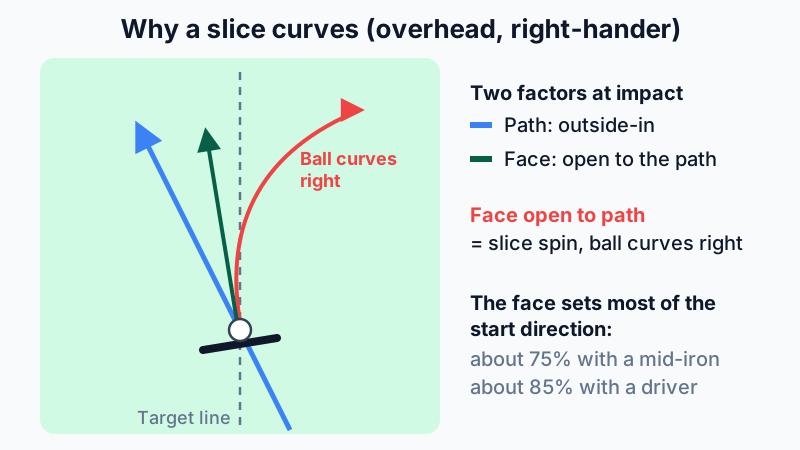
A slice is a shot that curves hard to the right (for a right-handed golfer). The curve comes from the relationship between your clubface angle (where the face points at impact) and your swing path (the direction the clubhead travels through the ball).
If the face is open to the path, the ball curves right. The more open it is to the path, the more it curves.
Many golfers blame the slice on an outside-in swing path (the club travelling from outside the target line to inside it), and that does contribute. But the face sets roughly 75% of the ball's starting direction with a mid-iron and about 85% with a driver, according to TrackMan data explained by the PGA Academy. The path plays a role, but the face does most of the work.
You could have a perfectly neutral path and still slice if your face is open. Fix the face first, and the rest gets easier.
The Path-Face-Result Table
This table shows how path and face combine to produce different shot shapes for a right-hander.
| Swing Path | Clubface | Ball Flight | |---|---|---| | Straight | Open to target and path | Push-slice: starts right, curves further right | | Outside-in | Left of target, open to path | Pull-slice: starts left, curves hard right | | Inside-out | Open to target, matching the path | Push: starts right and flies straight right | | Straight | Square | Straight shot | | Inside-out | Slightly closed to path | Draw: starts right, curves gently left |
If your typical miss starts left and curves right, you have an outside-in path with a face that's open to it. That's the classic amateur slice. Notice that both slice rows have one thing in common: the face is open to the path.
The Myth of the Over-the-Top Fix
The internet is full of advice about fixing your "over the top" move. Swing more from the inside, drop your hands, shallow the club.
That's all decent advice. But if you swing more from the inside without closing the face, you tend to hit a push instead of a slice. The ball goes right in a straight line rather than curving there, which isn't much of an improvement.
The order matters. Fix the face first, then work on the path.
Ready to ingrain this fix? Log your drill sessions in the free Green Streak app and see your scores build day by day.
How to Diagnose Your Slice
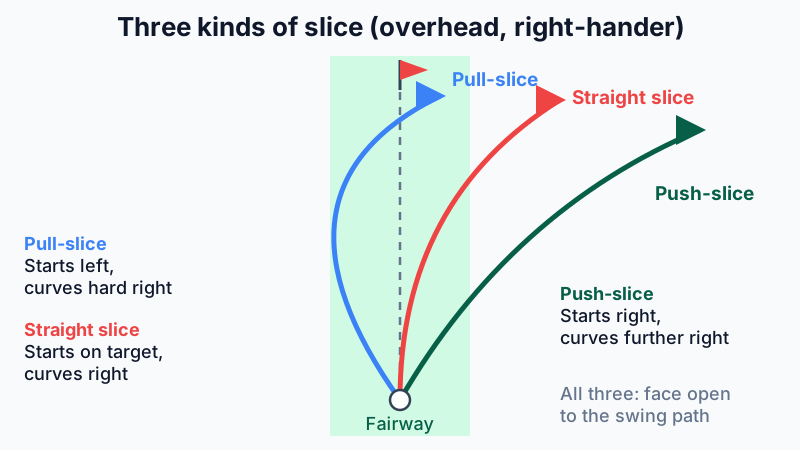
Before you try to fix anything, work out exactly what your slice looks like. Slices differ.
Film Your Swing
Prop your phone against your bag and record a few swings from behind (the down-the-line view). Watch for two things:
- Where does the club approach the ball from? Outside the target line, or along it?
- Can you see the clubface at impact? Is it pointing right of where the club is travelling?
You don't need a launch monitor. A slow-motion phone video shows you plenty.
Check Your Grip Right Now
Put your hands on the club as if you're about to hit a ball. Now look down at your lead hand (the left hand for right-handers).
- 0-1 knuckles visible: a "weak" grip. It makes an open face at impact much more likely. This is the classic slice grip.
- 2 knuckles visible: a neutral grip. You might slice or might not, depending on your release.
- 3 knuckles visible: a strong grip. It sets your hands up to close the face more easily.
If you can only see one knuckle, that's good news. The fix is simple.
Check Your Ball Flight Pattern
Hit 10 drives and pay attention:
- Starts left, curves right: outside-in path with the face open to it. The full slice package.
- Starts on target, curves right: the face is roughly square to the target but open to a path that's a little outside-in. Closing the face with the Knuckle Drill is the first step, and you may need some path work after that.
- Starts right, curves further right: the face is open to the target and to the path. The face is the main problem, so the Knuckle Drill is where to start.
The Fix: The Knuckle Drill Step by Step
This drill does one job well: it teaches your hands what a closing clubface feels like. Plenty of golfers report feeling the difference in their first session.
Step 1: Strengthen Your Grip
Address the ball with your normal setup and look down at your lead hand on the club.
Turn that hand away from the target on the grip (to the right, for a right-handed golfer) until you can clearly see 3 knuckles. Your thumb should sit slightly to the right side of the shaft, not straight down the top.
This feels strange at first, and your brain will tell you it's wrong. Stick with it. A stronger grip makes it easier to square the face without having to manipulate it during the swing.
Step 2: Knuckles Down Through Impact
Make slow swings. As the club approaches the ball, focus on one feeling: turn the knuckles of your lead hand down towards the grass.
- Knuckles pointing at the sky at impact = open face = slice
- Knuckles rotating towards the ground through impact = closing face = straight or draw
Exaggerate this at first. It should feel like turning a doorknob anticlockwise through the hitting zone. The sensation will feel extreme, and that's normal.
Step 3: The Hook Challenge
Now the fun part. Go to the range, or set up a hitting net in your garage, and don't try to hit it straight.
With a 7-iron, your goal is to hook the ball left, on purpose.
- Take your strong grip with 3 knuckles showing
- Make a smooth swing
- Turn those knuckles down firmly through impact
- Hit 10 balls and count how many curve left
If the ball hooks, you've shown you can close the face. Now dial back the rotation until the ball flies straight or with a gentle draw.
If the ball still goes right, your grip isn't strong enough yet. Turn your hand a little further and try again.
Beginner Tip: Start with a 7-iron, not a driver. The shorter club is easier to control, and you'll see the changes in ball flight more clearly. Move to the driver once the 7-iron is curving left consistently, then aim for a gentle draw.
Your Practice Plan to Ingrain the Fix
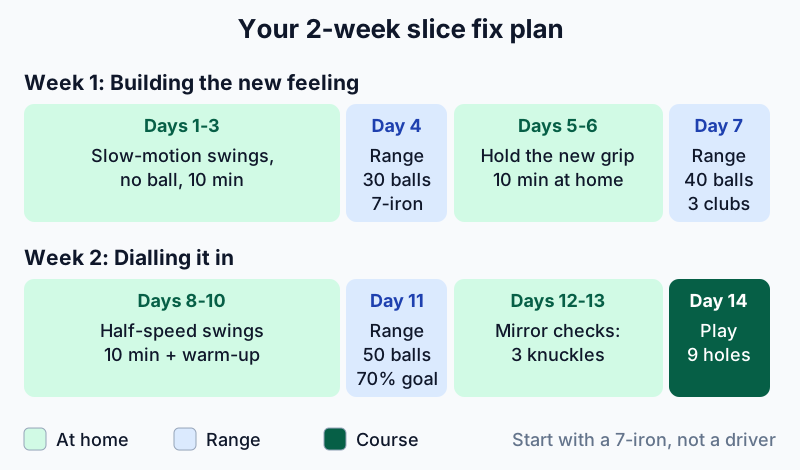
Changing your grip takes 30 seconds. Making it feel normal takes repetition. Here's a 2-week plan to make the new grip automatic.
Week 1: Building the New Feeling
- Day 1-3: 10 minutes of slow-motion swings at home with the new grip. No ball. Focus on the knuckles-down feeling through impact.
- Day 4: Range session. Hit 30 balls with a 7-iron using the Knuckle Drill. Any ball that curves left is a win.
- Day 5-6: 10 minutes of grip practice at home. Hold the club while you watch TV. It sounds odd, but your hands need to learn the new position.
- Day 7: Range session. Hit 40 balls across 7-iron, 5-iron and driver. Note which clubs still slice.
Week 2: Dialling It In
- Day 8-10: 10 minutes of half-speed swings with the new grip. Add the 5-minute warm-up routine before each session.
- Day 11: Range session. Hit 50 balls, aiming for 70% of shots to curve left or fly straight.
- Day 12-13: Grip checks at home. Use a mirror to confirm you still see 3 knuckles at address.
- Day 14: Play 9 holes. Don't think about score. Count how many tee shots go right compared with left or straight.
The daily habit is what makes this stick. Even 5 minutes of holding the club with the new grip counts. The Seinfeld Strategy applies here: don't break the chain of daily practice, even when sessions are short.
Tracking your progress? Use the free Green Streak app to log each practice session and your Knuckle Drill score out of 10. Watching that score rise is a good sign the grip change is bedding in.
The 19th Hole: Read enough slice threads on r/golf and golf forums and the same exchange plays out. A golfer posts a banana ball, lists every path drill they've tried, and the first useful reply asks for a photo of their grip. It fits the TrackMan data above. If the face sets most of the starting direction, path drills on their own tend to turn a slice into a push. Check your knuckles before you rebuild your swing.
Can I Fix My Slice Without a Coach?
Many slicers can fix it themselves. A weak grip is a common default, and it's a setup issue rather than a talent issue.
If your slice is mainly grip-related (and for many amateurs it is), the Knuckle Drill may be all you need. Plenty of golfers sort it out without a lesson.
There are limits to the DIY approach, though. If years of compensating for an open face have grooved a strong outside-in path, a grip fix alone might not be enough. You might go from a banana slice to a pull-hook, and that's when a lesson makes sense.
My advice is to try the grip fix first and give it two solid weeks with the plan above. If the ball is still curving right after 14 days of regular work, book a lesson. You'll get more from it because you'll already understand what the clubface does.
5 Common Mistakes When Fixing a Slice
Aiming Left to Compensate
This is the trap many slicers fall into. You know the ball goes right, so you aim left to allow for it. The problem is that aiming left encourages an even more outside-in swing path, which makes the slice worse.
Aim where you want the ball to finish and commit to that line. It feels uncomfortable at first, but it makes you fix the real problem rather than cover it up.
Gripping Tighter Under Pressure
A new grip feels unstable. On the course, especially under pressure, your hands want to go back to the old position. You squeeze the club harder to "control" it, which locks up your wrists and stops the face closing.
Keep your grip pressure light. Sam Snead famously said to hold the club like a bird: firm enough that it doesn't fly away, soft enough that you don't crush it.
Over-Correcting Into a Hook
Some golfers go from a weak grip to a very strong one and start hooking everything left. If that happens, you've over-corrected. Turn the grip back slightly until you see 2.5 knuckles instead of 3. Small adjustments make a big difference.
Changing Three Things at Once
If you change your grip, path, stance, ball position and takeaway at the same time, you can't tell what's working. Fix the grip first and give it a week. Then work on the path if you need to, one change at a time.
Expecting Instant Results on the Course
The range is the lab and the course is the exam. Your new grip will feel great on the range, where there are no consequences. The first time you stand on a narrow hole with out of bounds right, your hands might go back to the old grip.
That's normal. UCL research on habit formation found it took an average of 66 days for a new daily habit to become automatic, and much longer for some people. Keep logging your sessions and give the change time.
When to Get a Lesson
Not every slice needs professional help, but some do. Book a lesson if:
- You've tried the Knuckle Drill for 2+ weeks with no improvement. Something else is going on, and a trained eye should spot it quickly.
- Your slice has come back after you'd fixed it. That usually means a second issue (ball position, alignment or early extension) is overriding the grip fix.
- You're missing left and right with no pattern. Misses in both directions point to a deeper swing issue that YouTube is unlikely to solve.
- You're hurting yourself. Pain in your wrists, elbows or back during the swing is a red flag. A PGA pro can spot mechanical problems that lead to injury.
A lesson focused on your specific fault is usually worth more than hours of random YouTube tips. If you can film your swing and see the face closing, you're probably fine on your own.
For many golfers, the slice fix starts with what's in their hands.
Sources & Further Reading
- TrackMan Ball Flight Laws: the data behind how clubface and path create ball flight
- PGA Academy: Starting Line — Path or Face?: how much of the starting direction the clubface controls
- GOLF.com: The Biggest Cause of Your Slice: GOLFTEC data on how many golfers slice
- PGA of America Teaching Resources: professional instruction methodology and grip fundamentals
- Golf Digest: Slice the Ball? The Fix Is 'Knuckles Down': a clubface-first slice fix from a top instructor
- UCL Habit Formation Research: how long it takes to build new habits
Related Articles
- The Seinfeld Strategy: Why "Don't Break the Chain" Works for Golf
- Best Golf Nets for Garage Practice
- Stop Topping the Golf Ball: 5 Drills That Fix It Fast
- Golf Driver Drills: 6 Drills for Straighter, More Consistent Tee Shots
- The 5-Minute Golf Warm-Up Routine
- How to Break 100 in Golf: A Complete Guide
- How to Build a DIY Golf Simulator at Home
Frequently Asked Questions
Why do I only slice the driver and not my irons?
The driver has the least loft and the longest shaft. With less loft there's less backspin, so the same face-to-path difference produces much more curve. A face 5 degrees open to the path gives a noticeable slice with a driver but only a small fade with a pitching wedge. The fault is there with every club; the driver just shows it up.
How long does it take to fix a golf slice?
It varies. Some golfers see a change in ball flight in their first session with the Knuckle Drill. The grip change itself is instant, but it takes regular repetition over several weeks before it holds up under pressure.
Will a draw-biased driver fix my slice?
It might reduce the curve, but it won't fix the cause. Draw-biased drivers move weight towards the heel, which helps the face close a little. That might turn a big slice into a fade. Without fixing your grip, though, you're putting a plaster on a broken bone.
Can a strong grip cause a hook?
Yes. If you turn your hands into a very strong position, the face can close too much and the ball will hook left. Make the change gradually. Start with 3 knuckles and adjust from there. The goal is a straight ball or gentle draw, not a snap hook.
Should I fix my grip or my swing path first?
Grip first. It takes 30 seconds to change and it sets the clubface, which controls roughly 75-85% of where the ball starts. Path changes take weeks or months of practice. Fix the easy part first, then see whether the path needs work.
Is it normal for the new grip to feel uncomfortable?
Yes. A stronger grip feels "wrong" to slicers because their hands have grooved the weak position over hundreds of rounds. Give it 5-7 days of daily grip practice before you judge it. The discomfort usually fades quicker than you'd expect.
Can I fix my slice with alignment sticks?
Alignment sticks help with aim and path awareness, but they don't fix a grip problem. If your face is open because of a weak grip, aiming straighter won't close it. Use alignment sticks after you've fixed the grip, to check you're not still aiming left out of habit.
Do golf gloves affect grip strength for slicers?
A worn-out glove lets the club twist in your hands during the swing, which can open the face. Replace your glove when it gets shiny or slick in the palm. A fresh glove with good traction makes it easier to hold your new, stronger grip through impact.
Disclaimer: This article is for informational purposes only and does not replace professional golf instruction. Individual results will vary based on ability, practice consistency, and physical condition. Consult a PGA professional for personalised swing advice.
Ready to build your practice streak?
Track your sessions, set goals, and improve with Green Streak — completely free.
Get Started Free