Golf Practice Plan for Beginners: Your First 30 Days
A 30-day golf practice plan for beginners, with week-by-week drills covering grip, putting, chipping, and full swing in just 15-30 minutes a day.

Quick Summary
- You do not need hours at the range. Short, focused daily sessions of 15-30 minutes suit beginners better than one marathon weekend session
- Each week has one job: grip and putting first, then chipping, then irons, then getting ready for the course
- Start close to the hole: Dave Pelz's research found 60-65% of all shots occur inside 100 yards of the hole
- Log your practice: the free Green Streak app records each session and your streak, so you can build the habit from day one
You have just decided to learn golf. Maybe a friend invited you out, or you watched a tournament and thought, "I could do that." Or a relative's old clubs have been sitting in your garage for six months.
Whatever brought you here, the question is the same: where do I actually start?
Quick Answer: The best golf practice plan for beginners follows a 30-day, week-by-week structure. Week 1 covers grip fundamentals and putting basics (15 minutes daily). Week 2 introduces chipping and short game (20 minutes daily). Week 3 builds iron play and the full swing (25-30 minutes daily). Week 4 brings everything together and prepares you for the course. Log each session in Green Streak to keep the habit going.
Table of Contents
- Why Most Beginners Practise Wrong
- What Equipment Do You Need
- Week 1: Grip, Stance, and Putting Basics
- Week 2: Chipping and the Short Game
- Week 3: Iron Play and the Full Swing
- Week 4: Putting It All Together
- How to Measure Your Progress
- Common Beginner Mistakes to Avoid
- What Comes After 30 Days
- Sources & Further Reading
- Related Articles
- Frequently Asked Questions
Why Most Beginners Practise Wrong
Plenty of new golfers start the same way. They buy a set of clubs, go to the driving range, grab the driver and try to hit the ball as far as possible. They do this for two hours. Their hands are raw. Their back hurts. They have no idea whether they improved.
It is a slow way to learn golf.
Many new golfers spend most of their practice time on the range hitting full shots. Yet short-game coach Dave Pelz found that 60-65% of all golf shots occur inside 100 yards of the hole. Those golfers are neglecting the shots they will play most often.
The 30-day plan below turns that around. You start with the shortest, simplest shots and work outward: putting first, then chipping, then irons and the full swing. It can feel backwards, but it gets you ready for a real course without wasting range sessions.
There are three reasons this approach works:
- Short shots build feel. A 5-foot putt teaches you clubface control and tempo. Both carry over to every longer shot.
- Early wins build confidence. You can sink a 3-foot putt on day one. You cannot hit a 200-yard drive on day one. Starting with what you can do keeps you coming back.
- You learn scoring before swinging. Golf is scored in strokes, and a big share of them happen on and around the green. Knowing that from the start shapes how you spend your practice time.
What Equipment Do You Need
You do not need 14 clubs and a full bag to start learning golf. Fewer clubs work better in the first month. Less equipment means fewer decisions and more repetitions with the clubs that matter.
Week 1 Equipment
- A putter: any putter will do, borrowed or bought
- 3 golf balls: you do not need a dozen
- A flat surface: carpet, a putting mat or a practice green
That is all. Your first week is grip, stance and putting. You do not need a range. You do not even need to leave your living room.
Week 2 Equipment (Add)
- A pitching wedge or 9-iron for chipping practice
- Access to a practice green or garden with short grass
Week 3 Equipment (Add)
- A 7-iron, your main full swing club
- A hybrid or 5-wood for longer shots later
- Access to a driving range
Week 4 Equipment (Full Starter Set)
- Everything above, plus a sand wedge and driver if you have them
- Tees: a handful is plenty
- A golf glove for your lead hand (optional but recommended)
If you do not own clubs yet, a second-hand beginner set is fine. Brand-new equipment will not make you a better golfer at this stage. Spend your money on range balls instead.
Week 1: Grip, Stance, and Putting Basics
Daily time commitment: 15 minutes
Goal: Build a correct grip, understand basic stance, and develop a repeatable putting stroke.
This is the most important week of the plan, because everything after it builds on what you set up here. It is also the week that tempts many beginners to skip ahead. Don't.
Day 1-2: The Grip
Your hands are the only part of your body that touches the club. A poor grip makes everything else harder to learn.
Work through the complete grip fundamentals guide and focus on these three checkpoints:
- The club sits in your fingers, not your palm. Hold the club out in front of you. The grip should rest diagonally across the fingers of your lead hand (left hand for right-handers), from the base of the index finger to the mid-point of the pinky.
- You can see 2-2.5 knuckles on your lead hand at address. That is a neutral grip, which makes it easier to return the clubface square at impact.
- Grip pressure is a 4 out of 10. Squeeze as hard as you can (that is a 10). Now release to a 4. That is your target. If your forearms feel tense, you are gripping too hard.
Day 1-2 drill: Pick up the club, set your grip, check the three points, put it down. Repeat 20 times. Then hold the club and waggle the clubhead by hinging your wrists. If the clubhead moves freely, your grip is correct. If it feels stiff, the club is too deep in your palm. This takes 10 minutes. Spend the other 5 minutes holding the club while you watch television, so it starts to feel familiar.
Day 3-4: Stance and Posture
With the grip sorted, you need to stand correctly over the ball. Poor posture causes a lot of beginner swing problems. Set up well and your body can turn freely; set up badly and you spend the whole swing compensating.
The basic stance:
- Feet shoulder-width apart for irons, slightly wider for longer clubs
- Slight bend at the hips: push your backside out slightly, as if sitting on a tall stool
- Knees softly flexed, neither locked nor deeply bent
- Arms hanging naturally from your shoulders, so the club reaches the ground without you stretching for it
- Weight balanced between both feet, slightly favouring the balls of your feet
Day 3-4 drill: Set up in your stance in front of a mirror or window reflection. Check your spine angle, knee flex and arm hang. Hold the position for 10 seconds, stand up and reset. Do 10 reps and count how many pass every check. Then add a club, take your grip and combine grip and stance. Do this for 15 minutes total. The combination of grip and stance should start feeling natural by the end of Day 4.
Day 5-7: Putting Fundamentals
Putting is the simplest stroke in golf: a short, controlled pendulum motion. You will also use your putter more than any other club in the bag.
The putting basics:
- Eyes directly over the ball. Drop a ball from the bridge of your nose. It should land on or very near your ball's position.
- Shoulders rock, wrists stay quiet. The putting stroke is a pendulum powered by your shoulders. Your wrists should not break or flip.
- Same tempo back and through. The backstroke and follow-through should take roughly the same amount of time. No jabbing.
- The putter face stays square. At impact, the face of your putter should point directly at your target.
Day 5-7 drills (15 minutes daily, split into two blocks):
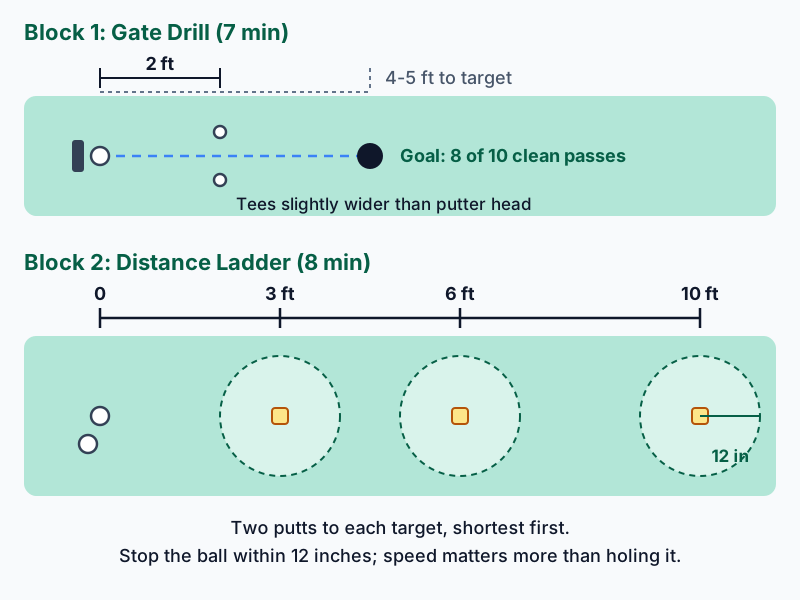
Block 1, the Gate Drill (7 minutes): Place two tees or coins slightly wider than your putter head, about 2 feet in front of the ball. Set a target 4-5 feet away. Putt through the gate without touching either tee. This trains a square face and a straight path. Aim for 8 out of 10 clean passes. It is the first drill in the full library of putting drills for good reason.
Block 2, the Distance Ladder (8 minutes): Set targets at 3, 6, and 10 feet. Hit two putts to each distance, starting short and working long. Your goal is not to hole every putt. Your goal is to stop the ball within 12 inches of the target. This teaches speed control, which matters more than aim at this stage.
Week 1 checklist:
- [ ] Correct grip with 2-2.5 knuckles visible
- [ ] Comfortable stance with proper hip bend and knee flex
- [ ] 20 Gate Drill putts per session with 8/10 clean passes
- [ ] Distance Ladder from 3-10 feet with reasonable speed control
Week 2: Chipping and the Short Game
Daily time commitment: 20 minutes
Goal: Develop a basic chip shot and understand how to get the ball onto the green from within 30 yards.
You can putt from off the green, and often you should. But there will be times when the grass is too long or there is a slope between you and the putting surface. That is when chipping takes over.
Day 8-9: The Bump-and-Run
The bump-and-run is the safest, most forgiving chip shot in golf. The ball pops up briefly, lands on the green and rolls toward the hole like a putt. There is nothing fancy about it.
How to hit a bump-and-run:
- Take your pitching wedge or 9-iron
- Grip down on the club about 2 inches for more control
- Set up with a narrow stance, feet about 8 inches apart
- Place the ball in the centre of your stance or slightly back
- Lean the shaft slightly forward so your hands are ahead of the ball
- Make a putting-length stroke with your shoulders rocking and wrists firm
- Follow through to the same height as your backstroke
The ball should pop up, land on the green and roll, like a putt with a small hop at the start.
Day 8-9 drill (20 minutes): If you have access to a practice green, chip 20 balls from 5-10 yards off the green. Aim for the middle of the green, not the flag. Count how many finish within 10 feet of the hole. If you are practising at home, chip onto a towel from 5-8 feet away using foam or practice balls.
Day 10-11: Distance Control in Chipping
The chip technique stays the same. What changes is how far back you take the club.
The clock face system:
- 7 o'clock backstroke (hands just past your trail thigh) = 5-10 yard chip
- 8 o'clock backstroke (hands to hip height) = 10-20 yard chip
- 9 o'clock backstroke (lead arm parallel to the ground) = 20-30 yard pitch
Day 10-11 drill (20 minutes): Set three targets at different distances. Hit 5 chips to each target. Note which clock position gets closest to each distance. This calibration is personal. Your 8 o'clock might be 12 yards while someone else's is 18. The exact numbers matter less than repeating them. For more detail on chipping technique, the complete chipping tips guide breaks down every element.
Day 12-14: Combining Putting and Chipping
Now you bring the first two weeks together with one simple drill.
The Up-and-Down Challenge (20 minutes):
- Drop a ball 10-15 yards off the practice green
- Chip it onto the green
- Putt it into the hole (or to within tap-in distance)
- Count total strokes. Par is 2 (one chip + one putt)
- Repeat from 10 different positions
Your goal by the end of Week 2: get up and down (chip + one putt) at least 3 times out of 10 attempts. That is a realistic beginner benchmark, and it is the same skill that saves shots on the course.
Week 2 checklist:
- [ ] Comfortable bump-and-run technique with pitching wedge or 9-iron
- [ ] Three clock positions calibrated for three distances
- [ ] 3 out of 10 up-and-downs from 10-15 yards
- [ ] Continued daily putting (incorporate 5 minutes of putting into each session)
Building the habit? Two weeks of daily practice is a serious commitment. Log every session in the Green Streak app and let the streak keep you accountable on the days you do not feel like picking up a club.
Week 3: Iron Play and the Full Swing
Daily time commitment: 25-30 minutes
Goal: Build a basic full swing with a 7-iron and make consistent contact with the ball.
This is the week many beginners have been waiting for: the full swing. But notice that you are arriving here with two weeks of grip knowledge, putting feel, and chipping confidence already in place. That foundation matters more than you realise.
Day 15-16: The Half Swing
You do not start with a full swing. You start with half of one.
The half swing with a 7-iron:
- Set up with your normal stance: feet shoulder-width apart, slight hip bend, grip pressure at a 4
- Take the club back until your lead arm is parallel to the ground (roughly 9 o'clock on the clock face)
- Swing down and through the ball, finishing with the club at the same height on the other side
- Focus on one thing: hitting the ground after the ball, not before it
That last point matters most. With irons, the club should strike the ball first, then brush the turf. Hitting the ground first gives you a heavy (chunked) shot, and trying to avoid that often leads to topping. They are two of the commonest beginner faults.
Day 15-16 drill (25 minutes): At the driving range, hit 30 balls with a half swing. Do not worry about where they go. Focus only on ball-first contact. Listen for the sound: a clean "click" followed by a brush of grass means good contact. A "thud" means you hit the ground first.
Place a tee in the ground 2 inches ahead of the ball (toward the target). Your divot should start at the ball and include the tee. If the divot starts behind the ball, your low point is too early. Getting the low point in front of the ball is the basis of good iron play.
Day 17-18: Building to a Three-Quarter Swing
Once ball-first contact feels reliable with a half swing, extend the backswing.
The three-quarter swing:
- Take the club back until your hands are at chest height and the club shaft points roughly toward the sky
- Feel your shoulders turn, so your back starts to face the target
- Swing down, focusing on the same ball-first contact
- Follow through naturally and let momentum carry the club to a balanced finish
You will not abandon the three-quarter swing once you have a full one. Many skilled golfers use it throughout a round. A three-quarter 7-iron is one of the most controlled, reliable shots in golf.
Day 17-18 drill (25 minutes): Hit 20 balls with the three-quarter swing. After each shot, hold your finish position for 2 seconds. If you can balance comfortably at the finish, your swing was controlled. If you stumble or fall forward, you swung too hard. Balance at the finish is the simplest check you have.
Day 19-21: The Full Swing
Now you let it go. But "full swing" does not mean "swing as hard as you can". It means a complete shoulder turn with a natural release through the ball.
Full swing keys for beginners:
- Turn your shoulders rather than lifting your arms. At the top of the backswing, your lead shoulder should be under your chin.
- Start the downswing from the ground up. Let your lower body lead and your arms follow.
- Swing through the ball, not at it. The ball is in the way of your swing, not the target of it.
- Finish in a balanced position. Belt buckle facing the target, weight on your lead foot, club over your shoulder.
Day 19-21 drill (30 minutes): Hit 30 balls with your 7-iron. After every 10 shots, put the club down and rate yourself on three metrics: contact quality (1-5), balance at finish (1-5), and comfort level (1-5). Write the numbers down and compare them across the three sessions.
Resist the temptation to pull out the driver this week. The 7-iron teaches you the swing. Once that swing is reliable, it carries over to the rest of the bag. For a structured range session format, the driving range practice routine guide provides a framework you can adapt.
Week 3 checklist:
- [ ] Ball-first contact on 6 out of 10 half swings
- [ ] Three-quarter swing with balanced finish on most shots
- [ ] Full swing with 7-iron producing consistent contact
- [ ] Continued putting and chipping (10 minutes per session, before hitting full shots)
Week 4: Putting It All Together
Daily time commitment: 25-30 minutes
Goal: Simulate on-course situations, build confidence with multiple clubs, and prepare for your first round.
This week you stop practising shots in isolation and start thinking like a golfer on a course.
Day 22-23: The Simulated Hole
At the driving range and practice green, play imaginary holes.
How to simulate a hole:
- Pick a target on the range. That is your fairway
- Hit a tee shot with your longest comfortable club (7-iron, hybrid or fairway wood; leave the driver unless your 7-iron is reliable)
- Walk to the practice green. Drop a ball 20 yards off the green, where your approach shot "landed"
- Chip onto the green
- Putt until you hole out
- Write down your score for that "hole"
Play 5-6 simulated holes per session. This trains you to think through a hole in order, rather than hitting the same shot over and over on the range.
Day 24-25: Introduction to Other Clubs
You have been living with a putter, a pitching wedge, and a 7-iron. Now it is time to meet the rest of your bag.
Add these one at a time:
- 9-iron: Same swing as the 7-iron, shorter shaft, more loft. The ball goes higher and shorter. Hit 10 balls and note the distance.
- Hybrid or 5-wood: Same swing concept, longer shaft. Tee the ball up slightly. Focus on sweeping the ball off the tee rather than hitting down on it.
- Driver (optional): Only if your 7-iron swing is producing consistent contact. Tee the ball higher. Widen your stance. Swing smoothly, at 70% effort at most.
Day 24-25 drill (30 minutes): Hit 5 balls with each new club. After every 5 shots, return to the 7-iron for 5 shots. This "home base" technique prevents new clubs from corrupting your base swing. The 7-iron is your anchor. Always come back to it.
Day 26-27: The Pre-Round Routine
Before your first real round, establish a warm-up routine that you will use before every future round.
The 15-minute pre-round warm-up:
- 5 minutes putting: 10 putts from 3 feet (build confidence), then 5 putts from 15-20 feet (calibrate speed for today's greens)
- 5 minutes chipping: 10 chips from just off the green. Get comfortable with the surface speed.
- 5 minutes on the range: 5 wedge shots, 5 seven-iron shots. No driver. Just feel the swing and find your tempo.
This routine gets your body and mind ready without tiring you out before the first tee.
Day 28-30: Your First Round
You are ready. Not to shoot par. Not to impress anyone. But to play golf, keep score, and enjoy the experience.
First round rules for yourself:
- Play from the forward tees. Every course has them. There is no shame in using them. You will have more fun, score better, and learn faster.
- Pick up at double bogey. If you have used 2 over par on a hole and the ball is still not in, pick it up and write down double bogey. This keeps the pace of play moving and prevents demoralising blow-up holes.
- Putt from off the green when the grass allows. A bad putt is usually better than a bad chip, and it keeps the big numbers off your card.
- Play your comfortable clubs. If the driver scares you, leave it in the bag. A hybrid off every tee is a perfectly valid strategy.
- Keep an honest score. Count every stroke. Every penalty. This is your baseline. Every future round will be measured against it.
Your target for the first round is not a number. It is information. You want to know which parts of the game feel comfortable and which need more work. That information shapes your practice plan for the next 30 days.
Week 4 checklist:
- [ ] 5-6 simulated holes played in practice
- [ ] Comfortable with at least 5 clubs (putter, wedge, 9-iron, 7-iron, hybrid)
- [ ] Pre-round warm-up routine practised twice
- [ ] First round completed with honest score recorded
The 19th Hole: I only started playing golf properly in the second half of 2022, so the beginner stage is not a distant memory for me. The best decision I made early on was to start logging every round in a scoring app from January 2023. My first full year averaged 94.8, more than 25 over par. It was not a flattering number, but it was an honest one, and it is still the baseline I measure against. In 2026 my average is 89.6. Without that first year written down, I would have no idea whether I had actually improved or just remembered my good days. Do not fear your first score. Welcome it. It is the number that makes every future improvement measurable.
How to Measure Your Progress
A few simple numbers will show you where to focus your practice time.
The Five Beginner Benchmarks
Keep a note of these from day one. They give you a clear picture of how you are getting on.
| Metric | Day 1 Benchmark | Day 30 Target | How to Measure | |--------|-----------------|---------------|----------------| | Gate Drill pass rate | Below 50% | 80%+ | Count clean passes out of 20 putts | | Three-putt frequency | Every other green | Less than 4 per round | Count three-putts during rounds | | Chip contact quality | 3 out of 10 clean | 6 out of 10 clean | Count chips with ball-first contact | | 7-iron contact quality | 2 out of 10 solid | 5 out of 10 solid | Count shots with a balanced finish and clean contact | | First round score vs second | Your first score | Lower than your first | Honest scorekeeping |
The Practice Log
Log every session: what you did, for how long and how it went. That record shows you what is working.
I built the Green Streak app for this. Log each session, keep your streak going and watch the weeks add up. Turning up regularly counts for a lot, and the article on the science behind building a practice habit explains why.
If you want to go deeper on structured practice, the guide on how to practise golf effectively covers deliberate practice principles that apply at every skill level.
Common Beginner Mistakes to Avoid
Talk to any group of new golfers and the same mistakes come up again and again. Avoiding them will save you a lot of frustration.
Starting with the Driver
The driver is the longest, least forgiving club in the bag. It amplifies every flaw in your grip, stance, and swing. Starting with the driver is like learning to drive in a sports car: possible, but needlessly difficult. Start with the putter and work up. You will reach the driver eventually. It will be there when you are ready.
Practising Without a Target
Hitting balls into a field with no target is exercise more than practice. Every shot you hit in practice should have a specific target: a flag, a distance marker or a spot on the green. Without a target, you cannot measure accuracy, and without measuring accuracy, you cannot improve.
Changing Everything at Once
You watched a YouTube video and now you want to change your grip, your stance, your backswing, and your follow-through simultaneously. Do not do this. Change one thing at a time. Give each change a full week of daily practice before adding another variable. Stacking multiple changes overwhelms your brain and usually makes everything worse.
Ignoring Putting
Putting is unglamorous, and few people post putting videos on social media. But you will hit more strokes with your putter than with any other club in the bag. If you shoot 100 and take 40 putts, cutting that to 36 putts is a 4-stroke improvement from a skill you can practise on your living room carpet. The best putting drills for home make this easy.
Swinging Too Hard
Beginners tend to think power means swinging harder. Swing speed comes mostly from technique rather than effort. A smooth 80% swing will produce better contact, straighter shots, and often more distance than a 100% lunge at the ball. Swing within yourself; good tempo usually beats brute force.
Not Getting Help When Stuck
If you have followed this plan for 30 days and a specific fault persists, consider a single lesson with a PGA professional. Maybe you cannot stop topping the ball, your chips always go right or your putts keep missing left. A 30-minute lesson aimed at one problem can save you hours of guessing. You do not need a swing overhaul. You need a focused fix.
What Comes After 30 Days
Thirty days gives you a foundation. What you build on that foundation depends on your goals.
If You Want to Break 100
Focus on eliminating big numbers. That means fewer three-putts, fewer topped shots, and fewer penalty strokes. The complete guide to breaking 100 lays out the exact strategy and practice plan for getting under that milestone.
If You Want to Keep Improving Generally
Maintain a daily practice habit of 15-20 minutes. Rotate between putting, chipping, and full swing across the week. The driving range practice routine provides a structured format for range sessions, while the short game drills keep your scoring skills sharp.
If You Want to Invest in Equipment
Wait until after your first month. By day 30, you know enough about your game to make informed equipment decisions. You know whether you prefer a blade or mallet putter. You know which irons feel comfortable. You know whether you need a hybrid or a fairway wood off the tee. Buying equipment before you know your game is guesswork. After 30 days of practice, you can buy with a purpose.
Consider looking into training aids that target your specific weaknesses rather than buying general-purpose gadgets.
Sources & Further Reading
- Pelz, D., "Dave Pelz's Short Game Bible" (1999), sample text, Library of Congress: the 60-65% of shots inside 100 yards finding
- Cepeda et al. (2006), "Distributed Practice in Verbal Recall Tasks," Psychological Bulletin: meta-analysis of spaced vs massed practice and retention
- PGA of America Teaching Resources: beginner instruction and finding a PGA coach
- Golf Monthly Tips and Instruction: short game technique guides and beginner-friendly drill libraries
- R&A Rules and Equipment: official equipment guidance and rules for new golfers
- Broadie, M., "Every Shot Counts" (2014): strokes gained data showing where amateurs lose the most strokes
Related Articles
- Best Putting Drills at Home: 10 Drills for Speed and Start Line
- How to Grip a Golf Club: The Complete Beginner's Guide
- Stop Topping the Golf Ball: Drills That Fix It Fast
- How to Break 100 in Golf: The Strategy Guide for High Handicappers
- Driving Range Practice Routine: Make Every Bucket Count
- How to Practice Golf Effectively: The Complete Guide
Frequently Asked Questions
How long should a beginner practise golf each day?
Fifteen to thirty minutes is the ideal range for beginners. Research on distributed practice shows that spreading learning across shorter, more frequent sessions produces better retention than cramming it into long, infrequent ones. That is why a 15-minute daily session tends to beat a 2-hour weekend session. Start with 15 minutes in Week 1 and build to 30 minutes by Week 3. Consistency matters far more than duration.
What should a beginner golfer practise first?
Start with the grip and putting. The grip is the foundation of every shot in golf, and putting is the simplest stroke with the fastest feedback loop. Many teaching professionals favour a short-game-first approach for beginners. It builds touch and confidence before you add the complexity of a full swing. You can practise both at home with just a putter and a golf ball.
Can I learn golf without taking lessons?
Yes. Many golfers learn the basics through structured self-practice, online instruction, and playing with experienced friends. The 30-day plan in this article gives you a progressive structure to follow on your own. That said, if you develop a persistent fault that self-practice cannot fix, such as a consistent slice, chronic topping or the putting yips, a single targeted lesson is worth the money. You do not need a full course of lessons to get started.
What is the fastest way to improve as a beginner golfer?
Focus on your short game. Dave Pelz's research found that 60-65% of all golf shots occur inside 100 yards of the hole. Improving your putting from 40 putts per round to 36 saves four strokes immediately without changing your swing at all. Combine daily short game practice with honest scorekeeping and you will be able to see whether it is working.
Do I need a full set of golf clubs to start?
No. A putter, a pitching wedge, and a 7-iron are enough to learn every fundamental skill in the first month. Many coaches suggest beginners start with a reduced set of clubs to simplify decision-making and build confidence with fewer variables. You can add clubs as your skills develop and you understand what gaps exist in your distances.
How do I know if I am ready to play my first round?
You are ready if you can make solid contact on 5 out of 10 swings with your 7-iron. You should also be able to chip onto the green from 10-15 yards without topping or chunking most of the time, and two-putt from 15 feet regularly. You will not play well by experienced standards, but you will be able to get the ball around the course, keep up with pace of play, and enjoy the experience. Play from the forward tees, pick up after double bogey if needed, and treat the round as a learning experience.
Disclaimer: This article is for informational purposes only and does not replace professional golf instruction. Individual results will vary based on ability, practice consistency, and physical condition. Consult a PGA professional for personalised swing advice.
Ready to build your practice streak?
Track your sessions, set goals, and improve with Green Streak — completely free.
Get Started Free