Golf Putting Drills: 10 Drills to Eliminate Three-Putts
A 15-handicapper three-putts about once every 10 holes. These 10 practice-green drills build break reading, lag control and clutch confidence.
Quick Summary
- Three-putts cost more than you think: Shot Scope data shows a 15-handicapper three-putts about once every 10 holes, and the fix is on the practice green
- Break reading needs real grass: the 10 drills below all use a practice green with actual slope, speed and grain
- Lag putting from 30+ feet is where many three-putts start: judging distance on a real green is a different skill from rolling putts on carpet
- Keep score: log your sessions and drill scores in the free Green Streak app and chase your personal bests
You read the green perfectly and hit the putt exactly where you aimed. Then you watched it slide 6 feet past, because your sense of speed came from the living room carpet, not the green outside.
Quick Answer: Putting drills on a real practice green train two things indoor drills can't: reading break and judging true green speed. The Par-18 (nine stations, par 2 each) and the Lag Zone (20-40 foot putts into a 3-foot circle) target the two big causes of three-putts: poor speed and misread slopes. I'd do 20 minutes on the practice green twice a week. Log your sessions in Green Streak.
Table of Contents
- Why Practice-Green Drills Beat Indoor Drills for Scoring
- What You Need for These Drills
- The 10 Best Golf Putting Drills on the Practice Green
- Drill Comparison Table
- How Often Should I Do Putting Drills on the Practice Green
- The Pre-Round Putting Warm-Up Plan
- How to Measure Your Putting Improvement
- Sources & Further Reading
- Related Articles
- Frequently Asked Questions
Why Practice-Green Drills Beat Indoor Drills for Scoring
Carpet drills build stroke mechanics, and that matters. But the stroke is only one piece of putting.
On a real green you face things no carpet or mat can copy: slope, grain, and green speed that changes from morning to afternoon. Uphill putts need a firm strike, and downhill putts punish any extra pace.
Shot Scope data shows the average golfer leaves 55% of their putts short of the hole. It names leaving putts short as one of the biggest contributors to three-putts. Many of those costly misses are lag putts on real greens with real break, and no indoor drill can fully train that.
You hear the same story from a lot of golfers. They stick with carpet drills for months, the stroke gets smoother and their alignment improves. But the three-putts on Saturday barely change.
The missing piece is usually the surface. Carpet can't teach you how hard to hit a 35-footer up a slope, or how much a downhill putt will turn at the end. Only grass can.
Three-putts tend to happen on long putts with break, and you can't recreate those on your living room floor. For that you need a green with some slope, and the 10 drills below.
If you want to build your stroke at home between green sessions, see the companion guide on putting drills at home. The two approaches work well together.
What You Need for These Drills
Every drill below needs a practice putting green. Most golf courses have one, and many public courses let non-members use it for free or a small fee (£5-£10).
Equipment Checklist
- A putter
- 4-6 golf balls (more saves walking; the Compass Drill uses 12)
- 6-10 tees (for marking positions and targets)
- A coin or ball marker
- A way to measure 3 feet (a putter is roughly 34-35 inches long, which is close enough)
- A scorecard and pencil, or the Green Streak app on your phone to log drill scores
That's it. No training aids or special equipment, just balls, tees and a real green.
Building a putting habit? These drills work best when you do them regularly. Log every practice-green session in the free Green Streak app and watch your drill scores and personal bests climb.
The 10 Best Golf Putting Drills on the Practice Green
These drills are built for real grass with real break. Each one has setup instructions, steps, scoring and a time guide.
I'd use them in rotation: three drills per session, about 20 minutes in total.
Drill 1 - The Compass Drill (Short Putts From All Angles)
What it trains: Holing short putts on different slopes: uphill, downhill, and sidehill both ways.
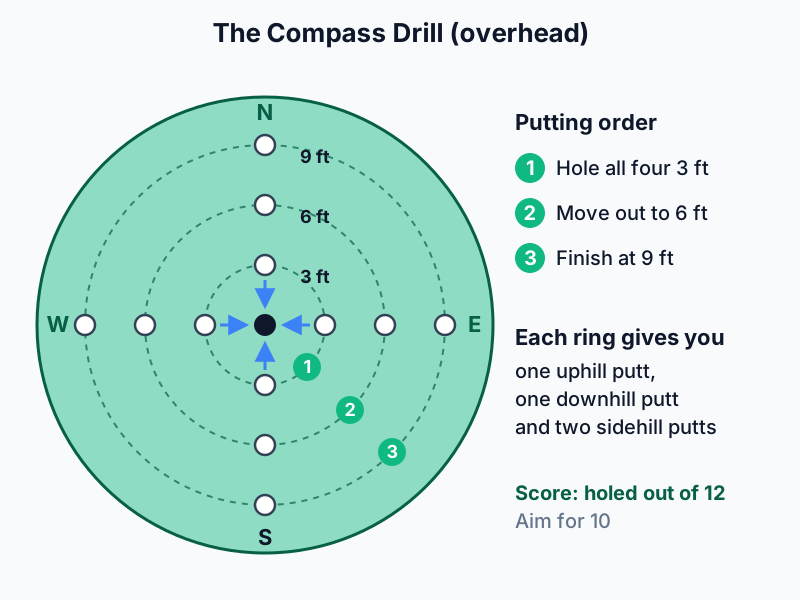
Setup: Find a hole on the practice green with visible slope. Place one ball 3 feet north of the hole, one 3 feet east, one 3 feet south and one 3 feet west. Repeat the pattern at 6 feet and 9 feet. You now have 12 balls arranged like a compass.
How to execute: Start at 3 feet and hole all four putts around the compass. Move out to 6 feet, then 9 feet. Each distance gives you an uphill putt, a downhill putt and two sidehill putts.
Success criteria: Read the break on every putt and count how many you hole out of 12. Aim for 10. At 3 feet, anything less than 4 out of 4 means your read or your start line needs work. At 9 feet, 2 out of 4 is a solid start.
Time: 5-7 minutes.
The value of this drill is that it makes you read break on every putt. On carpet you hit straight putts. On a real green, even a 3-footer can break a couple of inches, and that adjustment only comes from reps on grass.
Drill 2 - The Lag Zone (Distance Control From 20-40 Feet)
What it trains: Lag putting: getting long putts close enough for a tap-in.
Setup: Pick a hole and mark starting points 20, 30 and 40 feet away with tees. Then mark a "zone" around the hole with tees in a circle of 3-foot radius (roughly one putter length from the hole in every direction).
How to execute: Hit 3 balls from 20 feet, then 3 from 30 feet, then 3 from 40 feet. The goal is for every putt to finish inside the zone. Short of the zone doesn't count, and neither does past it.
Success criteria: Get 6 out of 9 putts to stop in the zone. If you score below 4, move in to 15-foot and 25-foot stations and work your way back out.
Time: 5-7 minutes.
Tour players lag it close so reliably that they average around half a three-putt per round. This drill trains your hands to judge distance on a real surface, which is where that skill comes from.
Drill 3 - The Safety Zone (Never Leave It Short)
What it trains: "Never up, never in": making sure every putt reaches the hole.
Setup: Place 5 balls 15-20 feet from a hole. Mark a line 3 feet behind the hole with two tees.
How to execute: Every putt must finish past the hole but short of the 3-foot line. Short of the hole is a fail, and so is more than 3 feet past. The safe zone is the strip between "reached the hole" and "still a tap-in".
Success criteria: 4 out of 5 putts finish in the safe zone.
Time: 3-5 minutes.
Dave Pelz's research led him to recommend hitting putts so they would finish about 17 inches past the hole. That's enough speed to hold the line through the bumpy, footprinted area around the cup, without so much that the hole effectively gets smaller. This drill trains that speed window.
Drill 4 - The Horseshoe (Pressure Finishing)
What it trains: Holing the second putt after a lag, the one that stops a three-putt.
Setup: Pick a hole on a slope and imagine your lag putt came up the hill from 6 o'clock. Place 5 balls in a horseshoe around the far side of the hole, all at 3 feet, at roughly 9, 10, 12, 2 and 3 o'clock.
How to execute: Hole all 5 putts in order. They copy the "comebacker" after a lag putt that ran past the hole. Every one is downhill or sidehill, which are the hardest short putts you face on the course.
Success criteria: Hole all 5. If you miss one, restart the sequence. The restart adds real pressure to the last couple of putts.
Time: 3-5 minutes.
Why a horseshoe and not a full circle? When a lag runs past, you're putting back the way you came. On a slope, that means a downhill or sidehill comebacker. You'll face uphill 3-footers too, but the tricky comebackers are what turn a decent lag into a three-putt, so this drill focuses on them.
Drill 5 - The Leapfrog (Progressive Speed Building)
What it trains: Small speed adjustments: learning to add a little pace at a time.
Setup: Find an open area of the practice green (you don't need a hole for this drill). Put a tee down at your starting spot.
How to execute: Hit your first putt about 10 feet. Hit your second so it finishes just past the first ball, by 6 inches to a foot. Hit your third past the second by the same margin. Keep going until you've leapfrogged 5-6 balls across the green.
Success criteria: Each ball must finish past the previous one but within 12 inches of it. If you leave one short of the last ball, or blast one 3 feet past, the chain is broken. Start again.
Time: 3-5 minutes.
This drill is harder than it sounds, because every putt needs a tiny change in pace. That fine control is what separates a ball that finishes 2 feet past the hole from one that finishes 6 feet past.
Making progress? Log your drill scores in the free Green Streak app after each session. Seeing your scores over time shows which drills are improving and which need more reps.
Drill 6 - The Par-18 (9-Hole Putting Course)
What it trains: On-course putting, with the pressure of keeping score.
Setup: Pick 9 different stations on the practice green, each 15-40 feet from a hole. Many practice greens only have 3-6 holes, so use each hole from different distances and angles. Drop one ball at each station.
How to execute: Play each station as a hole and putt out. Par is 2 on every hole: two putts is par, one is a birdie and three is a bogey. Keep score. Your target is 18 or fewer, which is level par for the nine.
Success criteria: Score 18 or under, and count how many holes you complete in par or better. A score of 15-16 means your lag putting is in good shape. A score of 20+ means three-putts are creeping in and you need more lag work.
Time: 10-12 minutes.
This is the most game-like putting drill you can do. It combines green reading, lag putting and holing out in the same sequence, just like a real round. It also makes a good pre-round warm-up. If you keep your Par-18 scores, the trend over a few months gives you an honest picture of whether your three-putt problem is shrinking.
Drill 7 - The Pressure Putt (10 Consecutive 3-Footers)
What it trains: Holing short putts as the pressure builds.
Setup: Place a ball 3 feet from the hole. Choose a spot with a little break rather than a dead-straight putt.
How to execute: Hole 3-foot putts one after another, counting as you go. If you miss one, the count goes back to zero. No exceptions.
Success criteria: Reach 10 in a row. Once you get there, keep going and see how far you can push your personal best.
Time: 3-7 minutes (depending on how often you restart).
This is the most mentally demanding drill on the list. Putts 1 to 5 feel routine. Putts 7 and 8 feel tense, and 9 and 10 feel like the back nine of a club championship. That rising pressure is what you feel on the course over a 3-footer to save par on the 17th.
Expect to fail several times on your first go. Many golfers find the misses cluster around putt 7 or 8, just as the pressure kicks in. That's the point. Learning to hole the eighth one when your hands feel tight is the skill that saves pars.
Drill 8 - The Break Reader (Read It, Call It, Score It)
What it trains: Green reading, probably the least-practised skill in putting.
Setup: Find 5 putts on the practice green between 10 and 20 feet, each with visible break. Stand behind each ball and study the slope.
How to execute: Before each putt, call your read out loud. Give the direction and amount: "Two inches left to right" or "Four inches right to left, aim at the left edge." Then hit it. Once the ball stops, check whether it broke the way you called, and whether the amount was within an inch of your guess.
Success criteria: Score one point for the right direction and one more if the amount was within an inch, for a maximum of 10. Aim to get the direction right on 4 of the 5 putts and the amount right on 3.
Time: 5-7 minutes.
Many golfers never practise green reading. They work on their stroke for hours and then guess at the break during a round. This drill turns reading into a skill you can measure. After 10 sessions you'll start to see patterns, such as under-reading right-to-left putts or over-reading downhill break. Knowing that about yourself is worth shots.
The 19th Hole: Watch a club golfer miss a 15-footer and look at what they do next. Usually they rehearse the stroke again: a practice swing, a shake of the head, a look at the putter face. Very few walk back behind the ball to check whether they aimed at the right spot. Blaming the stroke for putts that were misread is one of the most common habits in amateur golf. It sticks because green reading only develops where there's something to read, and a lot of putting practice happens on flat carpet. The Break Reader drill separates the two. If your line was right and the ball still missed, work on the stroke. If you called the break wrong, no amount of stroke work will fix it.
Drill 9 - The Speed Ladder (10-Foot Increments)
What it trains: Judging speed across a range of distances on the same green.
Setup: Place tees at 10, 20, 30 and 40 feet from your starting position. Aim for an open area of the green, not a hole.
How to execute: Hit one ball to each distance in order, finishing within 2 feet of the target tee. After 40 feet, come back down: 30, 20, 10. One full cycle is 8 putts.
Success criteria: Get 6 out of 8 putts within 2 feet. The 30-foot and 40-foot targets are the hardest, so if you keep missing there, your hands need more reps at those distances.
Time: 5 minutes (2 cycles).
This differs from the Lag Zone because there's no hole. Taking the hole away removes the worry about holing it, so you focus entirely on speed. How hard do you hit a 30-footer on this green? What about a 40-footer? Your hands learn the answer through repetition rather than calculation.
Drill 10 - The First Putt Challenge (9 Random Spots, Track Your Score)
What it trains: First-putt proximity, which has a big say in how often you three-putt.
Setup: Drop a ball at 9 random spots on the practice green, each 15-45 feet from a hole. Vary the distances, slopes and angles so no two putts look alike.
How to execute: Putt each ball once. Measure how far each one finishes from the hole (pace it off; one stride is roughly 2.5-3 feet). Add up the total distance left across all 9 putts.
Success criteria: A total under 27 feet (3 feet per putt on average) is good. Under 18 feet (2 feet on average) is excellent. Over 36 feet (4+ feet on average) means your lag putting needs a lot of work.
Time: 7-10 minutes.
This is the best all-round putting test on the list. It mirrors a real round: you face a long putt, read the break, judge the speed and roll it, with no second chances. Your total distance left sums up your lag putting in one number. Keep a note of it over time and watch it come down.
If you want to make this part of a complete practice session, pair it with 10 minutes of chipping and 15 minutes on the range. That 35-minute session covers the long game, the short game and putting.
Drill Comparison Table
| Drill | Skill Focus | Difficulty | Time | Balls Needed | Best For | |-------|------------|------------|------|-------------|----------| | The Compass | Short putts, all slopes | Medium | 5-7 min | 4-12 | Players who miss makeable putts | | The Lag Zone | Distance control, 20-40 ft | Medium | 5-7 min | 3-6 | Chronic three-putters | | The Safety Zone | Speed discipline | Easy | 3-5 min | 5 | Players who leave putts short | | The Horseshoe | Downhill comebackers | Medium | 3-5 min | 5 | Players who three-putt after running it past | | The Leapfrog | Fine speed adjustment | Hard | 3-5 min | 5-6 | Advanced speed control | | The Par-18 | Full putting simulation | Medium | 10-12 min | 1 | Pre-round warm-up | | The Pressure Putt | Clutch short putts | Hard | 3-7 min | 1 | Players who miss under pressure | | The Break Reader | Green reading accuracy | Hard | 5-7 min | 5 | Players with solid strokes but poor reads | | The Speed Ladder | Speed calibration | Medium | 5 min | 4 | Players on unfamiliar greens | | The First Putt Challenge | Overall putting assessment | Medium | 7-10 min | 9 | Tracking progress over time |
How Often Should I Do Putting Drills on the Practice Green
I'd aim for two practice-green sessions a week, or three if you can manage it. Each session should take 15-25 minutes and include 2-3 drills from the list above.
Practising where you actually play is the most direct way to build skills that carry over. That's why I'd rather do 20 minutes on a real green twice a week than on carpet every day, if on-course putting is the goal.
That said, indoor and outdoor putting practice aren't either-or. They train different skills.
| Skill | Best Trained | Where | |-------|-------------|-------| | Stroke mechanics | On carpet or putting mat | Home | | Face alignment | Gate drill with tees | Home or green | | Break reading | Real putting green only | Practice green | | Lag putting (20+ feet) | Real putting green only | Practice green | | Green speed adjustment | Real putting green only | Practice green | | Pressure putting | Both environments | Home or green | | Comebacker putts (3 ft, downhill) | Real putting green preferred | Practice green |
The two work well together. Use home drills to keep your stroke ticking over day to day. Use practice-green drills 2-3 times a week for break reading and speed control.
The Pre-Round Putting Warm-Up Plan
Arrive at least 20 minutes before your tee time. Spend the first 5 minutes on your warm-up routine at the range, then move to the practice green for 15 minutes.
The 15-Minute Pre-Round Sequence
- Speed calibration (3 minutes): Hit 6 lag putts from 30-40 feet to random spots. No hole needed. Get a feel for the green speed.
- The Speed Ladder (4 minutes): Hit putts to 10, 20, 30 and 40 feet and back down, one full cycle. This locks in the speed.
- The Compass at 3 feet (3 minutes): Four putts around a hole from 3 feet. See the break and build confidence.
- The Par-18 abbreviated (5 minutes): Play 5 holes from different spots, par 2 each, and keep score. This shifts your head from "practice" to "play".
Don't grind on your stroke before a round. The aim is to tune your speed to today's greens and build confidence, so you walk to the first tee feeling like you've already holed a few.
How to Measure Your Putting Improvement
Three numbers tell you most of what you need to know.
1. Three-putts per round. This is the one that shows up on the scorecard, so note it after every round. Shot Scope data has a 15-handicapper three-putting about once every 9.7 holes and a 5-handicapper about once every 16.7 holes. Aim to see your number come down over a couple of months.
2. First Putt Challenge score. Run the First Putt Challenge once a week and write down your total distance left. It's your putting fitness test, so watch the trend.
3. Putts per round. The broadest measure. Count total putts after each round. For reference, PGA Tour players average just under 29 putts per round. Every putt you save is a shot off your score.
Keep your round numbers on your scorecard or in a scoring app. Log your practice sessions and drill scores in Green Streak, which keeps your streak and personal bests. Seeing practice add up is what keeps you going when progress on the course feels slow.
Sources & Further Reading
- Broadie, M., "Every Shot Counts" (2014): Strokes gained analysis showing the value of lag putting improvement
- Pelz, D., "Dave Pelz's Putting Bible" (2000): Data on optimal putt speed, the 17-inch rule, and practice-green methodology
- PGA Tour Putting Statistics: Tour-level benchmarks for proximity, three-putt avoidance, and strokes gained putting
- Shot Scope: How Often Do Golfers Three-Putt?: Three-putt frequency by handicap and how often golfers leave putts short
- The Left Rough: The Truth About Greens in Regulation: PGA Tour putting benchmarks, including putts and three-putts per round
- Australian Golf Digest: Dave Pelz's Research-Based Tips: The 17-inches-past-the-hole speed guideline
Related Articles
- Best Putting Drills at Home: 10 Drills for Speed and Start Line
- How to Practice Golf Effectively: The Complete Guide
- Building a Consistent Golf Practice Habit
- Driving Range Practice Routine: How to Make Every Bucket Count
- How to Break 90 in Golf: A Step-by-Step Practice Plan
Frequently Asked Questions
How many putting drills should I do per practice session?
Two or three drills per session is the sweet spot. That fills 15-25 minutes without losing focus. For a balanced session, pick one speed drill, one short-putt drill and one scoring drill. Rotate them through the week so you cover all 10 over time.
Can I do these drills alone or do I need a partner?
All 10 drills work for solo practice. The Par-18 and Pressure Putt drills get better with a partner, though, because competing adds real pressure. If you have a friend willing to practise, challenge each other.
What is the best putting drill for lag putting?
The Lag Zone drill. It trains you to get 20, 30 and 40-foot putts to stop inside a 3-foot circle around the hole. That's the skill that prevents three-putts: getting your first putt close enough for a stress-free second. Pair it with the Speed Ladder to cover distance control from every length.
How long does it take to see putting improvement from drills?
Many golfers notice a difference within a few weeks of regular practice-green sessions (2-3 times a week). Progress varies from player to player, and consistency matters most. Occasional sessions tend to bring occasional results.
Should I practise putting before or after my round?
Before. Putting before you play tunes your speed to that day's greens. Practice after a round is useful for working on specific mistakes, but the speed benefit only helps if you do it before you tee off. Arrive about 20 minutes early and follow the pre-round plan above.
What is the difference between these drills and home putting drills?
Home drills train your stroke on a flat, predictable surface. Practice-green drills train break reading, speed and scoring in real conditions. Both matter. Use home drills daily to keep your stroke in shape, and practice-green drills 2-3 times a week for the skills that only come from real grass.
How do I read greens better?
The Break Reader drill is built for exactly this. Calling your read before every putt and scoring the result helps you spot patterns in slope, grain and speed. Many amateurs never practise green reading on purpose. After 10 sessions of the Break Reader, you'll know your reading tendencies and can start correcting them.
Do these drills work on any practice green?
Yes. Every drill adapts to any green size, speed and number of holes. Faster greens make the Safety Zone and Horseshoe harder, and slower greens make the Lag Zone a bit more forgiving. The scoring stays the same whatever the conditions, so the green sets the difficulty for you.
Disclaimer: This article is for informational purposes only and does not replace professional golf instruction. Individual results will vary based on ability, practice consistency, and physical condition. Consult a PGA professional for personalised swing advice.
Ready to build your practice streak?
Track your sessions, set goals, and improve with Green Streak — completely free.
Get Started Free