Golf Strength Training: Essential Exercises for More Distance
Research shows strength training adds clubhead speed and distance. These exercises build rotational power, core stability and speed at any level.
Quick Summary
- Strength training adds clubhead speed: a 2021 systematic review found that combined general and golf-specific training raised clubhead speed by 4.1% and hitting distance by 5.2% on average
- Rotational power matters more than bench press strength: the exercises in this programme target the core, glutes and explosive movement patterns the golf swing needs
- You can start with no equipment: the beginner template is all bodyweight, and the 6-week progression plan scales from living room to full gym
- Log your strength sessions in the free Green Streak app to keep your streak going on days you can't swing a club
Technique matters, but your driver swing speed also depends on how much force you can produce. And force comes from muscle.
Quick Answer: Strength training that focuses on rotational power, core stability and the glutes can add clubhead speed without changing your swing. A systematic review found combined general and golf-specific training raised clubhead speed by an average of 4.1%. Eight-week programmes with fast, golf-specific movements worked best. Start with bodyweight, progress to bands and weights over 6 weeks, and train 2-3 days a week, never on the day of a round.
Table of Contents
- Why Does Strength Matter for Golf?
- The Myth That Golf Does Not Need Gym Work
- The 12 Essential Golf Strength Exercises
- Core Exercises for Rotational Power
- Glute and Leg Exercises for Ground Force
- Upper Body Exercises for Stability and Control
- Explosive Power Exercises for Speed
- Exercise Reference Table
- How Often Should Golfers Strength Train?
- 3 Workout Templates by Level
- The 6-Week Progression Plan
- Equipment Needed at Each Level
- When to Train Relative to Golf
- Sources & Further Reading
- Related Articles
- Frequently Asked Questions
Why Does Strength Matter for Golf?
Clubhead speed depends on how much force your body can produce and how quickly it can deliver that force through rotation. A stronger engine can move the clubhead faster.
A 2026 meta-analysis in Sports Medicine pooled 33 studies and 798 golfers. In the controlled studies, physical training improved clubhead speed by about 1.05 m/s (around 2.3 mph) compared with control groups. Ball speed rose by 2.2 m/s (around 5 mph) and carry distance by 9.3 metres (around 10 yards). The authors rated the certainty of the evidence as low, but the direction is consistent: stronger, more powerful golfers swing faster.
You can see it at tour level. Bryson DeChambeau famously bulked up in pursuit of speed, and Rory McIlroy has long made gym work part of his routine. The benefit isn't limited to tour players, though. An 8-week study of recreational golfers had an average handicap of about 12. A golf-specific strength, flexibility and balance programme significantly increased their club speed, ball speed and driving distance.
This works because the golf swing is a kinetic chain. Power starts at the ground, passes through the legs and hips, speeds up through the core and comes out through the arms and club. A weak link anywhere in that chain leaks energy, and strength training reinforces each link.
This article is about building that strength. If you're after flexibility and stretching work, the companion article on golf stretches and exercises covers the 15-minute mobility routine. Strength and flexibility go together, but they need different training. This programme uses weights, resistance bands, medicine balls and bodyweight strength work rather than stretching.
The Myth That Golf Does Not Need Gym Work
There's a stubborn belief in golf that the gym is unnecessary. The idea is that skill alone decides distance, and that lifting weights makes you stiff and ruins your swing.
The research says otherwise.
A study in the Journal of Strength and Conditioning Research followed male club golfers through an 8-week programme of weight training and plyometrics, twice a week. The training group significantly increased clubhead speed and driving distance. The control group, who kept to their normal training, showed no significant change. The difference was strength and power work off the course.
The "lifting makes you stiff" worry is outdated. A 2024 randomised trial found that resistance training through a full range of motion improved sit-and-reach flexibility as much as static stretching did, while building more strength. The golf-specific study above found the same pattern, with flexibility improving in every measure alongside strength. The stiffness myth comes from bodybuilding-style training with a partial range of motion. Train through a full range and you can be strong and mobile.
A golfer who practises at the range five days a week but never trains their body may eventually hit a ceiling. Technique can only deliver what your body can produce. At some point, the limit may be your physical capacity to generate force rather than your swing path or tempo.
If you're practising golf effectively and your distance has stalled, more range time may not be the answer. The gym might be.
Ready to build strength for more distance? Log your strength sessions in the free Green Streak app. Gym work counts towards your daily streak, even on days you don't touch a club.
The 12 Essential Golf Strength Exercises
These exercises cover the four movement categories that matter most for golf: rotational power, core stability, lower-body strength and explosive speed. Each one comes with how to do it, the recommended sets and reps, and why it carries over to your game.
This isn't a general fitness list. I picked each exercise because it targets a specific demand of the golf swing.
Core Exercises for Rotational Power
The core is the link between your lower body and your arms. A weak core leaks power at that point of transfer. These three exercises build the rotational strength and anti-rotation stability the swing needs.
Exercise 1 — Medicine Ball Rotational Throws
Stand side-on to a solid wall, 3-4 feet away. Hold a medicine ball at hip height. Rotate away from the wall, loading your back hip. Then rotate explosively towards the wall and release the ball into it. Catch the rebound and reset. Do 8 reps per side.
Sets and reps: 3 sets of 8 per side. Use a 4-8 lb (~2-4 kg) ball.
Why it helps golf: This is the closest exercise to the golf swing. It trains the same rotational sequence: hips fire, core transfers, arms deliver. Throwing with explosive intent trains your fast-twitch muscle fibres, the ones responsible for speed. A study in the Journal of Strength and Conditioning Research found that medicine ball rotational throw performance correlated with clubhead speed (r = 0.67) in 48 skilled young male golfers.
Exercise 2 — Pallof Press
Attach a resistance band to a fixed point at chest height and stand side-on to the anchor. Hold the band at your chest with both hands. Press your arms straight out in front of you, hold for 3 seconds, then bring them back to your chest. Do 10 reps per side.
Sets and reps: 3 sets of 10 per side. The band should pull you towards the anchor, and your core resists that pull.
Why it helps golf: The Pallof press trains anti-rotation, the ability to resist forces pulling you off centre. That's what keeps your spine angle stable through the downswing while your hips rotate beneath you. It's a quiet, underrated exercise, and it works well for core stability.
Exercise 3 — Dead Bugs
Lie on your back with your arms pointing at the ceiling and your knees bent at 90 degrees (shins parallel to the floor). Extend your right arm overhead and your left leg towards the floor at the same time. Return to the start and alternate sides. Do 8 reps per side.
Sets and reps: 3 sets of 8 per side. Press your lower back flat into the floor throughout. If it arches, shorten the movement.
Why it helps golf: Dead bugs build the deep core stability that helps you resist early extension (standing up through impact). They teach your abdominals to brace while your limbs move independently, which is what happens during the swing.
Glute and Leg Exercises for Ground Force
The swing starts with your legs. They push into the ground, and that force travels up through the kinetic chain. Stronger legs and glutes mean more force into the ground and more speed out of the club.
Exercise 4 — Romanian Deadlifts
Stand with your feet hip-width apart, holding dumbbells or a barbell in front of your thighs. Push your hips back and hinge forward, keeping a flat back. Lower the weight until you feel a strong stretch in your hamstrings (usually around mid-shin). Drive your hips forward to stand. Do 8 reps.
Sets and reps: 3 sets of 8. Start light and master the hip hinge before adding load.
Why it helps golf: The Romanian deadlift strengthens the posterior chain (glutes, hamstrings and lower back). These are the main muscles that hold your spine angle and drive hip extension through impact. Lower-body power matters too: in the same study of 48 golfers, squat jump performance was one of the two best predictors of clubhead speed.
Exercise 5 — Bulgarian Split Squats
Stand about 2 feet in front of a bench or chair and rest the top of your rear foot on it. Lower your body by bending your front knee until your back knee nearly touches the floor. Drive through your front foot to stand. Do 8 reps per leg.
Sets and reps: 3 sets of 8 per leg. Hold dumbbells at your sides for extra resistance.
Why it helps golf: The golf swing loads one leg at a time, and at impact most of your weight is on the lead leg. Bulgarian split squats build single-leg strength, which mirrors that demand. They also challenge your balance and hip stability, both of which matter through the downswing.
Exercise 6 — Lateral Lunges
Stand with your feet together. Step your right foot wide to the right, sit your hips back and bend your right knee, keeping your left leg straight. Push off your right foot to return to standing. Do 8 reps per side.
Sets and reps: 3 sets of 8 per side. Hold a dumbbell at your chest to progress.
Why it helps golf: Weight transfer in the swing creates sizeable sideways forces. Lateral lunges strengthen the hip abductors and adductors, the muscles that control side-to-side movement and resist sway. Strong hips help keep your lower body stable in the backswing and stop you sliding early towards the target.
Working on your golf fitness? Strength work counts. Log every gym session in the free Green Streak app so your streak reflects all the work you put in.
Upper Body Exercises for Stability and Control
In golf, the upper body is less about raw pressing or pulling strength. It's about staying stable through rotation and holding your arm structure while your torso unwinds at speed. These three exercises build that.
Exercise 7 — Cable Rotations (or Band Rotations)
Set a cable machine or anchor a resistance band at chest height and stand side-on to it. Hold the handle with both hands at your chest. Press your arms out and rotate your torso away from the anchor, then control the return. Do 10 reps per side.
Sets and reps: 3 sets of 10 per side. Keep it controlled, without yanking or jerking.
Why it helps golf: Cable rotations train your core to produce rotational force against resistance. Unlike medicine ball throws, these are controlled reps that build strength through the full rotational range. The standing position and extended arms mimic the forces your torso handles during the swing.
Exercise 8 — Band Pull-Aparts
Hold a resistance band in front of your chest with your arms straight and hands shoulder-width apart. Pull the band apart by squeezing your shoulder blades together until it touches your chest. Return slowly. Do 15 reps.
Sets and reps: 3 sets of 15. Use a light band, as this is a high-rep exercise for your postural muscles.
Why it helps golf: Band pull-aparts strengthen the rear deltoids, rhomboids and mid-traps. These muscles steady your shoulder blades during the swing and help you avoid a rounded-shoulder posture. If you sit at a desk all day, this one is especially worth doing.
Exercise 9 — Push-Ups (With Rotation Variation)
Do a standard push-up. At the top, rotate your torso and reach one arm towards the ceiling. Return, do another push-up, then rotate to the other side. Alternate for 6 reps per side.
Sets and reps: 3 sets of 6 per side (12 push-ups per set). If you're a beginner, do standard push-ups first and add the rotation once you can manage 15 in a row.
Why it helps golf: The push-up builds pressing strength and shoulder stability. Adding the rotation turns it into a core exercise that challenges your stability under load. Moving from plank to rotation and back mirrors the stabilising work your body does in the swing.
Explosive Power Exercises for Speed
Strength without speed only gets you so far. Golf needs power, which is the ability to produce force quickly. These two exercises bridge the gap between slow strength work and fast swing speed by training your nervous system to recruit muscle fibres explosively.
The research backs this up. Medicine ball rotational throw performance correlates with clubhead speed (covered above), and kettlebell training improves explosive strength (covered below). Slow strength work builds the foundation, and explosive work teaches your body to use it quickly. If I only had 15 minutes, explosive power work is where I'd spend them.
Exercise 10 — Medicine Ball Overhead Slams
Stand with your feet shoulder-width apart and hold a medicine ball overhead. Slam it into the ground as hard as you can. Catch the bounce (or pick it up), reset and repeat. Do 10 reps.
Sets and reps: 3 sets of 10. Use a 6-10 lb (~3-5 kg) slam ball. Pick a dead ball that absorbs the impact, not a bouncy rubber one.
Why it helps golf: Slams build total-body power. You rise through your ankles, knees and hips, then your core and lats fire to drive the ball down. Linking the legs, trunk and arms at speed like this is what the downswing asks of you too.
Exercise 11 — Kettlebell Swings
Stand with your feet slightly wider than shoulder-width and hold a kettlebell with both hands. Hinge at the hips and let the kettlebell swing between your legs. Drive your hips forward explosively, swinging the kettlebell to chest height. Let it swing back and hinge again. Do 12 reps.
Sets and reps: 3 sets of 12. Start with a 20-25 lb (~9-11 kg) kettlebell for men and 15-20 lb (~7-9 kg) for women.
Why it helps golf: The kettlebell swing is an explosive, hip-driven movement. It trains the glutes and hamstrings to fire quickly, and those are the same muscles that start the downswing. Research published in the Journal of Strength and Conditioning Research found that six weeks of twice-weekly kettlebell swings improved half-squat strength by 9.8% in young men. Their vertical jump height rose by 19.8%.
Exercise 12 — Plank With Rotation
Start in a high plank with your hands under your shoulders and your body in a straight line. Keep your hips level, then rotate your chest to one side and reach that arm to the ceiling so you finish in a side plank. Pause for a second, lower the hand back to the floor and repeat on the other side. That's one rep per side.
Sets and reps: 3 sets of 6 per side. If your hips sag, do it from your knees until you can hold the line.
Why it helps golf: You have to hold your trunk stable while your upper body turns, which is the job your core does as you rotate through the ball. It needs no equipment, so it sits in the beginner template alongside dead bugs and push-ups.
Exercise Reference Table
| # | Exercise | Target Area | Sets x Reps | Equipment | Golf Benefit | |---|----------|-------------|-------------|-----------|--------------| | 1 | Medicine ball rotational throws | Core, obliques, hips | 3 x 8 per side | Medicine ball, wall | Rotational speed | | 2 | Pallof press | Core (anti-rotation) | 3 x 10 per side | Resistance band | Spine angle stability | | 3 | Dead bugs | Deep core, hip flexors | 3 x 8 per side | None | Helps resist early extension | | 4 | Romanian deadlifts | Glutes, hamstrings, lower back | 3 x 8 | Dumbbells or barbell | Posterior chain strength | | 5 | Bulgarian split squats | Quads, glutes, balance | 3 x 8 per leg | Bench, dumbbells optional | Unilateral leg power | | 6 | Lateral lunges | Hip abductors, adductors | 3 x 8 per side | Dumbbell optional | Lateral stability | | 7 | Cable/band rotations | Core, obliques | 3 x 10 per side | Cable or band | Controlled rotational strength | | 8 | Band pull-aparts | Rear delts, rhomboids, traps | 3 x 15 | Resistance band | Shoulder blade stability | | 9 | Push-ups with rotation | Chest, shoulders, core | 3 x 6 per side | None | Pressing strength + rotation | | 10 | Medicine ball slams | Full body, lats, core | 3 x 10 | Slam ball | Total body power | | 11 | Kettlebell swings | Glutes, hamstrings, hips | 3 x 12 | Kettlebell | Explosive hip extension | | 12 | Plank with rotation | Core, shoulders | 3 x 6 per side | None | Trunk stability while rotating |
How Often Should Golfers Strength Train?
Aim for two to three sessions a week. Twice a week was enough to improve clubhead speed and driving distance in the 8-week weights and plyometrics study above, and it leaves room for recovery. More than three sessions a week adds fatigue that can spill over into your golf.
Each session should last 30-45 minutes, including warm-up and cool-down. If you pair this with a daily golf stretches routine, the flexibility work covers mobility on off days while the strength work builds power on training days.
Space your sessions at least 48 hours apart. Monday-Wednesday-Friday or Tuesday-Thursday-Saturday both work, as long as heavy sessions stay clear of your rounds (see the timing rules below). The gap gives your muscles time to rebuild stronger, a process called supercompensation (the body's adaptation to training stress).
The 19th Hole: Golf gets called a gentle game until you try to play a lot of it in one go. Three summers running, I've played 72 holes in a single day to raise money for prostate cancer. That's four full rounds of walking, bending and swinging, back to back. My scores on those days don't follow a tidy fatigue curve. In 2025 I opened with a 100 and followed it with an 88, so I won't pretend they prove anything scientific. But the day makes the case for this programme better than any chart: your legs, glutes and core have to produce your last tee shot as well as your first. Two or three short sessions a week is a small price for a body that holds up.
3 Workout Templates by Level
Beginner Template — Bodyweight Only
For golfers who have never done strength training. You need no equipment, so you can do this in your living room, garage or garden.
| Exercise | Sets x Reps | Rest | |----------|-------------|------| | Dead bugs | 3 x 8 per side | 30 sec | | Push-ups (standard) | 3 x 10 | 30 sec | | Bodyweight split squats (no rear elevation) | 3 x 10 per leg | 30 sec | | Lateral lunges (bodyweight) | 3 x 8 per side | 30 sec | | Plank with rotation | 3 x 6 per side | 30 sec |
Total time: ~20 minutes, twice a week.
Intermediate Template — Bands and Dumbbells
For golfers with some training experience. You need a set of dumbbells (20-40 lb / ~9-18 kg) and a resistance band.
| Exercise | Sets x Reps | Rest | |----------|-------------|------| | Pallof press | 3 x 10 per side | 45 sec | | Romanian deadlifts (dumbbells) | 3 x 8 | 60 sec | | Bulgarian split squats (dumbbells) | 3 x 8 per leg | 60 sec | | Band pull-aparts | 3 x 15 | 30 sec | | Push-ups with rotation | 3 x 6 per side | 45 sec | | Band rotations | 3 x 10 per side | 45 sec |
Total time: ~30 minutes, two to three times a week.
Advanced Template — Full Gym
For golfers with 6+ months of training experience. You need gym access with cables, barbells, kettlebells and medicine balls.
| Exercise | Sets x Reps | Rest | |----------|-------------|------| | Medicine ball rotational throws | 3 x 8 per side | 60 sec | | Romanian deadlifts (barbell) | 4 x 6 | 90 sec | | Bulgarian split squats (dumbbells) | 3 x 8 per leg | 60 sec | | Cable rotations | 3 x 10 per side | 45 sec | | Kettlebell swings | 3 x 12 | 60 sec | | Medicine ball slams | 3 x 10 | 60 sec | | Band pull-aparts | 3 x 15 | 30 sec | | Dead bugs (weighted) | 3 x 8 per side | 30 sec |
Total time: ~40-45 minutes, three times a week.
| Level | Equipment | Sessions per Week | Duration | Exercises | Focus | |-------|-----------|-------------------|----------|-----------|-------| | Beginner | None | 2 | 20 min | 5 | Stability, movement patterns | | Intermediate | Bands + dumbbells | 2-3 | 30 min | 6 | Strength, unilateral work | | Advanced | Full gym | 3 | 40-45 min | 8 | Power, explosive speed |
The 6-Week Progression Plan
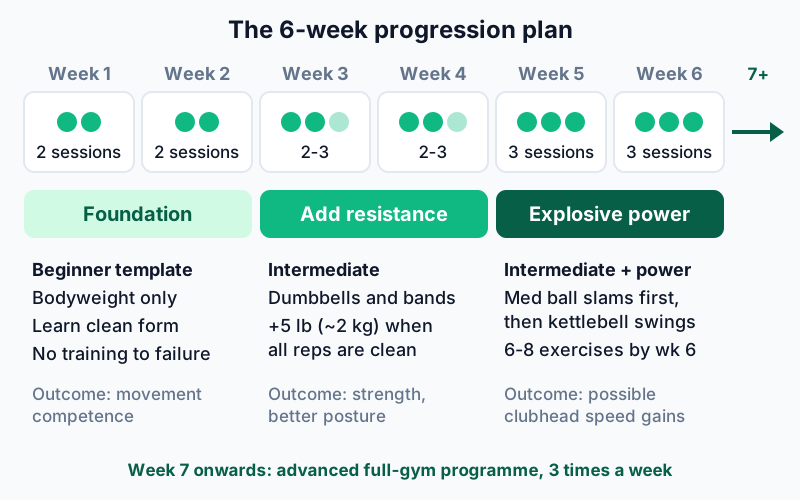
This plan assumes you're starting at beginner level. If you already train regularly, start at week 3.
Weeks 1-2 — Build the Foundation
Use the beginner template, twice a week. Focus on learning good form for every movement. Don't add weight and don't train to failure. The aim is to teach your body the movement patterns that will carry heavier loads later.
Log each session in Green Streak as a strength workout. Bodyweight work counts too, and at this stage the habit matters more than the intensity.
Weeks 3-4 — Add Resistance
Move to the intermediate template, two to three times a week, adding dumbbells and bands. Increase the resistance gradually: if you complete all reps with clean form, add 5 lb (~2 kg) next session. Soreness is normal in the first week of added resistance and fades as your body adapts.
Weeks 5-6 — Introduce Explosive Work
Add one explosive exercise per session. Start with medicine ball slams, which are easier to learn, before moving on to kettlebell swings. Keep the slow strength exercises, but pair them with speed work now. Train three times a week if your recovery allows.
By week 6, you should be doing 6-8 exercises per session, mixing strength and power movements. If you have access to a launch monitor, this is a good point to start checking your clubhead speed.
| Week | Template | Sessions | New Addition | Expected Outcome | |------|----------|----------|--------------|------------------| | 1-2 | Beginner | 2 | None (form focus) | Movement competence, reduced soreness | | 3-4 | Intermediate | 2-3 | Dumbbells and bands | Noticeable strength gains, better posture | | 5-6 | Intermediate + explosive | 3 | Med ball slams, KB swings | Possible clubhead speed gains | | 7+ | Advanced | 3 | Full programme | Ongoing gains, injury resilience |
Equipment Needed at Each Level
You can start tonight with nothing, so lack of equipment isn't a reason to wait.
Starting With Zero Equipment
The beginner template needs only your bodyweight and a floor. Dead bugs, push-ups, split squats, lateral lunges and plank rotations need nothing else. If you have a practice setup at home, you can train in the same space.
Adding Bands and Dumbbells (~£40-65)
A single loop resistance band (~£8-12) opens up Pallof presses, band pull-aparts and band rotations. A pair of adjustable dumbbells (~£30-50) covers Romanian deadlifts, split squats and loaded lateral lunges. Together they handle the whole intermediate programme.
Full Gym Setup (~£150-400 or Gym Membership)
A kettlebell (£25-40), a slam ball (£15-25), and a cable machine or second resistance band complete the advanced template. A gym membership at £25-40/month gives you access to everything. If you prefer training at home, a complete setup stays under £400.
| Level | Equipment | Approximate Cost | |-------|-----------|-----------------| | Beginner | Nothing | £0 | | Intermediate | Resistance band + dumbbells | £40-65 | | Advanced (home) | Add kettlebell + slam ball | £150-400 total | | Advanced (gym) | Gym membership | £25-40/month |
When to Train Relative to Golf
Timing matters. A hard strength session leaves your muscles needing a day or two to recover. Train too close to a round and you'll play with tired muscles that are slower, weaker and less coordinated than they should be.
The Rules
Don't strength train on the day of a round. Your muscles will be tired and your fine motor control dulled. Even a light gym session a few hours before a round can leave you slower and less coordinated.
Ideally, leave 48 hours between heavy training and golf. If you play on Saturday morning, make Thursday your last heavy session. Friday can be a light mobility day using your stretching routine or warm-up routine.
If you play several times a week, train on non-golf days. If you play on Monday and Thursday, train on Tuesday and at the weekend. The schedule fits around your golf, not the other way round.
Light training the day after a round is fine. Your body is already recovering from 18 holes. A lighter session with bands and bodyweight may even help you recover by getting blood flowing to tired muscles.
| Day | Activity | Notes | |-----|----------|-------| | Monday | Strength training (full session) | Heavy compound movements | | Tuesday | Golf practice | Short game or light range work the day after lifting | | Wednesday | Strength training (full session) | 48 hours before weekend golf | | Thursday | Rest or mobility only | Golf stretches routine | | Friday | Light training or rest | No heavy lifting before Saturday round | | Saturday | Golf round | Peak performance window | | Sunday | Active recovery | Light bands, bodyweight or a walk before Monday's session |
Sources & Further Reading
- Uthoff et al. (2021), "Effects of Resistance Training Methods on Golf Clubhead Speed and Hitting Distance: A Systematic Review," Journal of Strength and Conditioning Research: Average clubhead speed and distance gains by training type
- Johansen et al. (2026), "Effects of Physical Training Interventions on Golf Shot Performance: A Systematic Review with Meta-analysis," Sports Medicine: Pooled results from 33 studies and 798 golfers
- Fletcher & Hartwell (2004), "Effect of an 8-Week Combined Weights and Plyometrics Training Program on Golf Drive Performance," Journal of Strength and Conditioning Research: Controlled study of strength training and driving performance
- Lephart et al. (2007), "An Eight-Week Golf-Specific Exercise Program Improves Physical Characteristics, Swing Mechanics, and Golf Performance in Recreational Golfers," Journal of Strength and Conditioning Research: Strength, flexibility and balance training in recreational golfers
- Read et al. (2013), "Relationships Between Field-Based Measures of Strength and Power and Golf Club Head Speed," Journal of Strength and Conditioning Research: Medicine ball throws, jumps and clubhead speed
- Lake & Lauder (2012), "Kettlebell Swing Training Improves Maximal and Explosive Strength," Journal of Strength and Conditioning Research: Six-week kettlebell training outcomes
- Rosenfeldt et al. (2024), "Comparison of Resistance Training vs Static Stretching on Flexibility and Maximal Strength," BMC Sports Science, Medicine and Rehabilitation: Full range of motion resistance training and flexibility
- Titleist Performance Institute (TPI): Golf-specific fitness screening and biomechanics
Related Articles
- Golf Stretches and Exercises: The 15-Minute Flexibility Routine
- The 5-Minute Golf Warm-Up Routine That Actually Works
- How to Practice Golf Effectively
- Building a Consistent Golf Practice Habit
- How to Break 90 in Golf: A Step-by-Step Practice Plan
- The Complete Guide to Practicing Golf at Home
Frequently Asked Questions
Does strength training actually help golf?
Yes. A 2026 meta-analysis of 33 studies found that physical training improved clubhead speed, ball speed, carry distance and total distance compared with control groups. The authors rated the certainty of the evidence as low. Strength training builds the force that your swing technique delivers to the ball.
What muscles should golfers train?
Focus on the core (obliques and deep stabilisers), glutes, hamstrings and upper back. These muscle groups drive rotational power, push into the ground and keep your posture stable during the swing. The hips and core generate most of the speed, while the upper back holds the structure that delivers the club to the ball.
Will lifting weights make me stiff for golf?
No. A 2024 randomised trial found that resistance training through a full range of motion improved flexibility as much as static stretching. The stiffness worry comes from partial-range bodybuilding movements. Exercises like Romanian deadlifts, lateral lunges and cable rotations build strength through a full range of motion.
How many days a week should golfers lift?
Two to three sessions a week works well for many golfers. That gives enough stimulus for strength gains while leaving 48 hours of recovery between sessions. Keep training off the day of a round. If you play at weekends, Monday and Wednesday for heavy work, plus a light session on Sunday, fits well.
Can I do golf strength training at home?
Yes. The beginner programme needs no equipment and works in any living room. The intermediate programme needs only a resistance band and a pair of dumbbells. A complete home setup for the advanced programme costs under £400 and fits in the corner of a garage, the same space many golfers use for a hitting net.
Should I strength train on the day I play golf?
No. Don't train with weights on the day of a round, because even a light session can leave your muscles tired and your fine motor control dulled. Leave at least 24 hours between a strength session and golf. After a heavy session, 48 hours is better.
How long before I see results from golf strength training?
Many golfers notice better posture and general strength within a few weeks. Clubhead speed takes longer. A 2021 systematic review found that 8-week programmes including fast, golf-specific movements were the most effective at increasing clubhead speed and hitting distance. Sticking with 2-3 sessions a week without long breaks matters most.
What is the difference between golf stretching and golf strength training?
Stretching improves flexibility and range of motion through sustained holds and mobility work. Strength training builds force through resistance exercises. Both matter for golf. Stretching helps your body reach the positions the swing asks for, and strength training helps you produce power through them. This programme covers strength, and the companion stretching routine covers flexibility.
Disclaimer: This article is for informational purposes only and does not replace professional golf instruction. Individual results will vary based on ability, practice consistency, and physical condition. Consult a PGA professional for personalised swing advice.
Ready to build your practice streak?
Track your sessions, set goals, and improve with Green Streak — completely free.
Get Started Free