How Often Should You Practice Golf to Actually Improve?
Why short, frequent golf practice beats one long weekly session. What the research says about practice frequency, fatigue and what actually works.

Quick Summary
- Practise 4-6 days a week rather than once: research on motor learning shows that spreading practice across days helps skills stick
- 15 minutes a day beats 2 hours on Saturday: a similar total time, with better retention
- Longer sessions bring diminishing returns: many amateurs find focus and technique slip after 30-45 minutes, so shorter sessions give better-quality reps
- Log every session in the free Green Streak app and let your streak build the habit
You've been meaning to practise more, and you know it matters. But between work, family and a range that's a 20-minute drive away, another week passes with nothing but a Saturday round and a vague sense of guilt.
Quick Answer: Research on motor learning shows that spreading practice across several days works better than cramming it into one session. A study in Human Movement Science found that spacing sessions across days, rather than within a day, improved learning on a delayed retention test. For many golfers, that means 4-6 sessions a week of 15-30 minutes. Frequency matters more than duration, so start with 15 minutes of short game a day.
Table of Contents
- What Does the Research Say About Practice Frequency?
- Why 15 Minutes Daily Beats 2 Hours Weekly
- How Often Should You Practise Based on Your Handicap?
- When Do Diminishing Returns Kick In?
- What Counts as Practice?
- How to Fit Golf Practice Into a Busy Schedule
- The Role of Consistency and Streak Psychology
- A Weekly Practice Schedule That Works
- Sources & Further Reading
- Related Articles
- Frequently Asked Questions
What Does the Research Say About Practice Frequency?
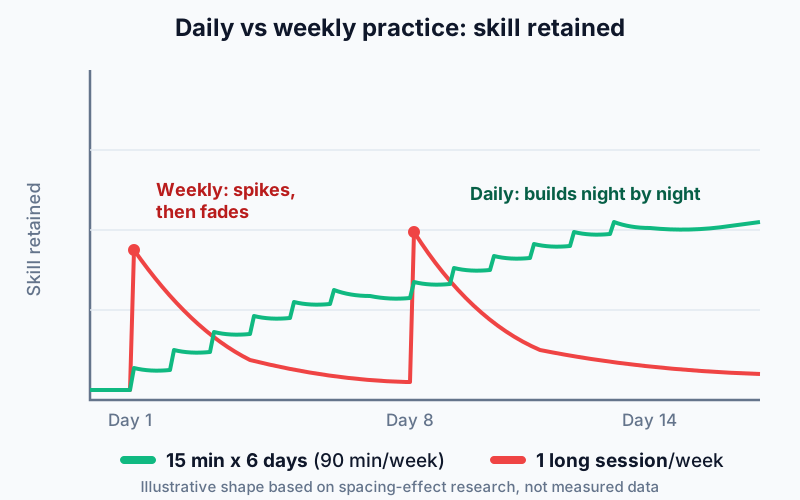
The research is fairly clear on this. The question isn't only how many hours you need. It's how you spread those hours across the week.
The spacing effect is one of the best-studied findings in learning research. A 2006 review in Psychological Bulletin pooled 839 assessments of distributed practice (spreading repetitions across several sessions) from 317 experiments on verbal learning. It compared them with massed practice (cramming into fewer, longer sessions).
It found that the longer you need to remember something, the bigger the ideal gap between sessions. Motor skills show a similar pattern. Shea and colleagues found that splitting practice across days, rather than within one day, produced better learning of balance and timing tasks.
Golf is a motor skill. Every swing, chip and putt is a movement pattern your brain learns through repetition, and much of that learning is locked in after the session ends. A 2020 meta-analysis of 48 studies found that sleep helps consolidate motor memories compared with an equivalent period awake.
So each practice day gives your brain fresh material to consolidate that night. Practise on Monday and then skip until Saturday, and you get one night's worth. Practise Monday to Thursday, and you get four, each building on the last.
For golfers, the implication is simple. Four 15-minute sessions across the week give your brain far more chances to consolidate than a single 60-minute session.
Why 15 Minutes Daily Beats 2 Hours Weekly
I can hear the objection already: "Fifteen minutes? That's barely enough to warm up." But look at the maths.
Fifteen minutes a day, six days a week, adds up to 90 minutes. A two-hour Saturday session is 120 minutes, so the weekend golfer gets 30 more minutes. Yet the spacing research above suggests the daily practiser will learn more.
There are a few reasons:
Fatigue hurts quality. After 30-40 minutes at the range, many amateurs start compensating. Grip pressure creeps up and tempo speeds up. By ball 150, you may be grooving the very habits you're trying to fix. In a 15-minute session, fatigue doesn't come into it.
Sleep consolidation adds up. Sleep helps your brain lock in the motor patterns from that day's practice. Six nights of consolidation a week instead of one is a big difference. It's like building a wall one course of bricks at a time, rather than stacking them all at once and hoping they hold.
Attention stays sharp. Focus on a repetitive task fades the longer you go. A 15-minute session is short enough to keep every rep deliberate.
| Approach | Weekly Time | Sessions Per Week | Quality Per Rep | Sleep Consolidation Cycles | Retention After 14 Days | |---|---|---|---|---|---| | 2-hour Saturday binge | 120 min | 1 | Declines after 30 min | 1 night | Low | | 45 min twice a week | 90 min | 2 | Moderate | 2 nights | Moderate | | 15 min x 6 days | 90 min | 6 | Stays high | 6 nights | High | | 30 min x 4 days | 120 min | 4 | High | 4 nights | High |
Short daily sessions hold their own against longer ones. For many golfers, they're the better use of the same or less total time.
Ready to start daily practice? The free Green Streak app logs your practice sessions, builds streaks and shows you how consistent you've been. Fifteen minutes a day is enough to start.
How Often Should You Practise Based on Your Handicap?
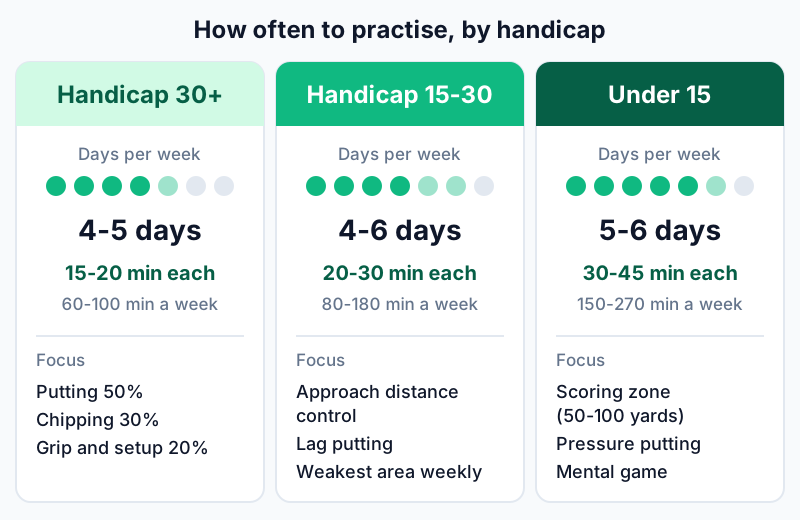
Your ideal practice frequency depends on where you are in the game. A 35-handicapper and a 10-handicapper have different needs, different gaps in their game and different returns on practice time.
Handicap 30+ (Beginner to High Handicapper)
Recommended frequency: 4-5 days per week, 15-20 minutes per session.
At this level, you're building the basic movement patterns. Grip, stance, tempo and contact are all new. Beginners get a lot from frequent, short practice, because regular repetition helps those new patterns bed in.
Focus areas: putting (50% of sessions), chipping (30%), and grip and setup fundamentals (20%). Full swing at the range can wait until your short game has a base.
A golfer shooting over 100 usually has plenty of easy strokes to drop. Many of them go once you stop three-putting and chunking chips.
Handicap 15-30 (Intermediate)
Recommended frequency: 4-6 days per week, 20-30 minutes per session.
You've got a swing, and it works most of the time. Your improvement now comes from consistency and cutting out the costly mistakes. At this stage, structured practice matters more than raw volume.
Focus areas: distance control on approach shots, lag putting and a reliable driving range routine. Give one session a week to your weakest area, based on your recent rounds.
Handicap Under 15 (Low Handicapper)
Recommended frequency: 5-6 days per week, 30-45 minutes per session.
Improvement at single-figure and low-teen handicaps is slower and harder won. Each shot you shave needs more precision. The principle stays the same, though: frequency beats volume.
Focus areas: scoring zone work (50-100 yards), pressure putting drills, mental game routines and course management. Add one longer session a week (60-90 minutes) for full-swing work alongside the shorter daily ones.
| Handicap Range | Sessions Per Week | Minutes Per Session | Total Weekly Time | Primary Focus | |---|---|---|---|---| | 30+ | 4-5 | 15-20 | 60-100 min | Putting, chipping, fundamentals | | 15-30 | 4-6 | 20-30 | 80-180 min | Consistency, distance control, weak spots | | Under 15 | 5-6 | 30-45 | 150-270 min | Scoring zone, pressure drills, mental game |
Notice the pattern. Every level gets at least 4 sessions a week. The total time rises as your handicap drops, but the daily commitment stays manageable.
When Do Diminishing Returns Kick In?
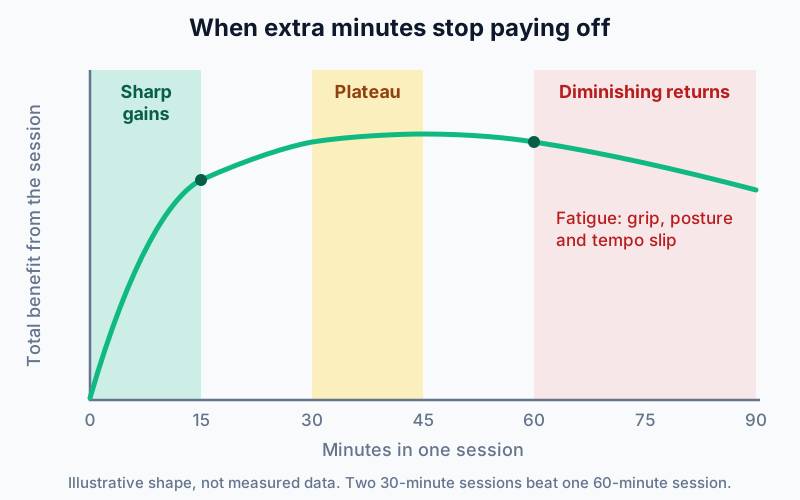
More isn't always better. For amateur golfers, there comes a point where extra time in a single session stops helping much, and it can even do harm.
The 30-minute threshold. There's no magic cut-off, but for many amateurs quality starts to slip around the half-hour mark. You're still hitting balls, but you're no longer giving each one full attention. The spacing research above points the same way: more, shorter sessions beat fewer, longer ones.
Physical fatigue makes it worse. After 45 minutes of range work, your grip changes, your posture shifts and your swing speed drops. You start compensating for tired muscles. Those compensations can turn into patterns that follow you to the course.
The concentration cliff. Focus on a single repetitive task fades over time. Unless you switch between activities (putting, then chipping, then full swing), staying locked in for more than 30 minutes is hard.
In practice, if you have 60 free minutes, split them into two 30-minute sessions with a break in between. Better still, practise for 30 minutes today and 30 minutes tomorrow. You'll retain more and avoid the fatigue trap.
See your patterns. Log each session's length and type in the free Green Streak app. Over time, your practice stats show which routines you keep up.
What Counts as Practice?
For busy golfers, this question makes a big difference. If "practice" means driving to the range, hitting balls for an hour and driving home, many people can only manage it once or twice a week. Practice is much broader than that.
Range Sessions
The classic. Full swings, wedge work, and maybe some bunker practice if the facility has sand. Range sessions are valuable, but they're not the only way to improve. For many golfers, they're not the most efficient way either.
Home Putting
Rolling putts on the carpet counts, and it counts a lot. Putts make up a big share of every round. A 10-minute putting session in the living room with a mug as a target builds feel and stroke consistency, and it costs nothing. A dedicated putting mat makes it even better.
Chipping and Short Game
Foam balls in the back garden, a chipping net in the garage or indoor pitch shots onto a towel all count. Short game practice feeds straight into scoring. If you can only do one thing, I'd make it this.
Swing Drills at Home
Mirror work, rehearsal swings and position checks don't need a ball or a range. Ten minutes in front of a mirror working on your takeaway or impact position builds awareness that carries over to your full swing.
Fitness and Mobility
Golf-specific stretching and strengthening can help your swing. Hip mobility exercises help you rotate, and core strength adds stability. A 15-minute mobility session is real golf practice, because it prepares your body for the swing you're trying to build.
Mental Game Work
Visualisation, course strategy review and pre-shot routine rehearsal all count. A meta-analysis of 75 brain-imaging papers found that imagining a movement consistently recruits a network that includes several regions used in actually performing it. Ten minutes visualising your round is time well spent.
The 19th Hole: Ask a room of club golfers how often they practise, and many will count only their range visits. That's why the answer is so often "once a week, if that." The distributed practice research above doesn't care where the reps happen. It cares how many days your brain gets fresh input to consolidate overnight. Ten minutes rolling putts at a mug on the carpet is a practice day, and so is a mirror session or a mobility routine. Count practice that way and "four to six days a week" stops sounding impossible. That's why Green Streak counts every type of practice, from the range to the living room carpet.
How to Fit Golf Practice Into a Busy Schedule
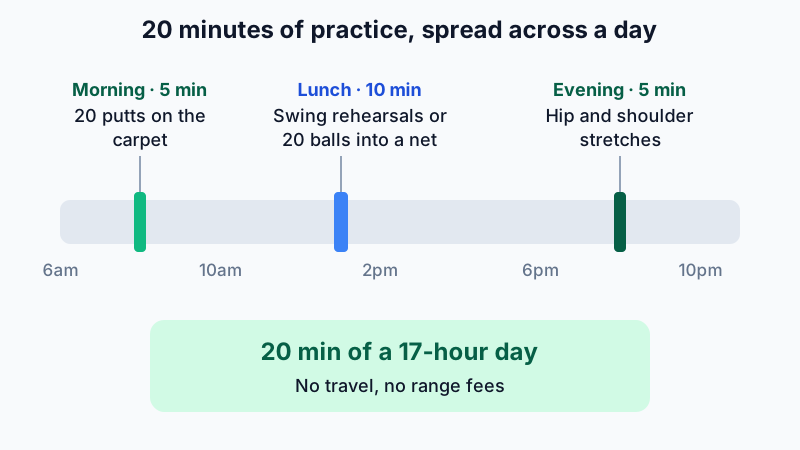
A common reason golfers don't practise enough is time, or at least how much time they think it takes. When practice means "go to the range", it's a 90-minute commitment including travel. When it means "roll 20 putts on the carpet", it takes less time than scrolling social media.
The Micro-Session Approach
Break practice into sessions so small they're hard to skip:
- Morning (5 minutes): 20 putts on the carpet before breakfast. Focus on a consistent stroke length.
- Lunch break (10 minutes): Swing rehearsals in the garden or garage. If you have a practice net, hit 20 balls with a 7-iron.
- Evening (5 minutes): Stretch your hips and shoulders while watching TV. That's golf fitness practice.
That's 20 minutes across the day, with no travel, no range fees and little disruption to your schedule.
The Commute Hack
If your commute passes within 5 minutes of a range or practice green, stop on the way home once or twice a week. Twenty minutes of chipping before dinner is realistic. Ninety minutes on a Saturday often isn't.
Weekend Sessions for Depth
Use weekends for the practice that needs a facility: full-swing work, bunker shots and on-course playing lessons. The daily micro-sessions cover maintenance and short game. The weekend session is for development.
Anchor It to an Existing Habit
In the habit-formation study published in the European Journal of Social Psychology, participants tied their new behaviour to a consistent daily cue, such as "after breakfast". You can do the same. Pair your putting practice with something you already do every day: after brushing your teeth, before making dinner or while the kettle boils. The cue comes round automatically, and the practice follows.
The Role of Consistency and Streak Psychology
Frequency only helps if you keep it up. A golfer who practises five days a week for three weeks and then stops for a month hasn't built anything lasting. Consistency is what makes the rest count.
The psychology behind this is well documented. Dr Phillippa Lally's research at University College London found that it took participants an average of 66 days for a daily behaviour to become a habit. That's well beyond the popular myth of 21 days, and the range ran from 18 to 254 days. Performing the behaviour more consistently was linked to a better fit with the habit-formation curve.
The Seinfeld Strategy applies directly here. Mark every day you practise, build a chain and protect it. Seeing an unbroken streak makes skipping a session feel costly.
That's why I built Green Streak. The app logs your practice, shows your streak and makes your consistency visible. Once you've practised 23 days in a row, the 24th feels a lot easier to find time for. The streak does some of the motivating for you.
There's a habit loop at work too. The cue (time of day), the routine (practice) and the reward (a longer streak) form a loop that gets stronger with each repetition. In Lally's study, automaticity kept rising with repetition before levelling off. That's why practising takes less effort as it shifts from deliberate to automatic.
What Happens When You Miss a Day?
Start again straight away. One missed day doesn't wipe out the skill you've built, and Lally's study found that missing one opportunity did not materially affect the habit-formation process. But a missed day that turns into a missed week is a different story. The longer the gap, the rustier you'll feel.
My rule is simple: never miss twice. If Monday gets away from you, make Tuesday count.
A Weekly Practice Schedule That Works
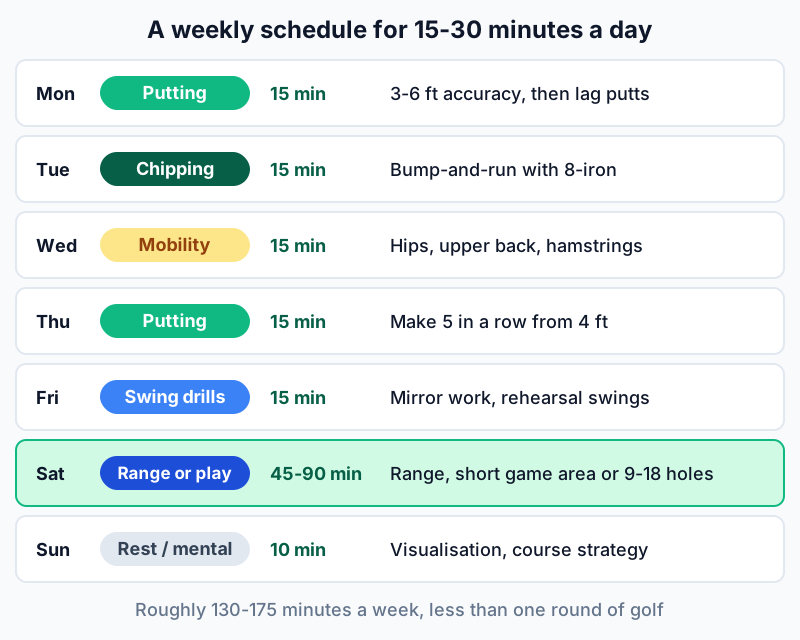
This is the schedule I'd suggest if you work full-time and have 15-30 minutes a day to spare. Adjust the session types to suit your handicap and weak spots.
| Day | Session Type | Duration | Focus | Location | |---|---|---|---|---| | Monday | Putting | 15 min | 3-6 foot accuracy, then lag putts from 20 feet | Home (carpet or mat) | | Tuesday | Chipping | 15 min | Bump-and-run with 8-iron, vary distances | Garden or garage | | Wednesday | Mobility | 15 min | Hip rotations, thoracic spine, hamstrings | Home | | Thursday | Putting | 15 min | Pressure game: make 5 in a row from 4 feet | Home (carpet or mat) | | Friday | Swing drills | 15 min | Mirror work, rehearsal swings, iron contact drills | Home | | Saturday | Full practice or play | 45-90 min | Range session, short game area, or 9-18 holes | Course or range | | Sunday | Rest or mental game | 10 min | Visualisation, course strategy, warm-up routine | Anywhere |
The total weekly commitment is roughly 130-175 minutes, which is less than a single round of golf takes.
The structure matters as much as the frequency. Putting appears twice because putts make up a big share of every round, and it's the easiest skill to practise at home. Mobility gets its own day because flexibility affects the swing you can make. The weekend session covers the facility-based work that home sessions can't.
If you can only manage four days, prioritise putting (twice), one short game session and one range or course day. I'd back those four sessions over a single weekly range binge.
Sources & Further Reading
- Cepeda et al. (2006), "Distributed Practice in Verbal Recall Tasks: A Review and Quantitative Synthesis," Psychological Bulletin: Meta-analysis of 839 assessments of distributed practice from 317 experiments
- Shea et al. (2000), "Spacing Practice Sessions Across Days Benefits the Learning of Motor Skills," Human Movement Science: Spacing practice across days versus within a day for motor learning
- Schmid et al. (2020), "Sleep-Dependent Motor Memory Consolidation in Healthy Adults: A Meta-Analysis," Neuroscience & Biobehavioral Reviews: How sleep helps consolidate motor skills
- Hétu et al. (2013), "The Neural Network of Motor Imagery: An ALE Meta-Analysis," Neuroscience & Biobehavioral Reviews: Why mental rehearsal engages the motor system
- Lally et al. (2010), "How Are Habits Formed," European Journal of Social Psychology: The 66-day habit formation study from University College London
- University of Surrey, "Does It Really Take 66 Days to Form a Habit?": Dr Pippa Lally on the 66-day average and the 18-254 day range
Related Articles
- How to Practice Golf Effectively
- Building a Consistent Golf Practice Habit
- The Seinfeld Strategy: Why "Don't Break the Chain" Works for Golf
- Driving Range Practice Routine That Actually Works
- Complete Guide to Practicing Golf at Home
- Best Putting Drills You Can Do at Home
- Golf Practice Schedule Template: Your Free Weekly Plan
Frequently Asked Questions
How many times a week should I practise golf to improve?
Aim for 4-6 times a week. Research on motor learning shows that spreading practice across days works better than cramming it into one session. Each session can be as short as 15 minutes. Frequency matters more than duration.
Is 30 minutes of golf practice enough?
Yes. For many amateur golfers, 30 minutes is a good length for a single session. Beyond that, fatigue and fading attention start to lower the quality of each rep. You'd often learn more by saving the extra time for another day.
Can I improve at golf without going to the range?
Yes. Putting on carpet, chipping foam balls in the garden, mirror swing drills and mobility exercises all count as real practice. Putts make up a big share of every round. I'd expect a golfer who rolls 30 putts on the carpet five days a week to improve faster than one who hits 200 range balls on a Saturday.
How long does it take to see improvement from regular practice?
It varies, but regular practice usually shows up in some parts of your game before others. Putting often improves first, then short game consistency, while full-swing changes take longest. Logging your sessions helps you connect what you practised with how you played.
Does practising at home actually help my golf game?
Yes. Home practice gives you the repetition your brain needs to consolidate movement patterns. A 2020 meta-analysis found that sleep helps consolidate motor memories after practice. A 10-minute home session gives your brain something to work on overnight, even without a ball flight to judge.
What is the minimum amount of golf practice to maintain my skill level?
As a rule of thumb, 2-3 focused sessions a week of at least 15 minutes each should stop many golfers going backwards. The less you practise, the more your touch fades. If you want to improve rather than maintain, aim for 4-6 sessions a week.
Should I practise golf every day or take rest days?
Six days of practice with one rest day is a sensible pattern for many golfers. The rest day gives your body time to recover, especially joints and tendons that take a pounding from repetitive swinging. Light stretching or visualisation on the rest day keeps the habit alive without taxing your body.
Is it better to practise one area of golf or mix it up?
Both focused (blocked) and varied (random) practice have their place, depending on your level. Beginners often do well with blocked practice, repeating one skill per session. As you improve, mixing skills within a session is closer to what the course asks of you and can help your practice carry over.
Disclaimer: This article is for informational purposes only and does not replace professional golf instruction. Individual results will vary based on ability, practice consistency, and physical condition. Consult a PGA professional for personalised swing advice.
Ready to build your practice streak?
Track your sessions, set goals, and improve with Green Streak — completely free.
Get Started Free