How to Practice Golf Effectively: The Complete Guide to Structured Practice
Many golfers never structure their practice. Learn research-backed ways to practise effectively and stop wasting time at the range.
Quick Summary
- Many range sessions are wasted: motor learning research shows that how you structure practice has a big effect on how much carries over to the course
- Random practice beats blocked practice for retention: mixing skills within a session improves long-term learning compared with drilling one shot repeatedly
- 60-65% of your strokes happen inside 100 yards: yet many golfers spend most of their practice time hitting drivers and irons
- Track your progress: log your practice sessions in the free Green Streak app to build consistency
You spend an hour at the range hammering drivers, walk away feeling great, then shoot the same score on Saturday. Writer Joshua Foer, drawing on Anders Ericsson's research, called this the "OK Plateau": the point where repetition without purpose stops producing improvement.
Quick Answer: To practise golf effectively, give every session a specific goal and split your time roughly 70/30 between short game and full swing. Mix your shots instead of hitting the same club repeatedly. Research in the Journal of Experimental Psychology found this kind of interleaved practice led to better retention than blocked repetition. Warm up, do focused skill work, add a pressure game, then finish by playing holes in your head. Log each session in Green Streak.
Table of Contents
- Why Do Most Golfers Practise Wrong?
- Deliberate Practice: What the Research Actually Says
- Blocked vs Random Practice: Which Is Better for Golf?
- The 70/30 Rule: Where to Spend Your Practice Time
- How to Structure a Practice Session
- How Long Should a Golf Practice Session Be?
- Practice Plans by Skill Level
- Practising With Purpose: Goals, Focus, and Tracking
- How Often Should I Practise Golf to Improve?
- Sources & Further Reading
- Related Articles
- Frequently Asked Questions
Why Do Most Golfers Practise Wrong?
You can watch this scene at any driving range, any week. A golfer tips out a bucket of 100 balls, pulls out the driver and hits them all in the same direction. He isn't aiming at anything specific. He never changes club or plays a single on-course shot. He leaves feeling like he practised, but he mostly got some exercise.
Plenty of golfers who use practice facilities don't follow any structured routine. They hit balls, and that's it.
The motor learning research below explains why that falls short. How you structure your practice matters as much as how many balls you hit.
The problem is that mindless repetition feels productive. You flush a 7-iron and it feels great, and you forget the six poor ones before it. You leave remembering the good shots and ignore the pattern of inconsistency.
It's one of the most common stories on golf forums: years of buckets, hundreds of balls a week and a handicap that barely moves. Things change when you stop asking "How many balls did I hit?" and start asking "What did I get better at today?"
Deliberate Practice: What the Research Actually Says
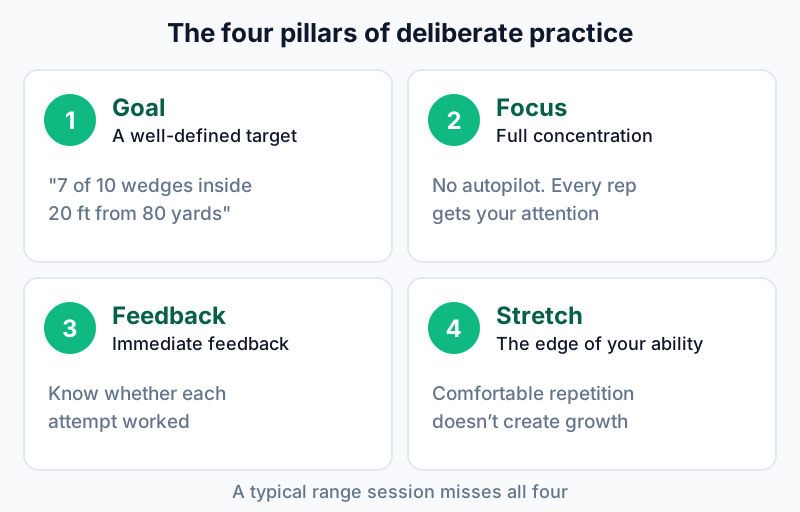
The term deliberate practice comes from psychologist K. Anders Ericsson, whose research on expert performance shaped everything from music training to medical education. It means more than doing something repeatedly. It has four requirements:
- A well-defined goal: not "hit it better" but "land 7 out of 10 wedge shots inside 20 feet from 80 yards."
- Full concentration: no autopilot. Every repetition gets your attention.
- Immediate feedback: you know whether each attempt succeeded or failed.
- Practice at the edge of your ability: comfortable repetition doesn't create growth.
A typical range session fails on all four. There's no goal, concentration drifts, feedback is vague ("that felt good") and the difficulty never changes.
Ericsson's landmark 1993 study in Psychological Review found that what separated the best performers was time spent in deliberate practice, not time spent simply playing. The best violinists in his study had built up more hours of focused, effortful solo practice than their less accomplished peers. Golf is a skill like any other, so the same principle applies.
That doesn't mean every session has to be gruelling. It means every session needs a point. Fifteen minutes of focused putting at a specific target beats an hour of aimless ball-striking. A session with a measurable goal gives you something to learn from, while "worked on my swing" gives you nothing to compare next time.
Ready to practise with purpose? The free Green Streak app lets you log every session by category, such as putting, chipping, irons or driving. Keep a record of what you work on and the patterns start to show.
Blocked vs Random Practice: Which Is Better for Golf?
This is one of the most researched topics in motor learning, and the answer surprises plenty of golfers.
Blocked practice means repeating the same skill over and over. Hit 30 7-irons in a row, then 30 pitching wedges, then 30 drivers. It's how most people practise at the range.
Random practice (also called interleaved practice) means mixing skills within the same session. Hit a 7-iron, then a wedge, then a driver, then a 5-iron. Change targets and distances, and never hit the same shot twice in a row.
The counterintuitive part is that blocked practice feels better. You start grooving the shot, your results improve within the session and you leave feeling confident.
Random practice feels worse. You never settle into a rhythm, your in-session results are messier and you leave less sure of yourself.
But in the research, random practice tends to win where it matters: retention and transfer to new situations.
| Factor | Blocked Practice | Random Practice | |--------|-----------------|-----------------| | In-session performance | Higher | Lower | | Long-term retention (days later) | Lower | Higher | | Transfer to course play | Poor | Strong | | Feels like | Progress | Struggle | | Simulates on-course conditions | No | Yes | | Best for | Complete beginners learning basics | Anyone past the beginner stage |
A study published in the Journal of Experimental Psychology tested this directly with a motor skill task. Participants who used interleaved practice performed worse during training but better on retention tests, including one taken ten days later. This is called the contextual interference effect. The effort of switching tasks makes you process each attempt more deeply, which helps the skill stick.
On the course, you never hit the same shot twice in a row. Every shot asks for a different club, distance or trajectory. Blocked practice trains you for a situation that doesn't happen during play, while random practice looks much more like the real thing.
Expect the switch to random practice to feel like a step backwards. Your range sessions will feel less satisfying. That's the contextual interference effect doing its job, and the payoff shows up on the course rather than in the bay.
How to Apply Random Practice at the Range
The simplest method is to play the course in your head. Stand on the range and imagine hole 1 at your home course. Hit your tee shot club, then the approach club you'd likely need, then a chip. Move on to hole 2. You switch clubs constantly and think before every shot.
Another approach is the "no two in a row" rule. Never hit the same club twice in succession. Alternate between long and short, high and low, draw and fade. Every ball gets a specific target and a specific shape.
The 70/30 Rule: Where to Spend Your Practice Time
For many golfers, this is the biggest single change they can make to how they practise.
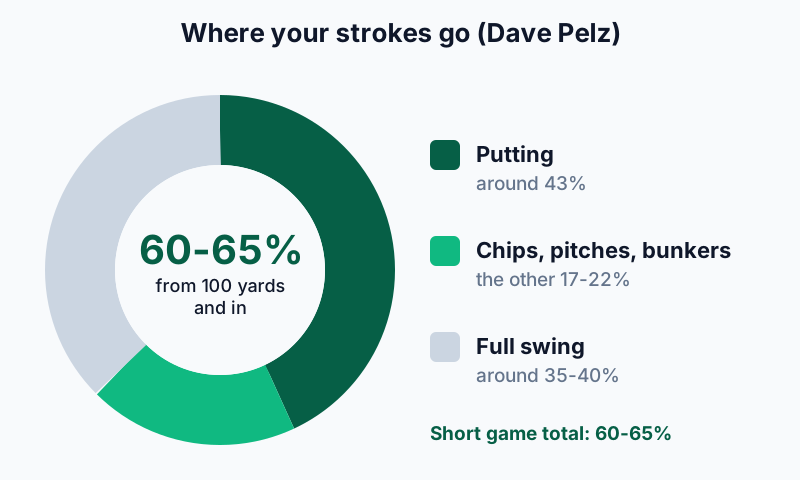
According to Dave Pelz, putting accounts for approximately 43% of your total strokes. Pelz, a former NASA physicist who turned to short game research, found that adding chips, pitches and bunker shots takes the short game to 60-65% of a golfer's score.
Yet many golfers spend the bulk of their practice time on the driving range, which gets the ratio backwards. If you want specific drills to fix that, the best putting drills for home practice are a good place to start.
The 70/30 rule flips it. Spend 70% of your practice time on shots inside 100 yards (putting, chipping, pitching, bunker play) and 30% on the full swing (irons, woods, driver).
Here's how I'd break that down:
| Practice Focus | Time Allocation | Why | |---------------|----------------|-----| | Putting | 30% | Around 43% of your strokes. Highest return per minute practised. | | Chipping and pitching | 25% | Saves pars, prevents double bogeys. Easiest to practise at home. | | Wedge play (50-100 yards) | 15% | The scoring zone. Distance control here sets up short putts. | | Full irons | 15% | Accuracy matters more than distance. Vary clubs and targets. | | Driver and woods | 15% | Important, but over-practised by many amateurs. |
If you have 60 minutes, that means 18 minutes putting, 15 chipping, 9 on wedge distances, 9 on irons and 9 hitting driver. Plenty of golfers would spend 45 of those 60 minutes on irons and driver instead.
Tracking where you spend your time? Log each practice session by category in the free Green Streak app, from putting and chipping to irons and driving. Then check whether your ratio matches the 70/30 rule.
How to Structure a Practice Session
A structured session has four phases. Each has a purpose, and the order matters.
Phase 1 — Warm-Up (5-10 Minutes)
Start with a dynamic warm-up to get your body moving. Then hit 10-15 easy wedge shots to find your rhythm. No full swings yet and no driver, just smooth, short shots to feel the clubface.
The warm-up is preparation rather than practice, so don't count these shots toward your skill work.
Phase 2 — Technical Skill Work (15-25 Minutes)
This is your focused block. Pick one skill and work on it deliberately. One thing, not three.
Examples:
- Putting from 4-6 feet with a gate drill (two tees just wider than your putter head, so the putter passes through without touching them)
- Chipping from a tight lie with a 56-degree wedge, with the landing zone marked by a towel
- Working on your takeaway with a specific drill to fix a slice
Set a measurable target before you start, such as "Make 7 out of 10 from 5 feet." Write the result down. That feedback loop is what drives improvement.
Phase 3 — Pressure Games (10-15 Minutes)
Skill work builds the pattern and pressure games test it. Here you simulate on-course conditions by adding consequences.
Par 18: Pick 9 spots around the practice green and play each as a hole: chip, then putt out. Par is 2 per hole, so 18 for the nine. Score it and try to beat your previous best.
Up and Down Challenge: Pick 9 different spots around the practice green. Chip and putt from each, and note your up-and-down percentage.
21: Putt from 3 feet. A make scores 1 point and a miss loses 3. Keep going until you reach 21. The penalty for missing makes 3-footers feel like they matter, because on the course they do.
Pressure games bring back some of the nerves you feel on the course. Your heart rate rises and your hands tighten. That's the feeling you want to practise with.
The 19th Hole: The contextual interference finding has an awkward side effect that shows up again and again on r/golf and other golf forums. Someone tries random practice for a week and hates how messy it feels. Then they go back to hitting 30 7-irons in a row because that "felt like it was working." The research predicts exactly that reaction. Interleaved practice looks worse during the session and wins on the retention test days later. So if your range sessions feel scrappier after you switch, it isn't failing. Judge it by Saturday's round, not Tuesday's bucket.
Phase 4 — Cool-Down and Simulation (5-10 Minutes)
Finish every session by playing the course in your head. On the range or the practice green, hit shot sequences as if you were playing holes: tee shot, approach, chip, putt. Change clubs between every shot. This bridges the gap between practice and play.
End with 5 easy wedge shots so you leave on a good note. It's nicer to take a good feeling to the course than a bad one.
How Long Should a Golf Practice Session Be?
Shorter than you think. Focused practice is mentally tiring. Once your concentration fades, the quality of each repetition drops and you risk grooving sloppy habits.
For most amateur golfers I'd aim for 45-60 minutes per session, split into the four phases above. With 30 minutes, cut the warm-up to 3 minutes and compress the other phases. With 15 minutes, pick one phase and do it well.
Frequency matters more than you might expect. Three 30-minute sessions a week are likely to do more for you than one 90-minute session, and the Seinfeld Strategy applies directly. Motor learning research suggests skills consolidate between sessions, including during sleep, so more sessions give you more of those consolidation periods.
Practice Plans by Skill Level
Not every golfer should practise the same way. Your level decides where the biggest gains are.
Beginner (Handicap 25+, Shooting 100+)
Your priority is contact and confidence. Don't chase perfection in your full swing yet.
| Day | Focus | Duration | Session Detail | |-----|-------|----------|----------------| | Monday | Putting | 20 min | Roll 30 putts from 3-6 feet. Track makes out of 10. | | Wednesday | Chipping | 20 min | Bump-and-run with 8-iron to a towel target. 30 shots, vary distance. | | Friday | Full swing | 30 min | 15 easy wedges, 10 mid-irons, 5 drivers. Use the "no two in a row" rule. | | Saturday | Play 9 holes | - | Apply strategy. Score every hole honestly. |
Put most of your practice time into the short game. Full swing improvements tend to follow as your contact and coordination develop. If you're trying to break 100, putting and chipping are usually the quickest route.
Mid-Handicap (Handicap 12-24, Shooting 84-96)
You can make contact. Now you need consistency and scoring.
| Day | Focus | Duration | Session Detail | |-----|-------|----------|----------------| | Monday | Putting pressure games | 25 min | Gate drill from 5 feet (15 min). Then "21" game (10 min). | | Tuesday | Wedge distances | 30 min | Hit to specific yardages: 50, 70, 90 yards. Track dispersion. | | Thursday | Short game variety | 30 min | 10 chips from good lies, 10 from rough, 10 bunker shots. Random order. | | Friday | Full swing (random) | 30 min | Play your home course on the range. Different club every shot. | | Saturday | Play 18 | - | Track fairways, greens in regulation, putts, and up-and-downs. |
At this level, random practice should make up most of your full swing work. You have the basic mechanics, so now train yourself to choose and hit shots under changing conditions.
Low Handicap (Handicap 0-11, Shooting 72-83)
Your margins are thin. Improvement comes from fixing weaknesses rather than polishing strengths.
| Day | Focus | Duration | Session Detail | |-----|-------|----------|----------------| | Monday | Weakness session | 40 min | Work exclusively on your worst statistical category from last month. | | Tuesday | Scoring zone | 30 min | 50-100 yard wedge shots to specific targets. Track proximity to pin. | | Wednesday | Putting | 30 min | Speed control from 20-40 feet (15 min). Make percentage from 6-10 feet (15 min). | | Thursday | Course simulation | 45 min | Play 18 holes on the range and practice green. Score every hole. | | Friday | Mobility and rest | 15 min | Dynamic stretching and foam rolling only. | | Saturday | Competition round | - | Play with full focus. Post-round review within 30 minutes. |
At this level, let the numbers decide. Track strokes gained by category if you can. If putting costs you 1.5 strokes per round relative to your irons, that's where your time goes. A GPS watch helps you collect accurate distance data for post-round analysis.
Practising With Purpose: Goals, Focus, and Tracking
Structure without measurement is incomplete. Note three things from every practice session:
- What you worked on: the specific skill and drill
- Your measurable result: makes out of 10, percentage, proximity
- What you'll do next time: adjustments based on today's numbers
This takes 30 seconds at the end of each session. Write it in a notebook, type it into your phone or log it in a practice tracker. Recording it makes you reflect, and reflection drives improvement.
A session logged with a number ("7 out of 10 from 5 feet") gives you something to beat next time. A session logged as "worked on chipping" gives you nothing to compare. That number is the difference between hoping you're getting better and knowing it.
Set process goals rather than outcome goals. "Make 7 out of 10 from 5 feet" is a process goal. "Lower my handicap by 2" is an outcome goal. You control the process but not the outcome directly, and the outcomes follow the process.
How Often Should I Practise Golf to Improve?
As a rule of thumb, aim for at least three focused sessions per week. Fewer than that and there are too many days between sessions for the work to build on itself.
If you can manage it, four to five sessions a week is better, with at least two of them being 15-20 minute short game sessions at home. A practice net in your garage, or even a putter and a patch of carpet, counts.
Here's the split I'd suggest:
- 2-3 sessions per week: Short game at home (putting, chipping). 15-20 minutes each.
- 1-2 sessions per week: Range or course practice with a structured range routine. 45-60 minutes each.
- 1 round per week: On-course play with a post-round review.
That's 4-6 touchpoints per week, totalling roughly 3-4 hours. What matters is how those hours are spread out and whether each one has a purpose.
Consistency compounds. Four 20-minute sessions a week should serve you better than one 80-minute session. The science of distributed practice backs this up: a meta-analysis of 63 studies found that spaced practice produced significantly better performance than massed practice.
Sources & Further Reading
- Ericsson, K.A. et al. (1993), "The Role of Deliberate Practice," Psychological Review: The foundational study on expert performance and deliberate practice
- Shea & Morgan (1979), "Contextual Interference Effects," Journal of Experimental Psychology: Landmark research on random vs blocked practice and motor skill retention
- Pelz, D., "Dave Pelz's Short Game Bible" (1999): Data-driven analysis of amateur scoring patterns and short game practice allocation
- Donovan & Radosevich (1999), "A Meta-Analytic Review of the Distribution of Practice Effect," Journal of Applied Psychology: Spaced vs massed practice
- GOLF.com: Dave Pelz's 10 Truths About Putting: Source of the 43% putting figure
- Golf Business News: Dave Pelz Obituary: Summary of Pelz's research on the short game's share of scoring
- PGA Tour Strokes Gained Statistics: Performance data showing the relative importance of each part of the game
Related Articles
- The Seinfeld Strategy: Why "Don't Break the Chain" Works for Golf
- The 5-Minute Golf Warm-Up Routine That Actually Works
- How to Break 100 in Golf: The Strategy Guide
- Best Putting Drills at Home: 10 Drills for Speed and Start Line
- Driving Range Practice Routine: How to Make Every Bucket Count
- Building a Consistent Golf Practice Habit
- Golf Practice Schedule Template: Your Free Weekly Plan
Frequently Asked Questions
How long should I practise golf each day?
Research on deliberate practice suggests focused, purposeful practice beats hours of mindless repetition, so 20-45 minutes done well is plenty. Set a goal, concentrate fully and note your results. If you only have 15 minutes, spend them putting with a specific drill.
What is the best way to practise golf at home?
Putting on carpet gives you the most return for the least setup. Set a target (a coin or mug) at 3-6 feet and track your make percentage. Chipping foam balls in the garden works too, and a practice net in the garage lets you work on full swings. Even rehearsing positions in a mirror counts.
Should I practise one thing or multiple things per session?
Keep your technical skill work to one area per session. Within that focus, use random practice: vary distances, targets and lies rather than repeating the same shot. A chipping session can include different lies, clubs and distances.
How do I know if my practice is actually working?
Track measurable outcomes: putts made out of 10 from set distances, chip proximity to the hole, fairway percentage. Compare these numbers monthly. If they're improving, your practice is working. If they're flat after four weeks, change your approach.
Is it better to practise golf or play golf?
They do different jobs. Practice builds skills in a controlled setting, and playing tests them under pressure. I'd aim for three to four practice sessions a week and one round. During rounds, focus on execution and save the tinkering for the practice ground.
What is the most effective golf practice drill?
The gate drill for putting is one of the best-value drills in golf. Place two tees just wider than your putter head, either side of the ball, and hit 5-foot putts without clipping them. It trains face angle and path together, and the feedback is instant: the putter either gets through cleanly or it doesn't.
Why am I not improving despite practising regularly?
The usual reason is unstructured practice. Hitting 100 balls with no goal, no measurable target and no variation teaches you very little. Switch to random practice, set targets before each session and spend 70% of your time on the short game.
How should I split my practice time between short game and full swing?
Roughly 70% on the short game (putting, chipping, pitching, bunker play) and 30% on the full swing. That broadly reflects where your strokes occur during a round. Many golfers flip this ratio, which is one reason their scores come down slowly despite plenty of range time.
Disclaimer: This article is for informational purposes only and does not replace professional golf instruction. Individual results will vary based on ability, practice consistency, and physical condition. Consult a PGA professional for personalised swing advice.
Ready to build your practice streak?
Track your sessions, set goals, and improve with Green Streak — completely free.
Get Started Free