The Mental Game of Golf: How to Stay Focused and Build Confidence
They say golf is 90% mental, yet many golfers never train their brain. 5 techniques to stay focused, build confidence and recover from bad holes fast.

Quick Summary
- They say golf is 90% mental, yet many golfers barely practise it: psychologists such as Dr Bob Rotella argue mental discipline sets the best players apart
- A consistent pre-shot routine helps: a 2021 meta-analysis of pre-performance routines found athletes performed better with one, with and without pressure
- The "next shot" mindset is your best recovery tool: golfers who bounce back from a double bogey treat each shot as its own event
- Practise the habit as well as the swing: log your sessions in the free Green Streak app and let a steady streak feed your confidence
You've just hit your best drive of the round on the 14th. Flushed it. Then you stood over your approach, thought about the water on the left, and dumped it straight in.
Quick Answer: The mental game is your ability to stay focused, manage your emotions and make confident decisions over 18 holes. Sports psychologists such as Dr Bob Rotella argue that many scoring collapses are mental rather than physical. Three skills make the biggest difference. A pre-shot routine anchors your focus, and a "next shot" mindset stops one bad hole becoming three. Regular practice gives you evidence to trust under pressure. Start with 5 minutes of visualisation and log it in Green Streak.
Table of Contents
- Why Is Golf 90% Mental
- The Pre-Shot Routine as Your Mental Anchor
- How Do I Stop Getting Nervous on the First Tee
- How to Recover From a Bad Hole
- Building Confidence Through Preparation
- How Do I Stay Focused for 18 Holes
- Process vs Outcome: The Framework That Changes Everything
- Course Management as a Mental Skill
- 5 Mental Game Exercises You Can Start Today
- How Daily Practice Builds Mental Toughness
- Sources & Further Reading
- Related Articles
- Frequently Asked Questions
Why Is Golf 90% Mental
You hear it all the time: "Golf is 90% mental." It's one of the game's oldest sayings, and nobody has ever measured it. So what does it actually mean in practice?
Once you have a reasonable swing, much of the gap between your best and worst rounds is in your head. Your swing doesn't change much from one Saturday to the next, but your scores do. What changes is your decisions, your emotions and your focus.
Dr Bob Rotella, author of Golf Is Not a Game of Perfect, has spent decades working with tour players. His point is that the best golfers don't hit fewer bad shots; they respond to them differently. They don't let hole 5 ruin hole 6. They commit fully to every shot and trust their swing instead of steering it.
Yet many golfers practise the physical game and ignore the mental side completely. They'll hit 200 range balls on a Saturday but won't spend 5 minutes on visualisation or breathing. It's like training for a marathon and forgetting to sleep.
The mental game is a set of skills rather than a talent you're born with, and like any skill, it improves with practice.
What "Mental" Actually Means on the Course
The mental game breaks down into four areas:
| Mental Skill | What It Controls | On-Course Example | |---|---|---| | Focus | Attention on the current shot | Blocking out the group behind you waiting on the tee | | Emotional regulation | Response to bad outcomes | Not slamming your putter after a three-putt | | Decision-making | Course management choices | Laying up instead of going for a par 5 in two over water | | Confidence | Trust in your abilities | Committing to your club selection without second-guessing |
You can train every one of these, and every one costs you shots when it breaks down.
The Pre-Shot Routine as Your Mental Anchor
If I could give one piece of mental game advice, it would be this: build a pre-shot routine and never skip it.
A pre-shot routine is the sequence you follow before every shot, with the same steps, rhythm and timing each time. It works like a reset button, pulling your attention into the present and away from the last hole or the next hazard.
Sports psychologist Dr Gio Valiante, who has worked with PGA Tour winners, puts a lot of weight on keeping your attention in the present. The routine is how you do that.
The 3-Step Pre-Shot Process
-
Assess: Stand behind the ball and pick a precise target, a spot on the fairway rather than "the fairway". Note the wind, the slope and the lie. This takes 5-10 seconds.
-
Visualise: See the shot: the flight, the trajectory and where it lands. Imagining a movement recruits many of the same brain regions used to perform it, so a clear picture helps prepare the swing you're about to make.
-
Commit: Step in, take one practice swing (no more) and address the ball. Then swing without hesitation. If you're standing over the ball thinking "maybe I should hit one more club", the routine has broken down.
The whole sequence should take 20-30 seconds and be identical every time. That sameness is what makes it work, because your brain learns the pattern and shifts into "hit the shot" mode.
Want to make mental game training a habit? Log your practice sessions in the free Green Streak app. The pre-shot routine is in the drill library, so you can score how many shots you complete it on.
How Do I Stop Getting Nervous on the First Tee
Everyone gets first-tee nerves, from tour pros to low handicappers. Anyone who says they never feel nervous on the first tee is either fibbing or not trying hard enough.
The nerves come from two places. You're being watched, and you haven't hit a shot yet, so your body is cold and your head isn't in "golf mode".
Here are three techniques that help.
Technique 1: Reframe the Arousal
Sports psychology calls nervousness "arousal": your body's fight-or-flight response kicking in. Your heart rate rises, your hands tighten and your breathing gets shallow.
The physical signs of nerves and excitement are almost identical. The heart rate and the adrenaline are the same, and only the label you put on them differs.
Research by Harvard psychologist Alison Wood Brooks found that people who reappraise anxiety as excitement perform better on stressful tasks than those who try to calm down. Her tasks included public speaking and maths tests. So instead of thinking "I'm nervous", try "I'm excited to play." It sounds daft, but the research backs it.
Technique 2: Shrink the Moment
Don't think about the whole round or your playing partners watching. Think only about your pre-shot routine. The routine becomes a tunnel: you walk in, hit the shot and walk out.
If your routine is solid, the first tee is just another shot. Assess, visualise, commit.
Technique 3: Take Your Medicine Early
Play a conservative first tee shot with a 5-wood or hybrid, aimed at the centre of the fairway. Leave the driver in the bag until your body has warmed up.
It's one of the simplest changes a nervous starter can make. A 5-wood 180 yards down the middle beats a driver that could go anywhere.
A proper 5-minute warm-up routine before the round helps a lot too, because cold muscles and cold nerves are a bad combination.
How to Recover From a Bad Hole
This is where many amateur rounds fall apart. You make a double bogey and then three more, because you're still angry about the first one.
Call it contamination: one bad hole spills into the next, and the one after that. Before you know it, a 38 on the front nine has become a 48 on the back.
The "Next Shot" Mindset
The best players work hard at one habit that many amateurs don't. They treat every shot as its own event, so the double bogey on the 7th has no bearing, emotional or tactical, on the tee shot at the 8th.
That sounds simple, but it's very hard to do.
It helps to build a physical reset between holes. Once you step off the green, the hole is over, and by the time you reach the next tee it no longer exists. Take one deep breath and start your routine.
The 10-Yard Rule
Some sports psychologists teach the "10-yard rule". You get 10 yards after a bad shot to be frustrated, so swear under your breath and feel it. After 10 yards it's done, and you let it go physically: shoulders drop, grip loosens, face relaxes.
The body leads the mind here. If you're still carrying tension 100 yards after a bad shot, your next swing will show it.
Building mental resilience takes daily reps. The free Green Streak app helps you build a practice streak. Turning up day after day is good training in discipline.
Building Confidence Through Preparation
Positive thinking only takes you so far. Real confidence comes from evidence: your brain needs proof that you can hit the shot in front of you, and preparation is how you get it.
This is where daily practice and the mental game meet. Every putting session you log adds to that evidence, and so does every 30 chips to a target or driving range routine. When you stand over a 5-footer on the 18th, your brain either says "you've holed thousands of these" or "hope this goes in".
There's an old sports psychology line that sums it up: confidence is the memory of past success.
The Consistency-Confidence Loop
This idea gets far less attention than it deserves in amateur golf.
| Stage | What Happens | Mental Effect | |---|---|---| | 1. Daily practice | You show up and do the work consistently | Builds identity as "someone who practises" | | 2. Skill improvement | Reps lead to better ball-striking and touch | Creates evidence of competence | | 3. On-course trust | You've done this shot hundreds of times in practice | Reduces second-guessing and overthinking | | 4. Better results | Confidence leads to committed swings and lower scores | Reinforces the loop, giving more motivation to practise |
The loop runs in reverse too. Stop practising and you lose the evidence, then the confidence. You play worse and lose the motivation to practise. Plenty of golfers are stuck in that spiral.
The Seinfeld Strategy is the simplest way to start the loop. Turn up every day, even for 10 minutes, and let the streak build the evidence your brain needs to trust you on the course.
The 19th Hole: Every summer since 2024 I've played 72 holes in a day for prostate cancer. It's the best mental game lesson I know, because you get four rounds on the same course with the same swing and the same tired legs. In 2025 I opened with a 100. A few hours later I shot 88, and my swing didn't get twelve shots better over a sandwich. In 2026 I started with an 80, my best round of the year, then went 90 and 92 before finishing with an 85. Same golfer, same day, a 12-shot spread. That's the "90% mental" idea from the top of this article in real numbers. The swing is fairly stable. What changes wildly is how you handle the round in front of you, and a bad round only ruins the next one if you carry it to the tee.
How Do I Stay Focused for 18 Holes
A round of golf takes about 4 hours, but you only swing the club for about 3 minutes in total. That leaves 3 hours and 57 minutes of walking, waiting and thinking. Staying focused for all of it is impossible, and trying to is a mistake.
The Attention Budget
Nobody can hold sharp focus for four hours straight, because attention naturally drifts. What a round really asks is that you focus on each shot, for 30-60 seconds at a time.
So rather than trying to stay focused for 4 hours, focus hard for those 30-60 seconds per shot and relax properly in between.
The Focus-Relax Cycle
Picture your attention as a dial. Between shots it sits at 2 out of 10. You're chatting with your playing partners, noticing the trees and breathing easily.
When you reach your ball, turn the dial to 5 and start your assessment. What's the yardage? What's the wind doing?
When you step into your pre-shot routine, the dial goes to 10. Full focus, and nothing else exists.
After you hit, the dial drops straight back to 2. The shot is done.
This cycling helps explain why some golfers finish strong while others fade on the back nine. The strong finishers aren't more focused overall. They're better at switching between focus and rest.
Three Reset Triggers
Build small habits that signal "focus on" and "focus off" to your brain:
- Velcro on the glove: tighten the Velcro when you reach your ball (focus on) and loosen it after the shot (focus off). The physical action becomes a mental cue.
- Deep breath at the ball: take one slow, deliberate breath before your routine starts. A long, slow breath out helps settle your heart rate.
- Look up at the sky: between shots, look at the clouds, the trees or anything far away. It gives your eyes (and your brain) a break from the tunnel vision of standing over a ball.
Process vs Outcome: The Framework That Changes Everything
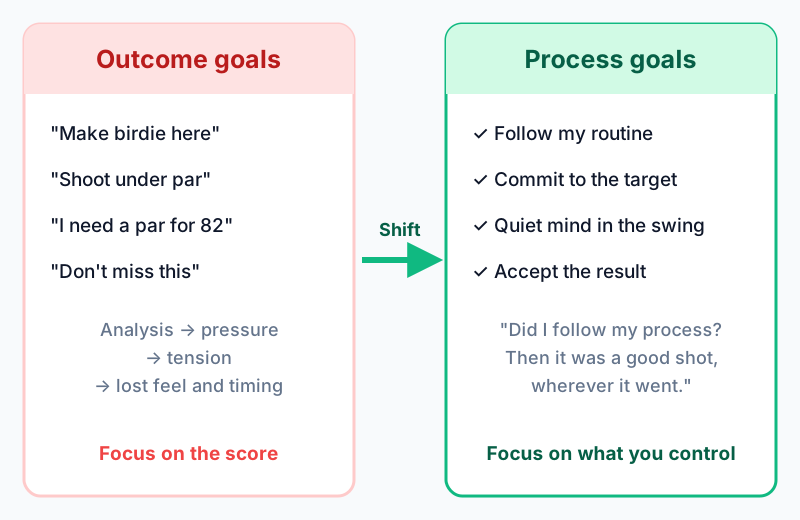
If you play golf thinking about your score, you'll often play worse. That sounds backwards, but it's a theme that runs right through sports psychology.
In Fearless Golf, Dr Gio Valiante argues that golfers who focus on process goals play more freely than those who focus on outcome goals. Process goals are about executing your routine, committing to targets and accepting outcomes. Outcome goals are about making birdie, shooting under par or winning.
Why Outcome Focus Hurts Performance
Thinking about outcomes switches on the analytical part of your brain: "I need a par here to shoot 82." That analysis creates pressure, pressure creates tension, and tension wrecks feel and timing.
This is how "choking" works. Your conscious mind takes over a task your body already knows how to do. Research published in the Journal of Experimental Psychology: General supports this "explicit monitoring" explanation. In experiments with golfers putting under pressure, paying attention to a skill that normally runs automatically made performance worse.
Every golfer knows the feeling. You stand over a 3-foot putt thinking "don't miss this", and suddenly your hands feel like they belong to someone else.
The Process Alternative
Instead of thinking about the result, think about the process.
- Before the shot: "I'm going to commit fully to my target and trust my routine."
- During the shot: Nothing. Quiet mind. Let the body work.
- After the shot: "Did I follow my process? Yes? Then it was a good shot, wherever it went."
This is hard to do, because your brain wants to keep score. With practice, though, the process mindset starts to feel natural, and good scores are more likely to follow.
Course Management as a Mental Skill
Plenty of golfers think course management is mainly about club selection. Much of it is really about managing your ego.
Aiming at a tucked pin instead of the centre of the green is usually an emotional decision rather than a strategic one. So is trying to carry 200 yards of water when a lay-up leaves you in perfect position.
The Smart Decision Framework
Before each shot, ask two questions:
- What happens if I hit this perfectly? (Best case)
- What happens if I miss it slightly? (Realistic case)
If the answer to question 2 is "I'm in the water" or "I'm in a bunker with no shot at the green", play the safe option. Tour pros aim at the fat part of the green far more often than the TV highlights suggest.
If you're working to break 100 or break 90, better decisions can save you as many shots as a swing change, and they're much quicker to learn.
Hero Shots vs Smart Shots
The hero shot feels great when it comes off. For many amateurs it rarely does, and the rest of the time it adds shots and kills your momentum.
Smart golf is boring golf: fairway, middle of the green, two putts, move on. It won't make good Instagram content, but it makes good scorecards.
5 Mental Game Exercises You Can Start Today
Theory only helps if you act on it. Here are five mental game drills you can add to your practice now.
Exercise 1: Box Breathing Between Shots
Box breathing is a simple paced-breathing technique for settling nerves.
- Breathe in for 4 seconds
- Hold for 4 seconds
- Breathe out for 4 seconds
- Hold for 4 seconds
Do one cycle as you walk between shots, especially after a bad one. Slow, controlled breathing helps you settle. A single round gives you dozens of chances to practise it, and with repetition it starts to happen without thinking.
Exercise 2: The Commitment Drill
Next time you play, set one rule before the round: once a club comes out of the bag, you hit that club. No putting it back, no second-guessing and no asking your mate what they think.
This drill trains decisiveness. Plenty of bad shots come less from picking the wrong club than from standing over the ball unsure whether you picked the right one. Indecision is poison for the swing.
Try it over 9 holes and count the holes where you kept the rule on every shot. That's your score out of 9.
Exercise 3: The Post-Round Review
After every round, write down three things:
- Three good shots: shots where you committed fully and went through your routine
- One lesson: one specific thing you learned about your game or your mental approach
- Nothing else: no dwelling on bad holes and no rehashing the triple bogey on the 12th. Three positives and one lesson, then you're done.
This trains your brain to look for evidence of competence instead of cataloguing failures. Over time, how you feel after a round shifts from "I played terribly" to "I hit some great shots and learned something".
Exercise 4: The Acceptance Practice
Before your next round, commit to accepting every shot without visible frustration. That means no club throws, no loud sighs and no head-shaking. Keep your posture relaxed between shots, especially after a poor one.
You're not trying to bottle up your emotions. You're breaking the physical habit of carrying frustration into the next shot. Your body language affects your mental state. Slumped shoulders and a tight jaw tell your brain things are going badly, while a relaxed posture tells it you're fine.
Start with 9 holes and count the holes you get through without a lapse. It's harder than it sounds, but it's the best way I know to stop one bad shot spoiling the next.
Exercise 5: The 5-Minute Visualisation Routine
Before your round, find a quiet spot, close your eyes and picture yourself playing the first three holes.
See the tee shot on the 1st: the flight and the landing. Walk yourself through your pre-shot routine. Feel the grip, see the target and hear the contact.
A 2013 meta-analysis of 75 brain-imaging papers found that imagining a movement consistently recruits a network that includes several brain regions used in actually performing it. Five minutes of this before a round is a simple way to get your head ready. It's free, needs no equipment and hardly anybody does it.
How Daily Practice Builds Mental Toughness
You can't work on the mental game once and tick it off the list. Like a muscle, it needs regular work.
That's why building a consistent practice habit matters beyond the physical side. Every day you turn up and practise, you prove to yourself that you're the kind of golfer who puts the work in. That change in how you see yourself is the foundation of mental toughness.
Picture yourself standing over a pressure putt on the 18th after practising your putting for 30 days in a row. Something is different. You're calmer, because you've put in the reps and earned the right to feel confident.
The streak itself becomes a mental edge. You think: "I've practised every day for 6 weeks. I'm prepared. I trust my stroke." That kind of self-talk can do more for you on the course than another swing tip.
If you're not already keeping track of your practice, start today. A simple streak, even 10 minutes of putting on the carpet, builds the daily discipline that feeds every other mental skill in this article.
Sources & Further Reading
- Dr Bob Rotella, Golf Is Not a Game of Perfect (1995): The foundational text on golf psychology and confidence
- Dr Gio Valiante, Fearless Golf (2005): Research on mastery vs ego orientation in competitive golfers
- Beilock & Carr (2001), "On the Fragility of Skilled Performance: What Governs Choking Under Pressure?," Journal of Experimental Psychology: General: The science of choking under pressure and explicit monitoring, tested with golf putting
- Brooks (2014), "Get Excited: Reappraising Pre-Performance Anxiety as Excitement," Journal of Experimental Psychology: General: Reframing anxiety as excitement to improve performance
- Rupprecht, Tran & Gröpel (2021), "The Effectiveness of Pre-Performance Routines in Sports: A Meta-Analysis," International Review of Sport and Exercise Psychology (University of Vienna summary): Evidence that routines improve performance across sports and skill levels
- Hétu et al. (2013), "The Neural Network of Motor Imagery: An ALE Meta-Analysis," Neuroscience & Biobehavioral Reviews: How imagining a movement recruits the brain's motor network
Related Articles
- Building a Consistent Golf Practice Habit: The daily habit that feeds confidence on the course
- The Seinfeld Strategy: Why Don't Break the Chain Works for Golf: How streak-based practice builds discipline and identity
- How to Break 90 in Golf: A step-by-step plan where mental game meets course management
- How to Break 100 in Golf: Smart decisions and mental discipline for high handicappers
- The 5-Minute Golf Warm-Up Routine: Physical and mental preparation before the first tee
- Golf Stretches and Exercises: The 15-Minute Flexibility Routine: Physical preparation that builds mental readiness
Frequently Asked Questions
How do I improve my golf mental game?
Start with a consistent pre-shot routine and use it on every shot, including on the range. Add 5 minutes of visualisation before each round, and focus on process goals rather than your score. The mental game improves with regular repetition, just like your swing. Keeping a practice streak builds the evidence that feeds confidence.
Why do I play better in practice than on the course?
Pressure changes how your brain runs the swing. In practice, the swing runs on autopilot. On the course, anxiety makes you monitor it consciously, and you start overthinking your mechanics. A pre-shot routine helps by recreating the feel of practice, signalling your brain to trust the swing it already has.
How do I stop thinking about my score during a round?
Switch to process goals. Instead of "I need a par", think "I'm going to commit to my target and trust my routine." Write your process goals on the scorecard before the round, and after each shot judge the process rather than the result. It takes practice, but it gets easier each round.
What is the best breathing technique for golf?
Box breathing works well between shots: breathe in for 4 seconds, hold for 4, breathe out for 4 and hold for 4. One cycle takes 16 seconds and helps you settle. Use it after bad shots, or before tense moments like the first tee or a big putt. The more you use it, the more natural it becomes.
How long does it take to improve your mental game in golf?
Many golfers notice a difference within a few rounds of using a pre-shot routine and breathing techniques consistently. Deeper changes, like bouncing back emotionally and thinking in terms of process, take weeks of deliberate practice. The mental game is a skill you build gradually, and regular practice gets you there sooner.
Can a pre-shot routine really help lower my scores?
It can. A consistent pre-shot routine cuts down on dithering, helps you manage nerves and sharpens your focus. A 2021 meta-analysis of pre-performance routines found athletes performed better with a routine than without one, in practice and in competition, at every skill level. Tour players lean heavily on theirs.
How do I recover mentally after a bad hole?
Use the 10-yard rule: give yourself 10 yards of frustration after a bad shot, then physically reset. Drop your shoulders, loosen your grip and take a deep breath. Remind yourself that the next shot is a separate event. The best golfers in the world make double bogeys too. The difference is they don't let one bad hole become three.
Is the mental game more important than technique?
Beyond a certain level, it often is. Dr Bob Rotella argues that many golfers have enough physical ability to play well but lack the mental discipline to use it consistently. A golfer with average technique and strong mental skills can often outscore a golfer with great technique and poor emotional control.
Disclaimer: This article is for informational purposes only and does not replace professional golf instruction. Individual results will vary based on ability, practice consistency, and physical condition. Consult a PGA professional for personalised swing advice.
Ready to build your practice streak?
Track your sessions, set goals, and improve with Green Streak — completely free.
Get Started Free