Off-Season Golf Practice Plan: How to Improve Through Winter
Many golfers stop practising when the clocks go back. This 12-week off-season plan covers putting, chipping, fitness and mental game. No course needed.

Quick Summary
- Skills get rusty without practice: a winter of doing nothing means spring starts with rebuilding rather than improving
- Four practice categories keep your whole game ticking over: indoor putting, garden chipping, fitness and flexibility, and mental game work
- A starter indoor setup costs less than two green fees: the £50 budget tier covers a putting mat, foam balls and a resistance band
- Log your winter sessions in the free Green Streak app and keep your streak alive until the course opens up again
October arrives and the clocks go back. For golfers in the UK and other northern climates, that means months of wet, cold, dark evenings and frozen fairways. Many golfers put the clubs in the garage and forget about them until April.
Quick Answer: Winter can decide how your next season starts. Skills fade when you stop using them, and many golfers find their touch on the greens goes first. A structured winter plan built on four pillars (indoor putting, garden chipping, golf-specific fitness and mental game work) takes 20-30 minutes a day and needs no course. Keep practising through winter and you'll start spring closer to where you finished. Log each session in Green Streak.
Table of Contents
- Why the Off-Season Is Your Biggest Opportunity
- How Quickly Do Golf Skills Decay Without Practice
- The 4-Pillar Winter Practice Framework
- Indoor Practice Setup on a Budget
- The Weekly Off-Season Schedule
- The Spring Ready 12-Week Programme
- Can I Use a Simulator for Winter Practice
- How to Maintain Your Streak Through Winter
- Motivation Strategies for Dark Evenings
- Sources & Further Reading
- Related Articles
- Frequently Asked Questions
Why the Off-Season Is Your Biggest Opportunity
The off-season doesn't have to be downtime. Used well, it's a chance to get ahead while others stop.
Plenty of golfers do no structured practice at all between October and March. They play their last round in autumn, put the clubs away and hope muscle memory carries them through the winter. It rarely does.
In the UK, the problem is worse. British winters are long and wet, and it's dark by 4pm. Many courses close or go to temporary greens, and the temptation to hibernate is strong. I live in the west of Scotland, so I know the feeling. Stepping outside in January to practise seems absurd when it's 3 degrees and the rain is horizontal.
That's exactly why winter practice is worth it. While plenty of others stop, you keep going. The skill decay section below explains why this matters. A golfer who stops completely tends to spend the first weeks of spring just getting back to where they were in October.
How Quickly Do Golf Skills Decay Without Practice
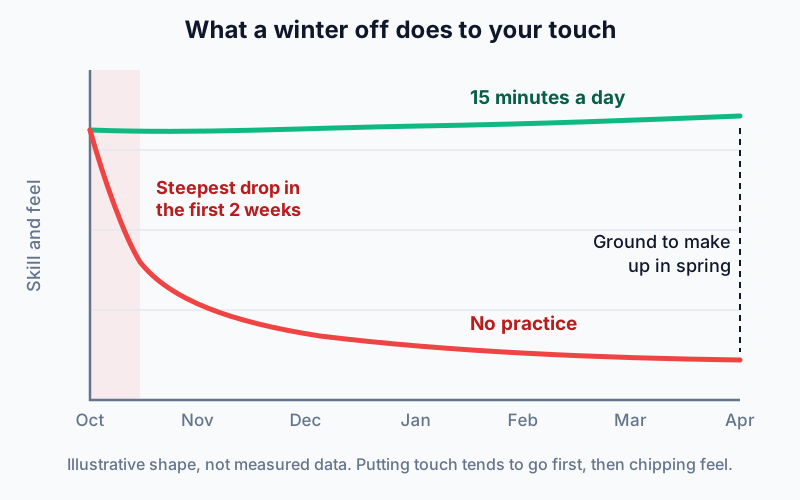
Skill decay is real: the longer you go without using a skill, the more of it you lose. Many golfers know the feeling of that first round back after a long break.
What does that mean in golf terms? Many golfers find putting touch goes first. Proprioception (your body's sense of its own position and movement) is sharpest when you use it regularly. Chipping feel tends to follow. Full swing mechanics usually hold up better, but even those get rusty over a long break.
Mental rehearsal can help fill the gaps. A meta-analysis of 75 brain-imaging papers found that imagining a movement consistently recruits a network that includes several brain regions used in actually performing it. It's no substitute for physical practice, but it keeps the pattern ticking over.
So you don't need to practise for hours. You need to practise consistently. Even 15 minutes a day keeps your touch far more alive than doing nothing.
Want to fight skill decay this winter? Log every off-season session in the free Green Streak app. The daily habit keeps your game ticking over while the course is frozen.
The 4-Pillar Winter Practice Framework
You don't need a course or good weather. You need a living room, a garden (even a small one) and 20-30 minutes.
Pillar 1 — Indoor Putting
Putts make up a big share of every round, and putting is the easiest skill to practise indoors. A hallway, a flat carpet or a putting mat gives you everything you need.
Focus on two things through winter: speed control and short putts inside 6 feet. Speed control carries over well from carpet to green because it trains your internal sense of distance. Short putts build confidence you'll be glad of in April.
Aim for 50-100 putts per session, 3-4 times a week. That takes 10-15 minutes. Keep a mat rolled out in a home office or spare corner and you can roll putts between calls. If the mat is already out, you'll use it. See my full guide to putting drills you can do at home for specific routines.
Pillar 2 — Chipping in the Garden
Even a 16-foot (5 m) strip of garden is enough for chipping practice. Use foam balls or low-flight practice balls if space is tight. They fly roughly a third as far as a real ball, so you can chip into a net or bucket without worrying about the neighbour's greenhouse.
Work on three shots: the bump-and-run with a 7-iron, the standard chip with a pitching wedge, and the lob with a sand wedge. Rotate through all three. Twenty minutes twice a week keeps your short game touch alive.
Cold hands are the enemy here. A pair of winter golf gloves (£10-15) helps, and so does picking the dry afternoons when you can. Even once a week outdoors makes a difference.
Pillar 3 — Fitness and Flexibility
Winter is a good time to build a physical base. You're not tired from playing rounds, and you have months before the season starts.
Golf-specific fitness focuses on three areas. Rotational power is the ability to turn your torso fast. Hip mobility lets you make a full backswing. Core stability helps protect your lower back from the forces of a full swing. A basic routine using bodyweight exercises and resistance bands takes 15-20 minutes and covers all three. My dedicated stretches and exercises guide has the full routine.
A systematic review in the Journal of Strength and Conditioning Research looked at programmes combining general and golf-specific strength training. They increased clubhead speed by an average of 4.1% and hitting distance by 5.2%, with 8-week programmes the most effective. Speed you build over winter is ready to use in spring.
Pillar 4 — Mental Game and Visualisation
The mental side of golf is easy to neglect. Winter suits it well, because mental training needs no equipment and no outdoor space.
Here are three exercises to build into your week:
-
Pre-shot routine rehearsal: Stand in your living room and run through your full pre-shot routine 10 times. Pick a target on the wall and go through every step: visualise the shot, take your practice swing, address the ball and pull the trigger. Rehearsing it this often helps the routine feel automatic when the pressure's on.
-
Course visualisation: Close your eyes and play your home course hole by hole. See the tee shot, pick the target and watch the ball flight. Walk up to the approach, decide the club, hit it and putt out. Imagining a movement recruits many of the same brain regions used to perform it, so vivid mental rehearsal is time well spent.
-
Strategy journaling: Write down three bad decisions from your last few rounds and what you'd do differently. This kind of reflection sharpens the course management that saves shots.
Building winter habits? The free Green Streak app logs putting, chipping, strength and flexibility sessions by category. You can see where your time goes and make sure no pillar gets neglected.
Indoor Practice Setup on a Budget
You don't need to spend a fortune. Here are three tiers to suit different budgets.
| Tier | Budget | What You Get | Best For | |------|--------|-------------|----------| | Starter | £50 | Putting mat, foam balls (pack of 12), resistance band set | Golfers trying winter practice for the first time | | Committed | £200 | Quality putting mat, chipping net, foam balls, yoga mat, band set | Golfers who want to cover all 4 pillars at home | | All-In | £800 | Premium putting mat, hitting net and mat, launch monitor (budget), full fitness kit | Golfers building a permanent home practice space |
The Starter Tier
A basic putting mat (6-8 feet long) and a dozen foam practice balls cost under £50 combined. Add a set of resistance bands for £10-15 and you have enough for putting, indoor chipping and basic fitness work. That covers most of what you need for winter.
The Committed Tier
Step up to a quality putting mat with a true-roll surface, add a pop-up chipping net for the garden and a yoga mat for stretching. At this level, you can run every session from the 4-pillar framework at home. A practice net in the garage opens up full swings too, if you have the ceiling height.
The All-In Tier
For £800, you can build a proper indoor hitting station. A quality hitting net, a turf mat and a budget launch monitor give you full swing data and feedback. My complete guide to building a DIY simulator goes further if you want it. But you don't need to spend this much to improve through winter. I'd back the starter tier, used consistently, over the all-in tier gathering dust.
The Weekly Off-Season Schedule
Here's a sample 6-session week that covers all four pillars. Each session takes 15-25 minutes.
| Day | Focus | Session | Time | |-----|-------|---------|------| | Monday | Putting | Speed control drills, 3-foot gate drill | 15 min | | Tuesday | Fitness | Rotational power, hip mobility, core work | 20 min | | Wednesday | Chipping | Bump-and-run, standard chip (garden or foam balls indoors) | 15 min | | Thursday | Mental Game | Course visualisation + strategy journaling | 15 min | | Friday | Putting | Long putt lag drill, pressure putting (10 in a row from 4 feet) | 15 min | | Saturday | Fitness + Flexibility | Strength session plus full stretching routine | 25 min | | Sunday | Rest or free practice | Play a round if the weather allows, or just hit a few chips | Optional |
The schedule is flexible, so move sessions around to fit your week. My one rule is not to skip two days in a row. Back-to-back missed days are how streaks quietly end.
The 19th Hole: My own scoring history shows how easily a golfer can stand still. I've logged every round in a scoring app since January 2023. My average in 2024 was 22.2 over par. In 2025 it was 22.1. That's two full seasons with a tenth of a shot to show for it. The drop only came in 2026, when my average fell to 19.9 over par. I can't pin that on any single winter, and I won't pretend otherwise. But a flat line like mine is what you get when every spring starts from roughly the same place as the last one. The off-season is where you decide whether this spring starts somewhere new.
The Spring Ready 12-Week Programme
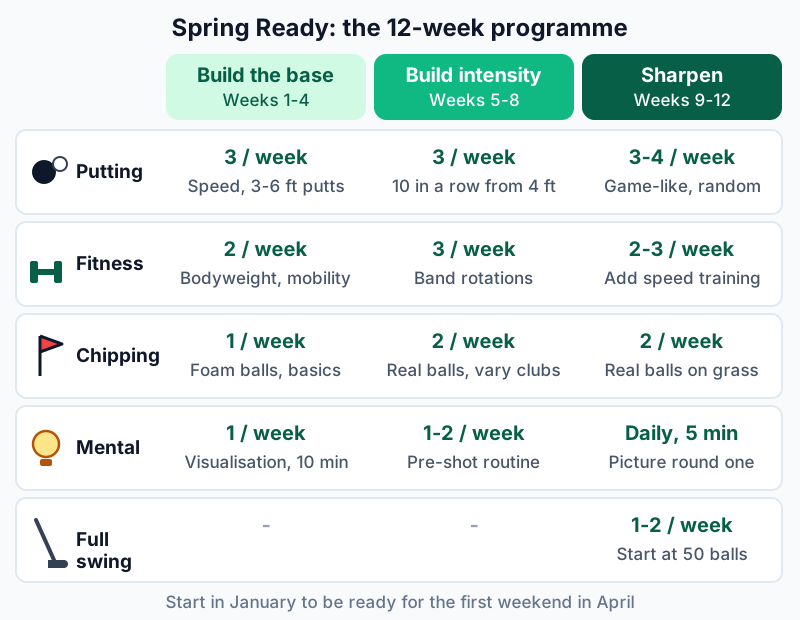
Start this programme in January and you'll be ready for the first weekend in April.
Weeks 1-4 — Build the Base
- Putting: 3 sessions per week (focus on speed control and 3-6 foot putts)
- Fitness: 2 sessions per week (bodyweight exercises, hip mobility, stretching)
- Chipping: 1 session per week (foam balls, basic technique maintenance)
- Mental: 1 session per week (course visualisation, 10 minutes)
The goal here is building the habit, so don't worry about intensity. Show up every day and log your session.
Weeks 5-8 — Build Intensity
- Putting: 3 sessions (add pressure drills: make 10 in a row from 4 feet before stopping)
- Fitness: 3 sessions (add resistance band rotational exercises, increase reps)
- Chipping: 2 sessions (if the weather allows, use real balls in the garden; add variety with different clubs)
- Mental: 1-2 sessions (add pre-shot routine rehearsal to visualisation)
By now the habit should be in place, so make each session slightly harder. Keep a note of your putting numbers too: how many 3-footers out of 20 are you holing?
Weeks 9-12 — Pre-Season Sharpening
- Putting: 3-4 sessions (game-like scenarios, random distances, breaking putts if your mat allows)
- Fitness: 2-3 sessions (maintain the base, add speed training with an inverted club or speed stick)
- Chipping: 2 sessions (move to real balls on real grass as the weather improves)
- Full swing: 1-2 sessions at the range or on a simulator if available
- Mental: Daily 5-minute visualisation of your first round back
This final phase moves you from maintenance to readiness. If you have access to a range or simulator, bring full swings back gradually. Don't go from zero to 200 balls in one session. Start with 50 and build up.
Can I Use a Simulator for Winter Practice
Yes. A home simulator is the closest thing to playing a real round when it's dark and freezing outside. A basic setup with a net, a mat and a budget launch monitor starts at around £800.
If you already have a hitting bay, a budget launch monitor like the Garmin Approach R10 or Rapsodo MLM2PRO adds shot data, club speed and even virtual courses. My DIY simulator build guide walks through every step, from budget to premium setups.
That said, a simulator is a luxury rather than a necessity. Everything in the 12-week programme above works without one. If you have the budget, a simulator makes winter practice more engaging and gives you full-swing feedback you can't get from a net alone. If you don't, the four-pillar framework covers everything except full-swing feedback, and full-swing mechanics tend to hold up best over winter anyway.
How to Maintain Your Streak Through Winter
The biggest challenge of off-season practice is motivation, not equipment. Nobody is posting their Saturday round scores or asking what you shot. The outside accountability disappears.
That's why tracking matters. I built Green Streak to make practice a daily habit, and winter is when that habit is hardest to keep. Once you've got a 30-day streak on the screen, you'll want to protect it, even on a cold Tuesday evening when the sofa is calling.
Here's what I'd count as a session in the off-season:
- 50 putts on a mat (10 minutes)
- 20 chips in the garden (10 minutes)
- A 15-minute stretching and mobility routine
- 10 minutes of mental visualisation
- A full gym session with golf-specific exercises
- A range or simulator visit
Any of those counts. The bar is low on purpose, because consistency matters more than perfection.
Motivation Strategies for Dark Evenings
British winter evenings test even the most committed golfer. It's dark by 4pm and cold, and the last thing you want to do is pick up a wedge. Here are some strategies that help.
Pair Practice With Something You Already Do
Put the putting mat next to the TV and roll putts during the football. Do your stretching routine while watching golf highlights. Tying a new habit to an existing one is one of the most reliable ways to make it stick. Research in the European Journal of Social Psychology found it took an average of 66 days for a daily behaviour, done in the same context each day, to become automatic. The range was 18 to 254 days.
Set a Minimum Viable Session
On the worst days, your session might be 10 putts and a 5-minute stretch. That's fine. The goal is keeping the streak going, not peak performance every day. A 5-minute session on a bad day beats doing nothing.
Use the Data as Fuel
Keep a note of your putting make percentage over the weeks. If you see it climb from 60% to 75% on 4-foot putts, the progress becomes its own motivation. Seeing a number improve is a strong reason to keep going.
Find an Accountability Partner
Tell a golfing mate about your winter plan, or better still, get them to do it with you. Comparing streaks adds a bit of friendly pressure, because nobody wants to be the one who breaks first.
Sources & Further Reading
- Lally et al. (2010), "How Are Habits Formed: Modelling Habit Formation in the Real World," European Journal of Social Psychology: The 66-day habit formation research
- University of Surrey, "Does It Really Take 66 Days to Form a Habit?": Dr Pippa Lally on the 66-day average and the 18-254 day range
- Uthoff et al. (2021), "Effects of Resistance Training Methods on Golf Clubhead Speed and Hitting Distance: A Systematic Review," Journal of Strength and Conditioning Research: Clubhead speed and distance gains from strength training
- Hétu et al. (2013), "The Neural Network of Motor Imagery: An ALE Meta-Analysis," Neuroscience & Biobehavioral Reviews: How mental rehearsal engages the brain's motor network
- Golf Monthly Winter Practice Tips: UK-focused winter practice guidance
Related Articles
- The Complete Guide to Practicing Golf at Home: The pillar guide to home practice covering every skill and budget
- Best Putting Drills at Home: 10 Drills for Speed and Start Line: Specific putting routines for your indoor sessions
- Best Golf Nets for Garage Practice: A buyer's guide to hitting nets for home practice
- Golf Stretches and Exercises: The 15-Minute Flexibility Routine: The fitness routine referenced in the winter framework
- Best Putting Mats for Home Practice: Side-by-side putting mat comparison for your indoor setup
- Building a Consistent Golf Practice Habit: The science behind daily consistency and streak-building
- Golf Strength Training: Essential Exercises for More Distance
Frequently Asked Questions
How long does it take for golf skills to come back after winter?
It varies, but many golfers need a few weeks of regular play to get back to their pre-winter form. If you've kept an off-season routine going, you'll usually have less ground to make up. Structured winter practice can spare you a lot of spring rust.
Can I really improve my golf without playing a round?
Yes. Putting, chipping, fitness and mental game work can all be trained without setting foot on a course. Putting and chipping in particular carry over well from indoor practice to the course. You can come back in spring with a sharper short game even after months without a round.
What is the minimum I should practise in the off-season?
I'd aim for at least three 15-minute sessions a week. That's 45 minutes in total, less than a single trip to the driving range. Even that small commitment keeps your touch far fresher than stopping altogether.
Is foam ball practice effective for chipping?
Foam balls work well for keeping your chipping technique in shape. You can still feel fat and thin strikes, and they're safe indoors and in small gardens. They travel about a third as far, so a 30-yard chip becomes a 10-yard foam ball shot. The swing itself is the same.
Do I need a putting mat or can I use the carpet?
Carpet works fine, especially for speed control practice. A putting mat adds consistency and a truer roll that's closer to a real green. If money is tight, start with carpet. Speed control drills on carpet carry over well, because the skill is about your internal sense of distance rather than the surface. Upgrade to a mat when you're ready to work on alignment and line.
How do I stay motivated to practise golf in winter?
Track your sessions somewhere you can see them. A streak app or wall calendar creates the "don't break the chain" effect that keeps you going on dark evenings. Pair practice with existing habits like watching TV, and set a minimum session of 5-10 minutes. Keeping a note of numbers like your putting make percentage also helps you see progress.
Should I take lessons during the off-season?
The off-season is a good time for lessons. Your pro can work on swing changes without the pressure of an upcoming round, and you have months to bed in new mechanics before the season. Some teaching pros offer lower rates in winter when demand drops. If you're considering a swing change, start it in November so it feels natural by April.
What should I focus on first — putting, chipping, or fitness?
Start with putting. It needs the least equipment, fits into the smallest space and packs plenty of reps into a short session. Putts make up a big share of every round, and indoor putting practice carries over well to the course. Add fitness in week 2, chipping in week 3 and mental game work in week 4 as you build the habit gradually.
Disclaimer: This article is for informational purposes only and does not replace professional golf instruction. Individual results will vary based on ability, practice consistency, and physical condition. Consult a PGA professional for personalised swing advice.
Ready to build your practice streak?
Track your sessions, set goals, and improve with Green Streak — completely free.
Get Started Free