How to Break 100 in Golf: The Strategy Guide for High Handicappers
You don't need a single par to break 100. Learn the maths, course strategy, and mental approach that turns triple bogeys into doubles and doubles into bogeys.

Quick Summary
- You can shoot 99 with no pars at all: nine bogeys and nine double bogeys on a par 72 gets you there, with no heroics required
- Penalty strokes wreck scorecards: every ball out of bounds or in the water costs you at least a stroke, and often turns a bogey into a triple
- Putt from off the green: a bad putt might finish 5 feet past, but a bad chip can fly 30 yards over or move 2 feet
- Follow a plan: the free Green Streak app has a Break 100 in 8 Weeks programme and logs your practice streak
You've just finished a round, added up the numbers and landed on 107 again. You hit a few good shots and even had a couple of decent holes. But somewhere around the 12th, things fell apart and a triple bogey turned into a snowman.
Quick Answer: To break 100 on a par-72 course, you need to finish 27 over par or better. That means you can make nine bogeys (one over par) and nine double bogeys (two over par) and still card a 99, without a single par. Keep the ball in play off the tee, aim for the centre of every green and cut out three-putts (taking three putts on one hole). Many golfers break 100 by avoiding big numbers rather than hitting great shots.
Table of Contents
- The Maths Behind Breaking 100
- Why Can't I Break 100?
- Tee Shot Strategy
- Approach Shot Strategy
- Short Game Strategy
- Putting Strategy
- Do I Need to Hit Pars to Break 100?
- Mental Game
- Practice Plan for Breaking 100
- Common Mistakes That Keep You Above 100
- Sources & Further Reading
- Related Articles
- Frequently Asked Questions
The Maths Behind Breaking 100
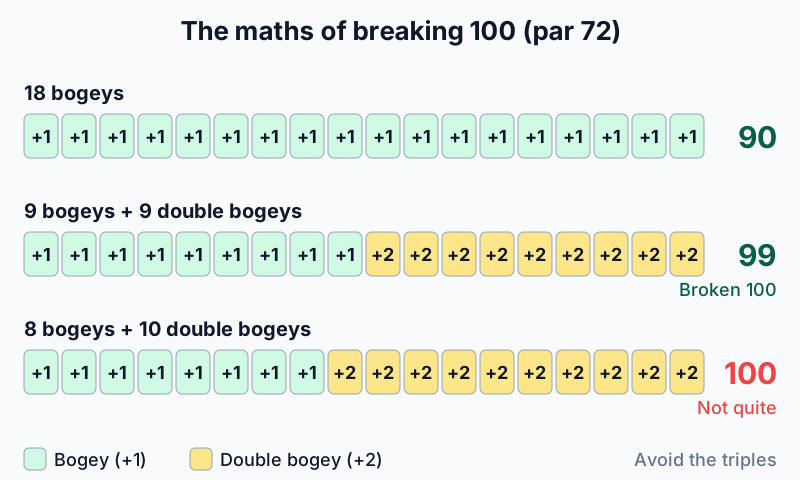
First, let me show you why this is more achievable than you think.
On a par-72 course, breaking 100 means shooting 99 or lower. That's 27 over par, or an average of 1.5 over par per hole.
Here's what that looks like in practice:
| Hole Type | Par | Your Target Score | How to Get There | |-----------|-----|-------------------|------------------| | Par 3 (typically 4 holes) | 3 | 4 (bogey) | Get near the green. Chip or putt on. Two-putt. | | Par 4 (typically 10 holes) | 4 | 5 or 6 (bogey or double) | Drive in play. Advance towards the green. Chip on. Two-putt. | | Par 5 (typically 4 holes) | 5 | 7 (double bogey) | Treat it like a par 6 or 7. Three or four comfortable shots to reach the green. Two-putt. |
With those targets, you'd card 99 as long as at least half of your par 4s are bogeys. Turn a few more par 4s into bogeys and you have room for a couple of bad holes without wrecking your round.
So you're not trying to make pars. You're trying to avoid triple bogeys (three over par) and worse. Every time you turn a triple into a double, you save a stroke. Do that four times in a round and you've knocked four shots off your score.
Why Can't I Break 100?
If you've been stuck above 100 for a while, your decisions may be costing you more than your swing.
For golfers scoring between 100 and 110, a lot of the damage tends to come from penalty shots and unforced errors. Think tee shots out of bounds, approaches into water and chips skulled across the green. Shot Scope data shows the average 25-handicapper hits only 50% of fairways and 9% of greens in regulation. That leaves plenty of chances for one mistake to snowball.
Many golfers above 100 try to play shots they haven't practised. They pull out the driver on every hole, aim at tucked flags and try hero recovery shots from behind trees.
Stop doing that. The route to breaking 100 is patient, sensible golf, and it works.
Just starting out? The free Green Streak app helps you build a daily practice habit from day one. Even 10 minutes of putting counts.
Tee Shot Strategy
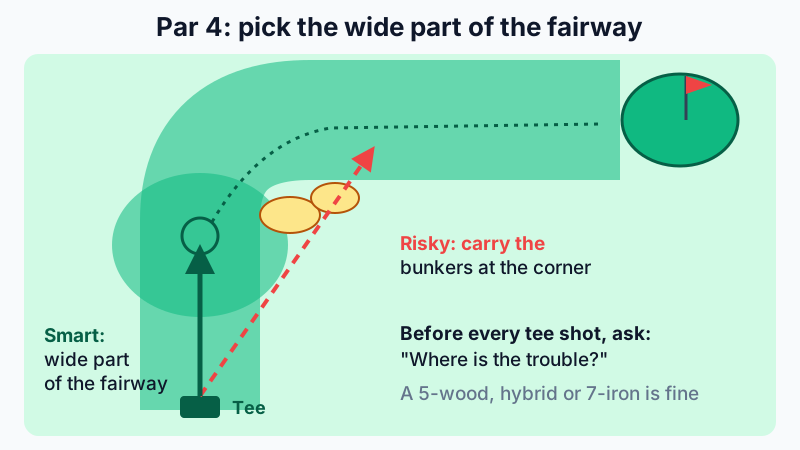
The tee shot sets up everything. When you're trying to break 100, the first priority is finding grass, not distance.
Find the Fairway, Forget the Distance
If your driver regularly goes out of bounds or into the trees, leave it in the bag. I mean it. A 5-wood, hybrid or even a 7-iron off the tee is a perfectly sensible play.
Being 170 yards from the green in the fairway is far better than hitting 250 yards out of bounds. Under stroke and distance (a one-stroke penalty plus replaying from where you last hit), you're playing your third shot from the tee.
The Tee Shot Decision
Ask yourself one question before every tee shot: "Where is the trouble?"
If there's water left and trees right, aim for the centre of the fairway with whatever club keeps you away from both. On tight holes, a smooth hybrid to 160 yards is a good play.
The PGA Tour average for fairways hit is around 59%, so even tour professionals miss roughly 40% of the time. If they miss fairways, you will too. Pick the club that gives you the best chance of staying in play.
Approach Shot Strategy
Once you're in the fairway (or the rough, no judgement), the approach shot is where many high handicappers make their biggest strategic mistake. They aim at the flag.
The Traffic Light System
Think of every approach shot as a traffic light:
- Green light: the flag is in the centre of the green with no trouble nearby. Aim at the flag, take one extra club and swing smoothly.
- Red light: the flag is tucked behind a bunker, near water or on the edge of the green. Aim for the fat part of the green, the middle, and forget the flag is there.
Often you'll be looking at a red light, and that's fine. A ball on the green 30 feet from the hole is far better than a ball in the bunker 10 feet from it.
Take One More Club
Whatever club you think you need, go one up. If you're thinking 7-iron, hit a 6-iron with a smoother swing.
Many amateur golfers don't hit their clubs as far as they think. Arccos shot data shows golfers routinely overestimate their distances: a bogey golfer typically hits 7-iron from 162 yards, but their median 7-iron travels just 140. Swinging easier with more club tends to give you better contact and more consistent results.
Short Game Strategy
For a high handicapper, this is where strokes are saved or thrown away, and the advice is simple.
Putt Everything Near the Green
If you're within 5 yards of the green and the grass between you and the putting surface is reasonably short, use your putter.
The bad outcomes are very different:
- A bad putt from off the green might finish 5-8 feet past the hole. You still have a putt for bogey.
- A bad chip gets chunked (the club digs in and the ball moves 2 feet) or skulled (the club catches the ball too high and it shoots across the green). Either one can lead to a double or triple bogey.
Putting takes the disaster out of it. It won't look like what you see on TV, but it keeps the big numbers off your card.
When You Must Chip
Sometimes you can't putt, because the grass is too long or too wet. If there's nothing but grass between you and the green, use a simple bump and run. Take your 8-iron or 9-iron, grip down and make a putting-style stroke. Good solid contact matters more than technique here.
The ball pops up, lands on the green and rolls towards the hole. No wrist flick and no lob shot. If a bunker is in the way, take a lofted wedge and just aim to land the ball in the middle of the green.
Want a plan to follow? The free Green Streak app logs your practice sessions and drill scores, so you can see your short-game practice adding up week by week.
Putting Strategy
Three-putts quietly wreck scores. You might not notice them happening, but they add up quickly. Three-putt four greens in a round and you've added four unnecessary strokes.
Eliminate the Three-Putt
The goal isn't to hole more putts. It's to stop three-putting. And three-putts usually happen because your first putt finishes too far from the hole.
The 3-foot circle rule: on every putt longer than 15 feet, your only job is to roll the ball inside a 3-foot circle around the hole. If you can reliably two-putt from 15 feet and beyond, three-putts start to disappear from your card.
Speed Over Line
On long putts, speed matters far more than direction. A putt on the right line that finishes 10 feet short or long leaves you a real chance of a three-putt. A putt that's slightly off line but with perfect speed will finish close to the hole.
Before putting, take two practice strokes while looking at the hole, not the ball. Feel the distance, then step up and repeat that stroke.
The 19th Hole: In June 2025 I played 72 holes in a day for prostate cancer. My first round was exactly 100. My next three were 88, 92 and 92, on the same course, on the same day. I didn't rebuild my swing between the first round and the second. That's why this guide is about decisions and big numbers rather than swing changes. At this level, a lot of shots can hide in how you manage the course, as well as in how you hit the ball.
Do I Need to Hit Pars to Break 100?
No, and this is the point many golfers miss.
You can shoot 99 without a single par on your card: nine bogeys and nine doubles. If you make a par along the way, great. But you don't need to chase them.
Chasing pars is often what keeps golfers above 100. They try to reach a par 5 in two and end up in the water. They aim at a tight flag and short-side themselves in a bunker. They try to birdie one hole to "make up" for a bad one.
Golfers who break 100 usually aren't hitting great shots. They're avoiding terrible ones. For many golfers, the difference between 100 and 95 comes from fewer blow-up holes rather than more brilliant ones.
Mental Game
At this stage, your mental game matters as much as your swing. One bad hole can spiral into four if you let it.
The Goldfish Memory
Be a goldfish, with a short memory. If you make a 9 on the 4th hole, it happened. You can't go back and fix it.
The trap many golfers fall into is trying to "make up for it". They've just made an 8, so they pull driver and try to crush it on the next hole. That usually leads to another bad score.
After a bad hole, take a breath, reset and play the next hole as if it's a fresh round. Your goal on the next hole is the same as on every other: bogey or double bogey.
Play One Shot at a Time
This sounds obvious, but many golfers are thinking three shots ahead. Standing over their tee shot, they're already planning their approach, then their putt.
Think only about the shot in front of you. Where is the safe target, and which club gets you there? That's all.
Accept Your Level
This is hard to hear, but it matters. Right now, you're not a par golfer. You're a bogey-and-double golfer, and that's fine. Plenty of single-figure golfers started exactly where you are.
The Seinfeld Strategy fits well here. Show up, do the work and stay consistent.
Practice Plan for Breaking 100
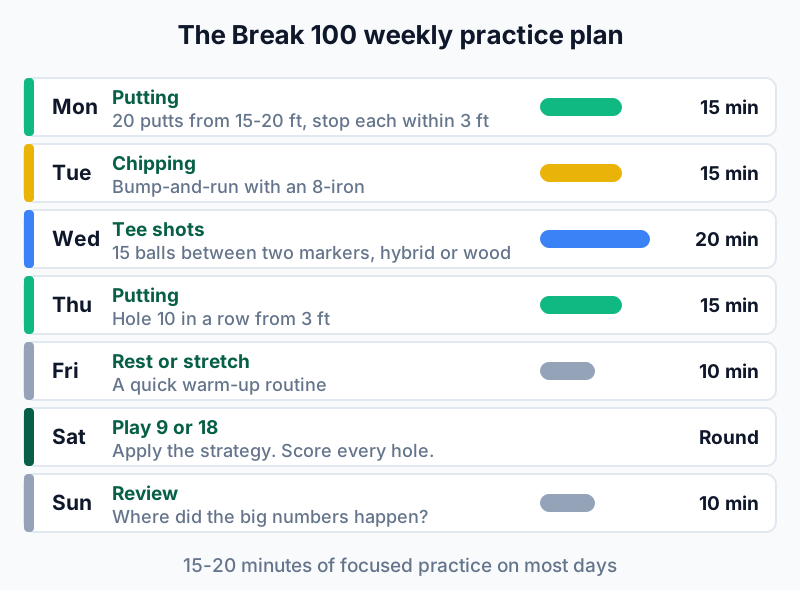
You don't need hours at the range. You need 15-20 minutes of focused practice on most days.
The Break 100 Weekly Practice Plan
| Day | Focus | Duration | What to Do | |-----|-------|----------|------------| | Monday | Putting | 15 min | Roll 20 putts from 15-20 feet, trying to stop each one within 3 feet of the target | | Tuesday | Chipping | 15 min | Bump-and-run with 8-iron from just off a green or on your lawn | | Wednesday | Tee shots | 20 min | Pick two markers as the edges of a fairway. Hit 15 balls with your hybrid or fairway wood and count how many finish between them | | Thursday | Putting | 15 min | Practise 3-foot putts. Hole 10 in a row before you stop. | | Friday | Rest or stretch | 10 min | A quick warm-up routine keeps your body loose | | Saturday | Play 9 or 18 | - | Apply the strategy. Score every hole. | | Sunday | Review | 10 min | Look at your scorecard. Where did the big numbers happen? |
If you can't get to a course or range, practise at home. A hitting net in your garage lets you work on contact, and a carpet and a golf ball are all you need for putting.
Consistency matters most. I'd take four 15-minute sessions a week over one 2-hour range blast.
Turning the Weekly Plan Into an 8-Week Programme
Repeating the same week gets stale, so I split the next two months into four phases. Each one keeps the weekly rhythm above but gives your round a single job.
| Weeks | Focus | Your job on the course | |-------|-------|------------------------| | 1-2 | Kill the three-putt | Count your putts. From beyond 15 feet, finish inside 3 feet. | | 3-4 | Simplify the short game | Putt from anywhere near the green. Chip only when you must. | | 5-6 | Find the fairway | Ask "where is the trouble?" on every tee and pick the safe club. | | 7-8 | Play the percentages | Traffic light approaches, one more club, and a goldfish memory. |
One focus at a time is easier to stick to than all of them at once. By week 8, each habit has had its own fortnight.
Want it laid out for you? The Break 100 programme in the Green Streak app gives you each session with the drills to do. It ticks off your progress as you go.
Common Mistakes That Keep You Above 100
The same patterns come up again and again from golfers stuck above 100. Here are the biggest ones.
Hitting Driver on Every Hole
Not every hole needs a driver. Par 3s obviously don't, and plenty of par 4s are better played with a hybrid off the tee. If a hole is tight or has trouble down one side, a shorter, straighter club saves strokes.
If your driver gives you trouble, work on fixing your slice before you rely on it in rounds.
Aiming at the Flag
The flag is a trap for high handicappers, because it's often near trouble. Aim for the centre of the green and give yourself a putt. Even a 40-footer is better than a greenside bunker.
Trying Hero Recovery Shots
Your ball is behind a tree. There's a 3-foot gap between two branches, and you'd need a low draw that curves 30 yards around the trunk.
Don't try it. Chip out sideways and take your medicine. Accept the dropped shot rather than gamble on something with a tiny chance of working and a good chance of making things worse.
Not Keeping Score Honestly
This one is tough, but count every stroke, every penalty and every whiff. If you don't keep an honest score, you don't know where you're losing strokes, and you can't fix what you can't see.
A GPS watch can help you learn your real distances, which feeds straight into better club selection.
Practising the Wrong Things
Many golfers above 100 spend all their practice time on the driving range hitting full shots. But a big share of your strokes are played inside 100 yards. Putting, chipping and short approaches are often where the easiest shots are to be saved.
Flip the ratio. Spend 60% of your practice time on your short game and 40% on full shots.
Sources & Further Reading
- USGA Handicap Research and Data: statistics on amateur scoring patterns and handicap distribution
- GOLF.com: 2025 USGA Handicap Report Facts: average Handicap Index figures for men and women
- Arccos: Know Your Club Distances With Smart Distance: how far golfers think they hit each club versus how far they actually hit it
- Golf Monthly: How Many Fairways Does the Average PGA Tour Player Miss?: tour driving accuracy data
- Shot Scope: 25 Handicap Law of Averages: fairways, greens and short game benchmarks for 25-handicappers
- PGA of America Teaching Resources: professional instruction methodology and distance data
- Golf Monthly Instruction and Tips: technique guides and amateur scoring analysis
- Golf Digest Improvement Resources: articles on scoring patterns and common amateur mistakes
Related Articles
- The Seinfeld Strategy: Why "Don't Break the Chain" Works for Golf
- Stop Topping the Golf Ball: Drills That Fix It Fast
- How to Fix Your Golf Slice: A Simple Drill That Works
- Best Golf Nets for Garage Practice
- The 5-Minute Golf Warm-Up Routine
Frequently Asked Questions
How long does it take to break 100 in golf?
There's no fixed timeline. It depends on how often you play and whether you practise with a purpose. Four 15-minute focused sessions a week, plus one round and the course strategy in this guide, is a realistic way to work towards it.
What handicap is a golfer who shoots 100?
A golfer who regularly shoots around 100 on a par-72 course typically has a Handicap Index somewhere in the 20s, depending on how difficult their courses are. For comparison, the USGA's 2025 figures put the average Handicap Index at 14.0 for men and 28.8 for women. As you break 100 more often, those better rounds start to count and your handicap comes down.
Should I take lessons to break 100?
Lessons can help, especially if you have a consistent miss like a slice or a top. But you can also break 100 through smarter course management. If you make decent contact most of the time, strategy and short-game practice may be enough. Save lessons for specific problems you can't fix on your own.
What clubs do I actually need to break 100?
You don't need 14 clubs. A driver or fairway wood, a hybrid, a 7-iron, a 9-iron, a pitching wedge, a sand wedge and a putter will cover most situations you face. A simpler bag means fewer decisions on the course and more time to get comfortable with each club.
Can I break 100 without hitting the ball far?
Yes. A golfer who hits it 180 yards straight off the tee will often beat one who hits it 250 yards but only finds the fairway half the time. At this level, accuracy and avoiding penalties matter far more than raw distance.
What is the most important skill for breaking 100?
I'd say putting and chipping. If you can two-putt reliably and avoid chunking or skulling chips, you'll cut out many of the big numbers that keep you above 100. For golfers at this level, a lot of the blow-up holes start around the green.
How many putts per round should I aim for?
Rather than chasing a putts-per-round number, aim to cut your three-putts. Shot Scope data shows the average 25-handicapper three-putts 13% of the time, which works out at more than two per round. Every one you remove is a stroke off your score. Work on lag putting (getting your first long putt close) rather than trying to hole everything.
What should I do after a bad hole?
Forget it. Take a breath, walk to the next tee and play that hole with a fresh mind. The biggest mistake is trying to "get those shots back" by taking risks. Play your normal game. A bogey on the next hole is a great recovery, and you don't need a birdie.
Disclaimer: This article is for informational purposes only and does not replace professional golf instruction. Individual results will vary based on ability, practice consistency, and physical condition. Consult a PGA professional for personalised swing advice.
Ready to build your practice streak?
Track your sessions, set goals, and improve with Green Streak — completely free.
Get Started Free