How to Hit Your Irons Consistently: The Complete Guide
Poor iron contact costs amateurs more shots than they realise. Learn the setup, drills and practice plan that deliver ball-first strikes every time.
Quick Summary
- Ball-first contact is the foundation of good iron play, and it comes down to where your club meets the ground
- Shaft lean at impact matters: your hands should be ahead of the clubhead when you strike the ball, which creates a descending blow
- 5 specific drills each target a different contact fault, and a couple of them can be rehearsed at home without a ball
- Log your drill sessions in the free Green Streak app to build a steady practice habit
You've just flushed a 7-iron pin-high, and it felt pure. On the very next hole, with the same club and the same swing thought, you hit it fat and watch it land 40 yards short. You'd trade your driver for consistent irons in a heartbeat.
Quick Answer: Consistent iron striking comes from ball-first contact: the club hits the ball before the turf, and the divot starts in front of where the ball sat. TrackMan says your iron low point should read "A" (after the ball), while many amateurs bottom out behind it. The fix starts with ball position, hands ahead of the clubhead at impact (shaft lean) and weight moving to your lead side. Five drills below target each part.
Table of Contents
- What Does Consistent Iron Contact Actually Mean?
- Why Do I Hit My Irons Inconsistently?
- The Setup Fundamentals for Pure Iron Shots
- The Key Move: Hands Ahead at Impact
- How to Transfer Your Weight Without Swaying
- 5 Drills for Consistent Iron Contact
- Ball Position Chart by Club
- Common Iron Mistakes and How to Fix Them
- Your 4-Week Iron Improvement Plan
- Sources & Further Reading
- Related Articles
- Frequently Asked Questions
What Does Consistent Iron Contact Actually Mean?
Plenty of amateurs think the goal with an iron is to hit the ball and then the ground. Others try to scoop the ball into the air. Neither is right.
Consistent iron contact means the clubhead strikes the ball first, then carries on down into the turf after the ball. That's why good iron players take a divot that starts at or just in front of where the ball was sitting, rather than behind it.
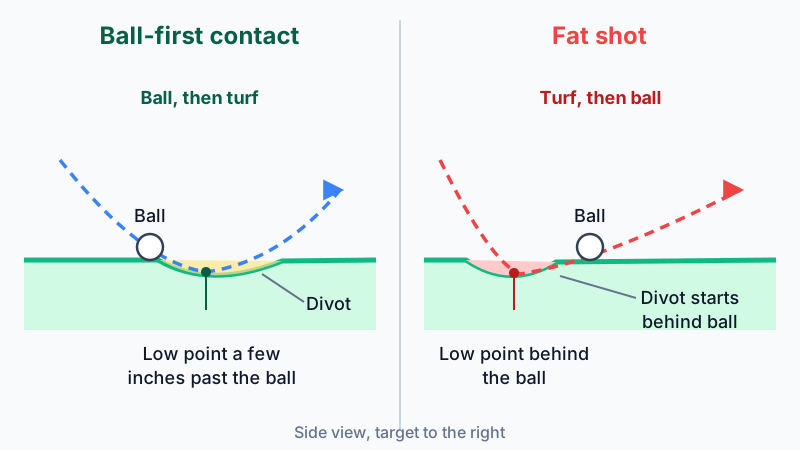
When you strike the ball this way, the loft of the club does the work. The ball launches and spins as the club was designed to make it. You don't need to help it into the air.
The lowest point of your swing arc (your low point) needs to be a few inches in front of the ball. Tour players do this consistently. TrackMan's tour data shows the average PGA Tour player hits down on a 6-iron at 3.7 degrees, which puts the bottom of the arc after the ball. Many higher handicappers bottom out at the ball or behind it.
Those few inches are what separate flushed irons from fat and thin ones.
Why Do I Hit My Irons Inconsistently?
If you're hitting it fat one shot and thin the next, you're not alone. The cause is usually one of three things.
Trying to Lift the Ball
This is the big one. Your brain sees the ball on the ground and wants to help it up. So you hang back on your trail foot and flip your wrists under the ball to scoop it.
Ironically, this moves your low point backwards. You either hit the ground before the ball (fat) or catch the ball on the upswing with the leading edge (thin or topped).
The club already has loft. A 7-iron has roughly 30-34 degrees built into the face, which is plenty to get the ball airborne. You don't need to add lift. You need to hit down.
Casting the Club
Casting means releasing the angle between your wrists and the shaft too early in the downswing. It's a bit like flicking a fishing rod. Your wrists unhinge before impact, the clubhead overtakes your hands and you lose the energy you stored.
That leaves you with no shaft lean. The club arrives with the shaft vertical or even leaning backwards. You'll catch the ball thin, or the club bounces off the ground into the ball's equator. Either way, contact is inconsistent.
It's one of the most common faults among amateurs.
Poor Weight Transfer
Your weight needs to move to your lead foot during the downswing. If it stays centred, or worse shifts to your trail foot, the bottom of your swing arc moves back. The club then hits the ground behind the ball.
You'll recognise this if your divots start 2-3 inches behind the ball, or if you hit a lot of fat shots that feel like digging a trench.
| What You Think Is Happening | What's Actually Happening | The Real Fix | |---|---|---| | "I need to hit up on the ball" | You're scooping, moving the low point behind the ball | Hit down. Trust the loft. | | "I'm not swinging hard enough" | You're casting, losing clubhead speed before impact | Maintain wrist angle longer | | "I'm lifting my head" | Your weight is stuck on the trail foot | Shift to your lead side before impact | | "My clubs don't fit me" | Your fundamentals need work first | Fix setup and contact before blaming equipment |
Ready to work on this? Log your drill sessions and scores in the free Green Streak app and keep your practice going day by day.
The Setup Fundamentals for Pure Iron Shots
Before you think about the swing, get the static parts right. A good setup makes consistent contact much easier, and a bad one makes it very hard.
Ball Position
Ball position changes with the club, and plenty of amateurs get it wrong. Some play everything in the middle, others play everything off the lead heel. Both lead to inconsistent strikes.
The rule is simple. Short irons go in the centre of your stance. As the clubs get longer, the ball moves gradually forward towards your lead foot. The full chart is in the Ball Position Chart by Club section below.
Stance Width
For a standard iron shot, your feet should be roughly shoulder-width apart. Any wider restricts your hip turn, and any narrower makes it hard to stay balanced.
One way to check: lay a club across your toes and step back. If the club reaches well beyond your shoulders on both sides, you're too wide. If it barely reaches them, you're too narrow.
Weight Distribution at Address
Start with about 55% of your weight on your lead foot rather than 50/50. That slight forward bias helps set your low point ahead of the ball.
It feels strange at first. Many golfers set up with their weight evenly split or even leaning slightly back, and that lean-back is what leads to the scoop. Start forward and stay forward.
Hands Ahead of the Ball
At address, your hands should be slightly ahead of the ball, by an inch or two. The shaft should lean slightly towards the target. This pre-sets the impact position you want to recreate when the club comes back to the ball.
If you look down and the shaft is vertical (or leaning away from the target), push your hands forward until they're over or just past the ball. That's your starting position.
The Key Move: Hands Ahead at Impact
If one thing separates good iron players from poor ones, it's that their hands are ahead of the clubhead at impact.
This is called shaft lean: the shaft leans towards the target as the club strikes the ball, so the handle is closer to the target than the clubhead. It creates a descending strike that squeezes the ball against the clubface.
What Shaft Lean Actually Does
With proper shaft lean at impact, three things happen:
- The club strikes the ball before the ground, giving you ball-first contact
- The effective loft decreases, so your 7-iron might deliver 26 degrees instead of 32, for a lower, more penetrating flight
- You strike the ball more solidly, with better energy transfer and that pure "click" feeling
This is part of why tour pros hit a 7-iron so much further than many amateurs. It's the same club with a different delivery.
How to Feel Shaft Lean
Stand in your address position with a 7-iron. Push your hands towards the target until the shaft leans noticeably forward. The grip end should point roughly at your lead hip.
That's the position you want to return to at impact. It feels like you're "trapping" the ball against the ground, with the club going down and through rather than up and under.
One simple cue worth trying: at address, press your hands forward until you feel the leading edge dig slightly into the turf. That reminds your body where your hands need to be when the club arrives at full speed.
Beginner Tip: If shaft lean feels completely foreign, start with half-swings. A smooth half-swing with your hands ahead gives better contact than a full swing with a flip. Build the feeling at slow speed first.
How to Transfer Your Weight Without Swaying
Weight transfer is what moves your low point forward. Without it, you can have perfect hands and still hit behind the ball.
The Difference Between Shifting and Swaying
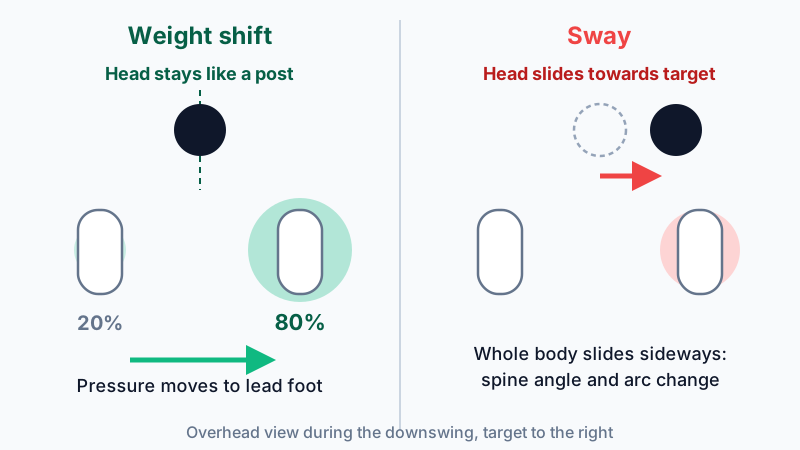
A weight shift moves pressure from your trail foot to your lead foot during the downswing. A sway is your whole body sliding sideways.
The difference matters. Swaying moves your whole centre of gravity towards the target, which changes your spine angle and arm structure. You lose the consistent arc you need.
A proper weight shift keeps your head fairly still while pressure moves through your feet. Imagine your head is a post driven into the ground. Your body turns around it, but your head doesn't slide.
The 80/20 Rule at Impact
At impact, most of your weight should be on your lead foot. Many coaches use roughly 80% as a feel, which is a big change from the 55/45 split at address.
Good players get their pressure moving to the lead side early. The weight shift starts the downswing rather than happening partway through it.
Many amateurs try to shift their weight at the same moment they swing the club down, and by then it's too late. The shift needs to start the downswing, like stepping into a throw.
The Bump Drill Feeling
Here's a feel that helps. At the top of your backswing, imagine bumping your lead hip an inch towards the target. That starts the chain reaction: your hips turn, your arms drop, your hands lead and the club arrives in the right position.
Don't turn it into a full slide. A one-inch bump is enough.
Building this habit? Log your practice sessions in the free Green Streak app and watch your drill scores week by week.
5 Drills for Consistent Iron Contact
These five drills each work on a different part of iron consistency. I've ordered them from most basic to most advanced. Start with Drill 1 and add one a week.
Drill 1 - The Towel Drill
Targets: Ball-first contact, low point control
Setup: At the range or in your garden. Lay a folded towel (or a thin cushion) on the ground about 2 inches behind where the ball will sit. Use a 9-iron or pitching wedge.
Execution:
- Place a ball on the ground, 2 inches in front of the towel
- Take your normal stance with your hands slightly forward
- Swing and hit the ball without touching the towel
- If you catch the towel, the club is bottoming out too early and your low point is behind the ball
What to feel: The club brushing the grass after the ball, not before it. Your divot should start in front of where the ball was. The towel punishes any early contact.
Reps: 20 balls per session. Count how many out of 20 you hit cleanly without touching the towel.
Success criteria: When you can hit 15 out of 20 without catching the towel, move to a 7-iron. The longer club makes it harder.
Drill 2 - The Step Drill
Targets: Weight transfer, sequencing, forward pressure shift
Setup: Range or garden. Use a 7-iron. Tee the ball up on a low tee, just off the ground.
Execution:
- Stand with your feet together, ball in the middle
- Start your backswing as normal
- As you start the downswing, step your lead foot 6-8 inches towards the target
- Let the step pull your weight forward naturally
- Swing through and hit the ball
What to feel: A baseball-style weight shift. Your trail foot goes light as your lead foot plants. You can't hang back while you're stepping forward. The timing feels odd at first, so give it 5-6 reps before judging it.
Reps: 15 balls per session. Start at 50% swing speed and build up.
Success criteria: Solid contact on 10 out of 15 while stepping means your weight transfer is improving. If you're topping shots during this drill, the step isn't big enough. Commit to a real step, not a shuffle.
Drill 3 - The 9-to-3 Drill
Targets: Contact consistency, rhythm, controlled ball-striking
Setup: Range or garden. Any iron from 9-iron to 7-iron. Ball on the ground, no tee.
Execution:
- Set up normally to the ball
- Take the club back only to the 9 o'clock position, with your hands about hip height and the shaft parallel to the ground
- Swing through to the 3 o'clock position, a mirror image with your hands at hip height on the follow-through
- Focus entirely on solid contact, not distance
What to feel: Control. This drill removes the extra moving parts of a full swing. From this short backswing there isn't time to cast the club. You'll feel your body turning through and your hands leading naturally.
Reps: 25 balls per session. The swings are short and low-effort, so this is a high-volume drill. Aim for a steady rhythm.
Success criteria: Solid contact on 20 out of 25. The ball should fly roughly 60-70% of your normal distance with that club. Once you're striking nearly every one solidly, gradually lengthen the swing to 10-to-2, then to full.
Drill 4 - The Tee Drill
Targets: Confidence, ball-first contact, reducing tension
Setup: Range. Use a 7-iron. Start with the ball on a tee about half an inch off the ground.
Execution:
- Tee the ball up at that height, just off the ground
- Take your normal iron stance and swing
- Focus on sweeping the ball cleanly off the tee
- Lower the tee over the session until the ball is on the ground
What to feel: Confidence. Hitting off a tee takes away the fear of hitting it fat. Your body relaxes and you'll notice how much better your swing feels when you're not worried about the ground. That's the feeling to carry over to balls on the turf.
Reps: 10 balls on the half-inch tee, 10 on a lower tee, then 10 off the ground. Compare the quality of contact across the three groups.
Success criteria: When your contact off the ground matches your contact off the tee, you've got rid of the tension that comes with the turf. Give it a few sessions.
The 19th Hole: Watch any busy range bay and you'll see golfers judging every iron by how far it went. The low-point data above suggests that's the wrong scoreboard. Swing speed matters, but so does where the club bottoms out. A few inches decide whether the ball is struck cleanly or chunked. So after each shot, change the question from "how far?" to "how clean was the strike, and where did the divot start?" Many golfers chase yards when they should chase the centre of the face. In my experience, distance tends to follow once the strike is consistent.
Drill 5 - The Alignment Stick Shaft Lean Drill
Targets: Shaft lean at impact, hand position, preventing casting
Setup: Range. Grab an alignment stick (or a thin dowel). Use a 7-iron or 8-iron.
Execution:
- Slide the alignment stick into the hole in the top of your grip so it sticks out past the grip end
- When you take your grip, the stick should run up past your lead side
- At address, the stick should point at or just inside your lead hip
- Make slow half-swings, keeping the stick clear of your body through impact
- If you cast the club, the stick will hit your side before impact, so you get instant feedback
What to feel: Your hands leading the clubhead through the hitting zone. The stick is a physical reminder of where your hands need to be. If you flip your wrists, it jabs you in the ribs straight away.
Reps: 15 slow-motion swings to get the feel, then 10 balls at half speed. Build to three-quarter speed over 2-3 sessions. Don't rush this one.
Success criteria: You can hit 10 balls in a row at three-quarter speed without the stick touching your body before impact. When you can, your shaft lean is in a good place.
Beginner Tip: If you don't have an alignment stick, a wooden dowel from a hardware shop costs about £2 and works just as well. Cut it to about 3 feet long.
Ball Position Chart by Club
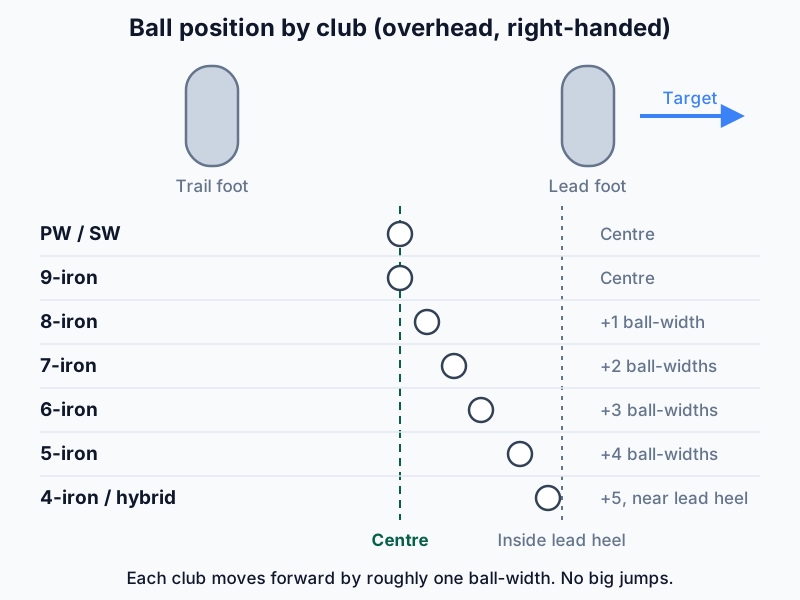
Getting the ball in the right spot for each club is one of the easiest ways to improve your iron contact. Many amateurs play the ball too far back, which gives low shots that start right (for a right-hander). Others play it too far forward, which leads to fat contact.
Use this chart as your starting point and adjust based on what gives you the best contact.
| Club | Ball Position | Where in Your Stance | Notes | |---|---|---|---| | Pitching Wedge / SW | Centre | Dead centre between your feet | Slightly forward of centre for higher trajectory | | 9-Iron | Centre | Dead centre | Consistent with wedges | | 8-Iron | Just forward of centre | One ball-width ahead of centre | Small shift forward | | 7-Iron | Forward of centre | Two ball-widths ahead of centre | The "standard" iron position | | 6-Iron | Forward of centre | Three ball-widths ahead of centre | Getting closer to your lead foot | | 5-Iron | Inside lead heel | Four ball-widths ahead of centre | Noticeably forward | | 4-Iron / Hybrid | Inside lead heel | Five ball-widths ahead of centre, near the lead heel | Similar to fairway woods |
The pattern is gradual, with no big jumps. Each club moves forward by roughly one ball-width. If you're struggling with a particular iron, check its ball position first. A 7-iron played too far back will give a low, weak shot even with good mechanics.
A good grip supports all of this. If your hands aren't set correctly on the club, ball position changes won't save you.
Common Iron Mistakes and How to Fix Them
Here are four common iron faults, what causes each one and the quickest fix to try.
Topping the Ball
What it looks like: The ball dribbles along the ground or takes off low like a line drive.
What's happening: The bottom edge of the clubface is striking the top half of the ball. Your low point is too high, so the club never gets down to the ball's equator.
Root causes: Early extension (standing up through impact), weight staying on the trail foot, or losing your spine angle.
Fastest fix: The Towel Drill, which trains the club to reach the correct low point. If you're topping it a lot, my full guide on stopping topped shots goes deeper.
Fat Shots
What it looks like: The club digs into the ground 2-4 inches behind the ball. You get a big divot, a jolt through your hands and a ball that goes nowhere.
What's happening: Your low point is behind the ball, so the club reaches the ground before it reaches the ball.
Root causes: Weight stuck on the trail foot, the ball too far forward in your stance, or casting the club (releasing the wrist angle too early).
Fastest fix: The Step Drill. It physically moves your weight forward, because you can't hang back and step at the same time.
Thin Shots
What it looks like: The ball comes off low and hot, with little spin, and it might sting your hands. It can run out to a decent distance but never gets more than about 20 feet off the ground.
What's happening: The leading edge of the club is striking the ball at or just below its equator. You make contact, but with the bottom edge rather than the face.
Root causes: Scooping (trying to lift the ball), an inconsistent spine angle, or the ball too far back in the stance.
Fastest fix: The Tee Drill. Start on a tee to take away the fear of the ground, then work down to the turf. Thin shots often come from tension, and the tee helps you relax.
Slicing Irons
What it looks like: The ball curves hard to the right (for a right-handed golfer). It often starts left of the target, but it can also start straight or right. The curve is usually smaller than with a driver slice because irons have more loft.
What's happening: The clubface is open relative to the swing path at impact. That face-to-path gap sets the curve, while the face angle mostly sets the start direction. The same fault that causes a driver slice affects your irons, just less dramatically.
Root causes: A weak grip, an open clubface at the top, or an out-to-in swing path.
Fastest fix: Check your grip first. If you can see fewer than 2 knuckles on your lead hand at address, try strengthening it. For many golfers, that alone reduces the slice.
| Fault | Ball Flight | Most Likely Cause | First Drill to Try | |---|---|---|---| | Top | Low runner along ground | Early extension / trail-foot weight | Towel Drill | | Fat | Short, heavy, big divot behind ball | Weight behind ball / casting | Step Drill | | Thin | Low laser, no spin | Scooping / tension | Tee Drill | | Slice | Left-to-right curve | Open face / weak grip | Alignment Stick Drill + grip check |
Your 4-Week Iron Improvement Plan
Drills only work if you do them consistently. Here's a 4-week plan built on 15-20 minute sessions. Use it alongside the driving range practice routine for your range sessions.
Week 1: Foundation
Focus: Ball-first contact and low point awareness.
| Day | Drill | Location | Duration | |---|---|---|---| | Monday | Towel Drill (20 balls) | Range | 15 min | | Tuesday | 9-to-3 Drill (25 balls) | Range | 15 min | | Wednesday | Slow-motion practice swings (no ball, focus on hands-ahead feeling) | Home | 10 min | | Thursday | Towel Drill (20 balls) | Range | 15 min | | Friday | Tee Drill (30 balls, varying tee heights) | Range | 15 min | | Saturday | Play 9 holes, note contact quality on each iron shot | Course | - | | Sunday | Rest | - | - |
Week 2: Weight Transfer
Focus: Getting your pressure to the lead foot before impact.
| Day | Drill | Location | Duration | |---|---|---|---| | Monday | Step Drill (15 balls) | Range | 15 min | | Tuesday | 9-to-3 Drill with weight shift focus (25 balls) | Range | 15 min | | Wednesday | Step Drill (10 balls) + Towel Drill (10 balls) | Range | 20 min | | Thursday | Slow-motion practice swings with step (no ball) | Home | 10 min | | Friday | Step Drill (15 balls) then 15 full swings | Range | 20 min | | Saturday | Play 9 holes, count divots that start in front of the ball | Course | - | | Sunday | Rest | - | - |
Week 3: Shaft Lean
Focus: Hands ahead of the clubhead at impact.
| Day | Drill | Location | Duration | |---|---|---|---| | Monday | Alignment Stick Drill (15 slow swings + 10 half-speed balls) | Range | 20 min | | Tuesday | 9-to-3 Drill with hands-ahead focus (25 balls) | Range | 15 min | | Wednesday | Alignment Stick Drill (15 slow swings, no ball) | Home/Garden | 10 min | | Thursday | Towel Drill (10 balls) + Alignment Stick Drill (10 balls) | Range | 20 min | | Friday | Full swings only, applying the feeling from the drills (30 balls) | Range | 20 min | | Saturday | Play 9 holes, focus on feeling hands ahead at impact | Course | - | | Sunday | Rest | - | - |
Week 4: Integration
Focus: Combining all elements into your full swing.
| Day | Drill | Location | Duration | |---|---|---|---| | Monday | 10 Towel Drill + 10 Step Drill + 10 full swings | Range | 20 min | | Tuesday | Alignment Stick Drill (10 balls) + 20 full swings, alternating clubs | Range | 20 min | | Wednesday | 9-to-3 Drill warm-up (10 balls) + full swing session (20 balls) | Range | 20 min | | Thursday | Tee Drill progression: 10 on tee, 10 low tee, 10 ground | Range | 20 min | | Friday | Pre-round warm-up simulation: 5 wedges, 5 mid-irons, 5 long irons | Range | 15 min | | Saturday | Play 18 holes, noting iron contact quality on every shot | Course | - | | Sunday | Review the week, note improvements, plan next focus area | Home | 10 min |
Log every session. The streak matters more than any single session. If you can only manage 10 minutes, do 10 minutes of the 9-to-3 Drill, because something beats nothing. That's the whole idea behind Green Streak: showing up matters more than being perfect.
Sources & Further Reading
- TrackMan: 6 Numbers Every Amateur Golfer Should Know: Low point and attack angle explained for iron shots
- TrackMan: What Is Attack Angle?: PGA Tour and LPGA Tour attack angle averages with irons
- PGA of America Teaching Resources: Professional instruction methodology on iron play fundamentals
- Titleist Performance Institute (TPI): Biomechanics research on weight transfer, sequencing, and early extension
- Golf Digest Instruction: Evidence-based technique guides on ball striking and iron consistency
Related Articles
- How to Stop Topping the Golf Ball: 5 Drills That Fix It Fast
- Fix Your Slice: The Knuckle Drill That Works in 5 Minutes
- How to Grip a Golf Club: The Complete Beginner's Guide
- Driving Range Practice Routine That Actually Works
- Best Golf Launch Monitors for Home Practice
- Best Golf Training Aids That Actually Work
Frequently Asked Questions
How far should I hit each iron?
It varies a lot with swing speed and contact quality, so there's no single right number. The best way to find yours is to measure carry distances on a launch monitor. Distance only matters once your contact is consistent, though. Focus on striking the centre of the face first, and the yardages settle down once you stop hitting it fat and thin.
Why do I hit my short irons well but struggle with long irons?
Long irons have less loft and longer shafts, which exaggerates every swing fault. A small cast with a pitching wedge might still give you an acceptable shot. The same cast with a 4-iron gives you a thin, weak miss. The drills in this guide work with all irons, so start with the short ones and gradually move to longer clubs.
Should I take a divot with my irons?
Yes, for standard iron shots off the ground. The divot should start at or slightly in front of where the ball was. If your divots start behind the ball, your low point needs to move forward. If you take no divot at all, you may be picking the ball cleanly. That can work, but it leaves less margin for error than a descending strike.
How long does it take to improve iron consistency?
It varies from golfer to golfer, but regular, focused practice is what moves it. The 4-week plan in this article builds each skill layer by layer. I'd rather do four 15-minute sessions a week than one 90-minute range blast, because spacing practice out tends to help skills stick.
Do I need to change my irons to hit them better?
Probably not. Modern game-improvement irons are very forgiving. Unless your clubs are badly fitted (wrong length, wrong lie angle, or shafts far too stiff or too flexible), better technique will make a much bigger difference than new equipment. Get fitted once your strike is consistent enough to give meaningful data.
What is the most important iron to practice with?
The 7-iron. It sits in the middle of the set, has moderate loft and length, and carries over well to both shorter and longer irons. If you can strike a 7-iron consistently, the skills transfer up and down the bag. That's why many of the drills in this guide use one.
Can I practice iron drills at home without hitting balls?
Yes. Slow-motion swings focusing on hand position, the Step Drill footwork and the Alignment Stick Drill all work without a ball. Rehearsing the motion builds the pattern without the distraction of ball flight, so you can focus on the movement rather than the result.
Why do I hit irons well on the range but not on the course?
Range mats hide fat contact. The club bounces off the mat and still reaches the ball, giving a decent-looking shot that would have been a chunk on grass. If you practise on mats, use the Towel Drill to check you're making ball-first contact. When you can, hit off grass at the range for more honest feedback.
Disclaimer: This article is for informational purposes only and does not replace professional golf instruction. Individual results will vary based on ability, practice consistency, and physical condition. Consult a PGA professional for personalised swing advice.
Ready to build your practice streak?
Track your sessions, set goals, and improve with Green Streak — completely free.
Get Started Free