Driving Range Practice Routine: How to Make Every Bucket Count
Many range sessions are a bucket of balls with no plan. This structured 60-ball routine turns mindless hitting into focused practice.

Quick Summary
- Unstructured range sessions rarely transfer to the course: hitting the same club at the same target builds rhythm on the range, not scores on Saturday
- The 60-ball routine splits a standard bucket into 4 phases: warm-up, skill work, simulated play and finish strong
- Random practice beats block practice for long-term retention: motor learning research backs it, so avoid hitting the same club twice in a row
- Track your progress: log your practice sessions in the free Green Streak app to build consistency
You've just hammered 80 balls at the range. Driver, driver, driver, a couple of 7-irons for variety, then more drivers. You walk away feeling good, then shoot the same score on Saturday.
Quick Answer: A productive range session needs structure. The 60-ball routine splits a standard bucket into four phases. Hit 15 warm-up balls (wedges to mid-irons) and 25 skill work balls (one focused drill). Then play your home course shot by shot with 15 balls and finish with 5 confident ones. Motor learning research shows that varied practice like this improves retention and transfer compared with hitting the same shot repeatedly. Warm up first and log the session in Green Streak.
Table of Contents
- Why Do Most Golfers Waste Their Range Time
- The 60-Ball Routine
- What Should I Do Before Hitting Balls at the Range
- Block Practice vs Random Practice at the Range
- How Should I Use Targets at the Range
- Range Routines by Goal
- The 7 Mistakes That Kill Your Range Sessions
- What to Track at the Range
- How Often Should I Go to the Driving Range
- Sources & Further Reading
- Related Articles
- Frequently Asked Questions
Why Do Most Golfers Waste Their Range Time
I know what a plateau feels like. My scoring average barely moved between 2024 and 2025: +22.2 over par one year, +22.1 the next. Playing and hitting balls isn't the same as getting better. For a lot of golfers stuck in that spot, the range is where the most time goes for the least return.
Look along the bays at any driving range and you'll see the same pattern. Plenty of golfers follow no structured routine at all. They grab a bucket, pull out their favourite club and start swinging, with no targets, no drills and no plan.
It feels like practice, but it's mostly repetition without purpose.
Motor learning research shows why. In Shea and Morgan's classic 1979 study, people who practised three tasks in a random order performed worse during practice. Yet they showed better retention and transfer afterwards than people who practised each task in a block. How practice is organised matters as well as how much you do.
The range also flatters you. You hit one flush 7-iron out of twelve and your brain remembers that shot. It forgets the thin one, the fat one, the push and the pull. You leave feeling productive when you weren't.
The fix is a structured routine where every ball has a purpose and every session has a plan. That plan is the 60-ball routine.
The 60-Ball Routine
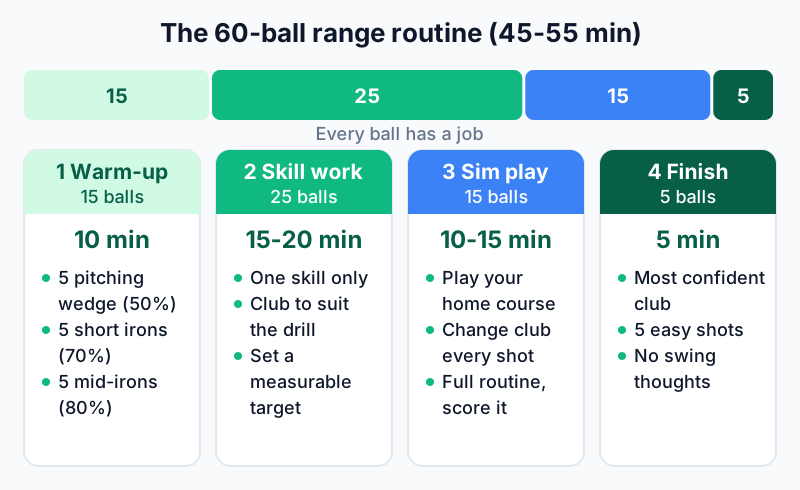
This is the routine I'd recommend to anyone who wants their range time to count. It takes 45-55 minutes with a standard medium bucket, and every ball has a job.
Phase 1 — Warm-Up (15 Balls, 10 Minutes)
Don't pick up the driver first. Your body is cold and your timing is off. Swinging at full speed before warming up is how you groove bad habits and risk injury.
Start with a dynamic warm-up before touching a club: hip circles, torso rotations and arm swings for about five minutes. Then hit balls in this order:
- 5 pitching wedge shots at 50% effort. Smooth tempo. Feel the clubface.
- 5 short iron shots (8 or 9-iron) at 70% effort. Focus on centre contact.
- 5 mid-iron shots (6 or 7-iron) at 80% effort. Start finding your rhythm.
Give each ball a specific target. Not "over there", but a specific flag, a yardage marker or a discoloured patch of grass.
The warm-up is preparation rather than practice. These 15 balls get your body and your focus ready for the real work.
Phase 2 — Skill Work (25 Balls, 15-20 Minutes)
This is the core of the session. Pick ONE skill and work on it deliberately.
One thing, not three. Trying to fix your takeaway, grip and weight shift in the same session usually means you fix none of them.
Choose your skill work based on your current weakness:
| Weakness | Drill | Club | Success Metric | |----------|-------|------|----------------| | Slicing | Headcover just outside and behind the ball; swing without hitting it | Driver/5-iron | 6/10 draws or straight | | Topping | Tee drill: place a tee 4 inches in front of the ball and clip it after the ball | 7-iron | Divot starts after ball position | | Distance control | 3 targets at 50, 75, 100 yards | Wedges | 6/10 within 10 yards of target | | Inconsistent contact | Feet-together drill | 7-iron | 8/10 centre-face strikes | | Push/pull | Alignment stick on ground | Any iron | 7/10 start on target line |
Set a measurable target before you start. It could be "Land 7 out of 10 wedge shots inside 15 feet from 80 yards." Or "Hit 6 out of 10 drives that start between the two 150 markers." Note the result.
If you're working on fixing a slice, you can give this whole phase to the knuckle drill with your driver. Twenty-five focused repetitions with one clear goal are more useful than 100 balls sprayed at nothing in particular.
Want to track your skill work? Log your drill, your score and your focus area in the free Green Streak app. After a month of logged range sessions, you'll see where you're improving and where you need to adjust.
Phase 3 — Simulated Play (15 Balls, 10-15 Minutes)
This is the phase many golfers skip, and I think it's the most valuable one.
Stand on the range and play your home course in your head. Picture hole 1 and hit the club you'd use off the tee to a specific target. Then hit the approach club you'd need from where that shot finished. Move on to the next tee.
Rules for simulated play:
- Change clubs every shot. On the course, you rarely hit the same club twice in a row, so train that way.
- Use your full pre-shot routine on every ball. Stand behind the ball, pick a target and visualise the shot. Step in, take one practice swing and hit it.
- Accept the result. Hit a bad tee shot? Your approach is now from the rough, 180 yards out. Play it as it lies, in your head.
- Score it. Give yourself a par if the approach would be on the green, a bogey if it's greenside and a double if it's in trouble.
This bridges the gap between range performance and course performance. The range rewards repetition, the course rewards adaptation, and simulated play trains adaptation.
The 19th Hole: Plenty of golfers judge a range session by how many balls they got through: bigger bucket, better practice. The contextual interference research mentioned earlier says otherwise. The group that practised in a random order looked worse during practice and still came out ahead when tested later. Volume wasn't the difference; how each ball was used was. A pattern you see all the time on golf forums is the golfer who proudly hits 150 balls three times a week and can't understand why nothing changes on Saturday. Simulated play is the step they tend to skip, because it feels slow and the results look worse in the moment. Fifteen balls with a full routine, a club change and a score attached will teach you more about your game than another large bucket of 7-irons.
Phase 4 — Finish Strong (5 Balls, 5 Minutes)
End every session on a good note. It's nicer to leave with a good feeling than a bad one.
Pick your most confident club, which for many golfers is a pitching wedge or 9-iron. Hit 5 smooth, controlled shots to a specific target. No experimenting and no swing thoughts, just confident swings.
The aim is to walk away feeling good about your swing and take that into your next session and your next round.
Session complete? Log it in the free Green Streak app and keep your practice streak alive. A range session counts toward your streak just like 15 minutes of putting at home.
What Should I Do Before Hitting Balls at the Range
Arrive 10 minutes before you need your bucket and use that time for a dynamic warm-up.
Static stretching (holding a position for 30+ seconds) before hitting works against you. A study in the Journal of Strength and Conditioning Research had 15 young competitive golfers do a 20-minute static stretching routine before hitting. Their driver clubhead speed fell by about 4% and their distance by about 5.6%, compared with an active, dynamic warm-up. Accuracy and consistency of contact dropped too.
Do a dynamic warm-up instead:
- Arm circles: 10 forward, 10 backward. Loosens the shoulders.
- Hip circles: 10 each direction. Frees up rotation.
- Torso rotations: Hold a club across your shoulders and rotate, 10 each side.
- Practice swings: 5 slow-motion swings with a mid-iron, no ball.
- Leg swings: 10 front-to-back per leg. Wakes up the hip flexors and hamstrings.
The full 5-minute warm-up routine covers everything you need. Do it before every range session, every round and every home practice session.
Block Practice vs Random Practice at the Range
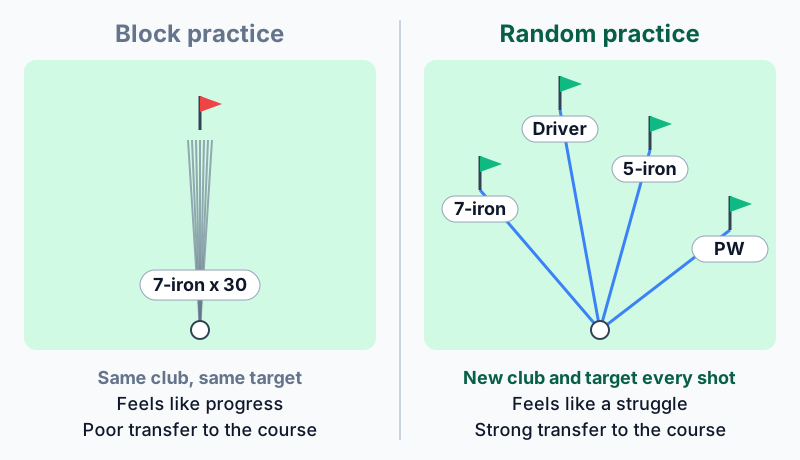
For many golfers, this is the biggest change they can make at the range.
Block practice is hitting the same club to the same target repeatedly, such as thirty 7-irons in a row. It feels productive because you start grooving the shot, and your results improve within the session.
Random practice (interleaved practice) means changing clubs, targets and shot shapes on every ball, so you never hit the same shot twice in a row.
Block practice feels better. Random practice tends to work better.
Research published in the Journal of Experimental Psychology found that random practice produced better retention, including when tested 10 days later, and better transfer than blocked practice. In-session performance is worse because you never settle into a rhythm, but more of what you learn carries over.
| Factor | Block Practice | Random Practice | |--------|---------------|-----------------| | In-session feel | Comfortable, rhythmic | Messy, difficult | | Long-term retention | Lower | Higher | | Course transfer | Poor (course never repeats shots) | Strong (mirrors on-course conditions) | | When to use | Complete beginners learning basics | Anyone past the beginner stage | | Example | 30 x 7-iron to 150 flag | 7-iron, wedge, driver, 5-iron, all different targets |
There's one exception. If you're working on a brand new swing change, block practice for the first 2-3 sessions helps you feel the new movement. After that, switch to random practice to make the pattern hold up on the course.
How Should I Use Targets at the Range
Every ball needs a target.
"The 150 marker" is a target, but "the range" isn't. "That brown patch left of the 100 flag" is a target, but "somewhere over there" isn't.
Distance Targets
Pick specific yardage markers and try to land within 10 yards of them. Note your dispersion. If 7 out of 10 balls land within a 20-yard circle around your target, your distance control is solid.
Direction Targets
Pick two flags or markers as your corridor. Hit 10 drives, each with your full pre-shot routine, and count only the balls that start between the two markers. Ignore where the ball finishes and focus on the start direction, which is set mostly by where the clubface points at impact. If you fight a slice, set the corridor for the start line you want, not the finish you hope for.
Dispersion, Not Distance
Many amateurs obsess over how far they hit it. The number that matters more at the range is how tightly your shots group. Picture a golfer who hits every 7-iron 145-155 yards inside a 15-yard-wide corridor. They'll usually score better than one who averages 165 but sprays it across a 40-yard zone.
Track your dispersion pattern rather than your longest shot. Tight patterns score, while long shots that could land anywhere don't.
Range Routines by Goal
The Breaking 100 Routine (60 Balls)
| Phase | Balls | Focus | |-------|-------|-------| | Warm-up | 15 | Wedge, 9-iron, 7-iron. Easy tempo only. | | Skill work | 25 | Contact quality. Tee every ball, hit centre face. Track solid strikes out of 25. | | Simulated play | 15 | Play 5 holes from your course. Use only 3 clubs: 7-iron, pitching wedge, putter (mental). | | Finish strong | 5 | Pitching wedge to 50 yards. Smooth and confident. |
At this level, contact consistency matters most. A golfer who hits 13 out of 15 mid-irons solidly will usually break 100 before one who hits 5 perfect and 10 terrible.
The Breaking 90 Routine (60 Balls)
| Phase | Balls | Focus | |-------|-------|-------| | Warm-up | 15 | Wedge to 5-iron progression. Find rhythm. | | Skill work | 25 | Wedge distances: 50, 75, 100 yards. Track proximity to target. | | Simulated play | 15 | Play 9 holes. Full pre-shot routine. Change clubs every shot. Score it. | | Finish strong | 5 | Your most confident club. Pure strikes. |
Breaking 90 leans heavily on the short game and wedge distances, and your range session should reflect that. More than half of your skill work balls should be wedge shots.
The Low Handicap Maintenance Routine (60 Balls)
| Phase | Balls | Focus | |-------|-------|-------| | Warm-up | 10 | Quick progression, wedge to driver. | | Skill work | 25 | Work on your weakest stat from last 5 rounds. | | Simulated play | 20 | Play 18 holes mentally. Full routine. Score every hole. | | Finish strong | 5 | Towel-over-club drill for tempo. Smooth and easy. |
At this level, simulated play gets the most balls because shot selection and decision-making matter more than raw skill development. You already have the swing, so train the thinking.
The 7 Mistakes That Kill Your Range Sessions
Mistake 1 - Skipping the Warm-Up
Grabbing a driver and swinging full speed with a cold body grooves bad mechanics. Your first 10-15 swings set the tone for the session, so make them smooth wedge shots rather than wild driver swings.
Mistake 2 - Driver Only
You hit driver on no more than a dozen or so holes per round. Your wedges, short irons and putter get used far more often. Spending most of your range time on the driver doesn't match how you play.
Mistake 3 - No Pre-Shot Routine
On the course, you go through a routine before every shot. At the range, it's easy to skip it entirely. That trains you to drop the routine under pressure, which is exactly when you need it most.
Mistake 4 - Hitting Too Fast
On the course, several minutes pass between your shots. At the range, plenty of golfers rake over another ball and hit it within seconds. That pace is nothing like a round. Slow down and take 30-45 seconds between shots. Step back, reset and play at course tempo.
Mistake 5 - Chasing Distance
Nobody at the range is impressed by your 280-yard drive; they're watching their own shots. Stop swinging out of your shoes. A golfer who hits a controlled 230 down the middle usually scores better than one who hits 280 into the trees every other hole.
Mistake 6 - No Targets
"Hitting balls" isn't practice. "Hitting at a specific target and noting how close you get" is. Every ball deserves a target.
Mistake 7 - Phone Distraction
Checking your phone every third ball breaks the focus that makes practice work. Leave it in your bag or use it only for filming swings. Deliberate practice needs your full attention.
What to Track at the Range
Bring a small notebook or use your phone's notes app. Record these three things after every session:
- What you worked on: the specific skill, club and drill.
- Your measurable result: for example, "7 out of 10 wedge shots inside 15 feet from 80 yards."
- One thing for next time: based on today's results, what should you focus on next?
Over time, this log shows patterns. Maybe your iron dispersion tightens over three weeks but your wedge accuracy stalls. That tells you where to shift your focus.
Tracking turns "I think I'm getting better" into something you can check. Building a consistent practice habit starts with this kind of deliberate logging.
How Often Should I Go to the Driving Range
Once or twice a week is enough, as long as each session is structured.
Here's the weekly split I'd suggest for most amateurs:
- 3-4 sessions at home (15-20 minutes each): putting, chipping, mirror work, flexibility
- 1-2 range sessions (45-60 minutes each): the full structured 60-ball routine
- 1 round per week: play with focus and review afterwards
Home practice handles the short game, and Dave Pelz's research found that more than 60% of shots are played from within about 100 yards. Range sessions handle full swing work and simulated play. The round tests everything under pressure.
If you can only get to the range once a week, make it count with the 60-ball routine and add daily home practice. A hitting net in the garage fills the gap between range visits, giving you full swing reps without the drive.
The Seinfeld Strategy applies here. One structured range session plus four 15-minute home sessions gives you five practice days a week, and that consistency adds up.
Sources & Further Reading
- Shea & Morgan (1979), "Contextual Interference Effects on the Acquisition, Retention, and Transfer of a Motor Skill," Journal of Experimental Psychology: Research on random vs blocked practice for motor skill retention
- Gergley (2009), Journal of Strength and Conditioning Research: Effects of static stretching before hitting on driver clubhead speed, distance and accuracy
- Dave Pelz, Short Game Bible (sample chapter, Library of Congress): Summary of Pelz's short game research, including the share of shots played within 100 yards
- PGA Tour Strokes Gained Statistics: Performance data showing relative importance of each skill area
- Ericsson, K.A. (1993), "The Role of Deliberate Practice," Psychological Review: Expert performance and the four requirements of deliberate practice
Related Articles
- How to Practice Golf Effectively: The Complete Guide
- Best Putting Drills at Home: 10 Drills for Speed and Start Line
- The 5-Minute Golf Warm-Up Routine That Actually Works
- The Seinfeld Strategy: Why "Don't Break the Chain" Works for Golf
- Fix Your Slice: The Knuckle Drill That Works
- Golf Driver Drills: 6 Drills for Straighter, More Consistent Tee Shots
Frequently Asked Questions
How many balls should I hit at the driving range?
Sixty balls in a structured routine will do more for you than 100+ hit without a plan. Give each ball a specific target, club and purpose. The 60-ball routine covers warm-up, skill work, simulated play and a strong finish in 45-55 minutes.
Should I hit driver at the range?
Yes, but not exclusively and not first. I'd keep driver to about 15% of your range balls, roughly 8-10 shots out of 60. Warm up with wedges and irons before touching it. Save driver work for the skill work phase if you have a specific issue, or use it naturally during simulated play.
What is the best driving range routine for beginners?
Put most of your balls into contact quality with short and mid-irons. Tee every ball, use a 7-iron and count how many out of 25 you strike solidly from the centre of the face. Pair this with 15 warm-up wedge shots and 5 confident finish shots. Leave the driver until your iron contact is consistent.
How do I practise on the range like a pro?
Tour players practise with a clear purpose. Each shot has a target, they use a full pre-shot routine and they track specific numbers rather than going on feel. Adopt the 60-ball routine, use your full routine on every ball and mix up your clubs and targets.
Should I use a pre-shot routine at the range?
Yes. Your pre-shot routine is a skill that needs practice. If you skip it at the range, it's more likely to break down on the course under pressure. Use your full routine on every ball during simulated play, and on at least half the balls during skill work.
How often should I go to the driving range?
Once or twice a week is enough if you add short home sessions on other days. The range is best for full swing work and simulated play, while short game and putting are easier to fit in at home in 15-minute sessions. One structured range visit a week plus four home sessions is likely to do more for you than three unstructured range visits.
What should I work on at the driving range?
Pick one skill per session based on your biggest weakness. If you miss fairways, work on driver dispersion. If you lose shots on approaches, work on wedge distance control. Look at your last scorecard: the holes where you scored worst point to your biggest weakness, so target that next.
Is random practice really better than block practice?
For golfers past the beginner stage, yes. Research on contextual interference shows better long-term retention and transfer from random practice than from block practice. Block practice feels better during the session because you settle into a rhythm. Random practice carries over better to the course, because golf rarely gives you the same shot twice in a row.
Disclaimer: This article is for informational purposes only and does not replace professional golf instruction. Individual results will vary based on ability, practice consistency, and physical condition. Consult a PGA professional for personalised swing advice.
Ready to build your practice streak?
Track your sessions, set goals, and improve with Green Streak — completely free.
Get Started Free