Golf Driver Drills: 6 Drills for Straighter, More Consistent Tee Shots
30+ handicappers find trouble on 45% of drives, per Arccos. These 6 golf driver drills fix strike, tempo, path and setup, each with a score you can track.
Quick Summary
- Accuracy is the gap, more than distance: Arccos data shows low handicappers keep 88% of drives in play, while 30+ handicappers are in penalty or recovery on 45.1% of them
- Fix the strike before the swing: a toe or heel strike costs ball speed and curve, so the first drill marks your clubface and counts centre hits out of 10
- Every drill here has a score: centre strikes, clean gates or fairways found. Higher is better, so you can see progress week to week
- Log your scores: record each session and drill score in the free Green Streak app and keep your practice streak going
You stripe one down the middle on the 1st, then hit the next three into the trees with what feels like the exact same swing. The driver is the club that makes golf feel random.
Quick Answer: The best golf driver drills train strike first, then start line, then speed. Centre contact matters because toe and heel strikes reduce ball speed, and the PGA Tour's average driver smash factor is 1.49, per TrackMan. Spray foot powder on the face and count centre strikes out of 10. Then groove a 3:1 backswing-to-downswing tempo, and finish by scoring 10 imaginary fairways. Score every drill so you know it's working.
Table of Contents
- Why Do I Hit My Driver So Inconsistently?
- What Should Driver Drills Actually Train?
- What You Need for These Drills
- 6 Golf Driver Drills for Straighter Tee Shots
- Driver Drill Comparison Table
- Your 4-Week Driver Practice Plan
- 5 Driver Practice Mistakes That Waste Your Bucket
- When Should You Get a Lesson or a Fitting?
- Sources & Further Reading
- Related Articles
- Frequently Asked Questions
Why Do I Hit My Driver So Inconsistently?
The driver is the longest, lowest-lofted club in your bag, so every small error gets magnified. A face a couple of degrees open to the path gives a 9-iron a gentle fade. With a driver's lower loft, the same mismatch produces far more curve, and extra speed carries the ball further offline.
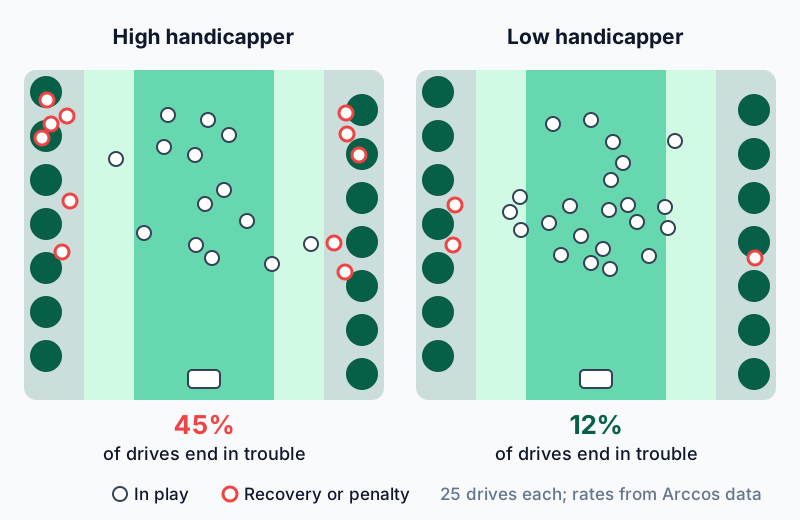
The numbers back this up. In its 2026 Driving Distance Report, Arccos found the highest handicappers end up in a recovery or penalty situation on 45% of driver tee shots. For low handicappers, that figure is 12%.
Nearly half your drives costing you a shot is a scoring problem rather than a style problem. And it's fixable.
For many mid and high handicappers, inconsistency with the driver comes from four places.
Strike Location All Over the Face
This is the one golfers underestimate. You can make a decent swing and still hit a poor drive if the ball comes off the heel or toe. TrackMan notes that impacts off the toe or heel reduce potential ball speed. Off-centre strikes also add curve, because the face twists and imparts spin (the gear effect, where a toe strike tends to draw and a heel strike tends to fade).
So a heel strike isn't just short. It's often short and right. That's a lot of "bad swings" that were really bad strikes.
Face Pointing the Wrong Way at Impact
Where the clubface points at impact has the biggest say in where the ball starts. If the face is open to your target, the ball starts right (for a right-hander). If it's also open to your swing path, it curves further right. That's the classic slice.
If a slice is your main miss, fix the face first with the Knuckle Drill. I won't repeat it here. The drills below work alongside it.
An Out-to-In Swing Path
Swing path is the direction the clubhead travels through impact. An out-to-in path (also called "over the top") means the club comes from outside the target line and cuts across the ball toward your feet. Combine that with an open face and you get the big banana ball.
Rushed Tempo and a Setup That Drifts
Many amateurs swing the driver harder than any other club. The transition gets quick, the arms fire early, and the sequence falls apart. On top of that, setup drifts. Ball position creeps back, the tee height changes, the stance narrows. Small setup changes create big strike changes.
| What You Think Is Happening | What's Often Actually Happening | Where to Start | |---|---|---| | "I'm not swinging hard enough" | Off-centre strikes are costing ball speed | Drill 1 - strike check | | "My swing is broken today" | Ball position or tee height has drifted | Drill 2 - setup checkpoints | | "I lose it under pressure" | Tempo speeds up when you try to hit it hard | Drill 3 - tempo count | | "I slice everything" | Out-to-in path with an open face | Knuckle Drill, then Drill 4 | | "I'm fine on the range, awful on the course" | Hitting the same target ball after ball | Drill 6 - fairway game |
What Should Driver Drills Actually Train?
A lot of driver practice goes like this. Grab the big stick, rake over a ball, swing as hard as possible, repeat 40 times. That builds speed and frustration in roughly equal measure.
Good golf driver drills train skills in a sensible order.
- Strike: hit the middle of the face. Everything else depends on it.
- Setup: make ball position, tee height and alignment the same every time.
- Tempo: a repeatable rhythm that holds up when you want to hit it hard.
- Path and start line: send the ball out on the line you intended.
- Control under pressure: hit fairways with one ball, one target, one chance.
Notice what's missing. Distance. I'm not saying speed doesn't matter. It does. But Arccos reports that men's average driving distance has shifted by less than one yard since 2018, despite years of new drivers. The same analysis calls accuracy off the tee "the single most correctable source of wasted strokes for most recreational players." That matches what I believe about driver practice. Chasing ten more yards is slow work. Cutting the number of drives that cost you a shot is much quicker.
Arccos also puts the distance gap between elite amateur men and 30+ handicappers at 63 yards, and attributes it to "ball-striking efficiency" rather than age. Strike the middle more often and some of that distance comes back without swinging any harder.
What You Need for These Drills
Nothing here needs expensive kit. Here's the full list.
- Your driver and a bucket of balls (range) or 10-20 balls (net)
- Foot powder spray or a dry-erase marker for marking the clubface. Impact tape works too
- Two alignment sticks, or two spare clubs laid on the ground
- A headcover: your driver's own headcover is fine
- Tees: a few of the same length, so your tee height stays consistent
- Your phone for a metronome or tempo app, and for filming the odd swing
Four of the six drills work at home into a net. If you're setting one up, my guide to the best golf nets for garage practice covers what to look for. The last two drills need a range, because you need to see the ball fly.
Warning: Driver is the longest club in the bag. Before swinging it indoors, make a slow practice swing to check your ceiling and walls. If the club gets anywhere near either, use a 3-wood or do the home drills as rehearsal swings without a ball.
Warm up first. Driver swings from cold are the fastest way to a sore back. The 5-minute golf warm-up routine takes, as the name suggests, five minutes.
Ready to ingrain this? Log your drill sessions in the free Green Streak app and watch your consistency build day by day.
6 Golf Driver Drills for Straighter Tee Shots
These drills run from most fundamental to most course-like. Start with Drill 1 and add the next one when you hit its target score. Each has an objective score where higher is better, so you can log it and see whether it's actually moving.
Drill 1 - The Foot Powder Strike Drill
What it trains: Centre-face contact, and awareness of where you really hit the ball.
Setup: Range or net. Your driver, foot powder spray (or a dry-erase marker, or impact tape), 10 balls, and your usual tee height.
How to do it:
- Spray a light, even coat of foot powder across the whole clubface. With a dry-erase marker, scribble over the face instead
- Hit one drive with your normal swing
- Look at the face. The ball leaves a clean mark where it made contact
- Call it: centre if the mark sits on or within about a ball's width of the face's centre (most drivers have a sweet-spot marking to help), or a miss if it's heel, toe, high or low of that
- Wipe, re-spray, repeat for 10 balls
What to feel: At first, nothing. That's the point. Many golfers have no idea where they're striking it. Within a few sessions you start to predict the mark before you look. When that happens, your feel is catching up with reality.
Adjust from the pattern: If most marks are on the heel, stand a touch further from the ball. If they're on the toe, a touch closer. If they're low on the face, tee it slightly higher. If they're on the crown or very high, tee it lower. A common starting point is having about half the ball above the top edge of the driver at address.
Score: Centre strikes out of 10.
Target: 6 out of 10 before moving on. Then keep this drill as your first 10 balls of every driver session.
Drill 2 - The Setup Checkpoint Drill
What it trains: Repeatable ball position, stance width and alignment. The boring stuff that makes the swing easier.
Setup: Home, net or range. Driver, two alignment sticks (or two clubs), tees of the same length. No ball needed, though you can add one at a net.
How to do it:
- Lay one stick on the ground pointing at your target. This is your feet line
- Lay the second stick at a right angle to the first, running toward the ball. Position it just inside your lead heel. This is your ball-position line
- Push a tee into the ground at the point where the second stick meets your ball position. Mark your tee height by pushing each tee in to the same depth
- Step away. Walk in from behind the ball as you would on the course and take your address without looking at the sticks
- Once you're set, freeze and look down. Check three things: ball level with the inside of your lead heel, toes parallel to the feet-line stick, and feet at least shoulder-width apart
- That's one rep. Step away and repeat 10 times
What to feel: Your stance should feel slightly wider than with an iron, with your trail shoulder a little lower than your lead shoulder. That small tilt helps you catch the ball level or slightly on the way up, which is what you want from a tee.
Score: Setups that pass all three checkpoints on the first attempt, out of 10. No shuffling your feet after you look down. If you adjust, it's a miss.
Target: 8 out of 10. Once you hit that twice in a row, take the checkpoints to the range and do three setup reps before your first drive each session.
Beginner Tip: If you're newer to golf, get Drill 2 right before worrying about anything else. A lot of early driver problems are setup problems in disguise. Ball too far back in the stance is a classic cause of slices and pop-ups.
Drill 3 - The 3-to-1 Tempo Count Drill
What it trains: Rhythm and transition. It stops you lunging at the ball from the top.
Setup: Range or net. Driver, 10 balls, and a metronome or tempo app on your phone. Keep the foot powder from Drill 1 on the face.
The idea: John Novosel's Tour Tempo research found that great players take about three times as long to swing back as they do to swing down. Practical Golf's summary notes that physicist Dr. Robert Grober's later measurements found touring pros averaged the same 3:1 ratio, within a tight range. The overall speed varies by player. Novosel's tempos run from 27/9 down to 18/6 (video frames back, then down), but the ratio stays at 3:1.
How to do it:
- Set the metronome to a slow, steady beat. Start slower than you think
- Make 5 rehearsal swings without a ball. Start the takeaway on beat one, reach the top on beat three, and strike on the next beat. Say it out loud: "one, two, three... hit"
- Now hit 10 balls to the same count
- After each ball, check the face for the strike mark
What to feel: Unhurried at the top. Many amateurs rush from the top because they want to hit it hard. The count gives you a pause without you having to try to pause. The downswing should feel like it happens on its own.
Score: Centre strikes out of 10 while holding the count. If you lose the rhythm (rushed, jerky or off the beat), that ball counts as a miss even if the strike was good.
Target: Match your Drill 1 score. When your tempo score equals your normal strike score, the rhythm is no longer costing you anything. Then speed the metronome up a notch.
Drill 4 - The Headcover Gate Drill
What it trains: Swing path. It punishes the over-the-top move that causes pulls and slices.
Setup: Range or net. Driver, your driver headcover, 10 balls.
How to do it (for a slice or pull):
- Tee the ball up as normal
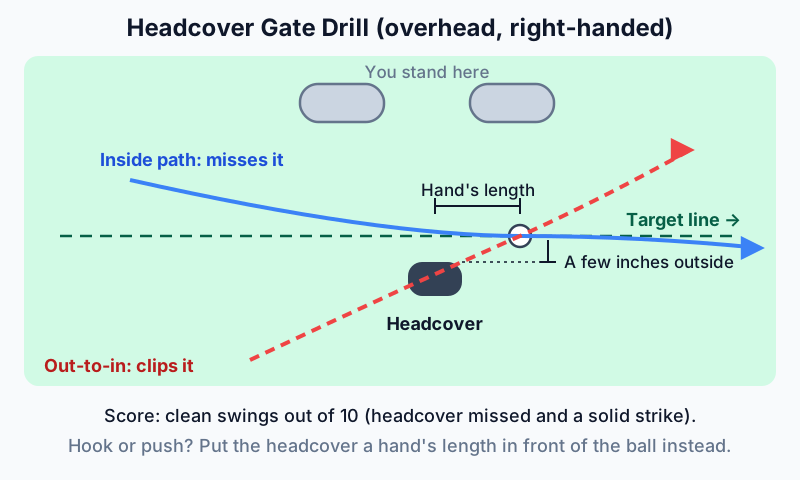
- Place the headcover on the ground about a hand's length behind the ball and a few inches outside the target line (on the far side of the ball from you)
- Make slow practice swings first. An out-to-in path comes down from outside the line and clips the headcover
- Hit 10 balls. Your aim is to swing down from inside, missing the headcover and striking the ball
For a hook or push: Move the headcover to a hand's length in front of the ball, a few inches outside the target line. An excessively in-to-out path will clip it after impact.
What to feel: The trail elbow dropping toward your trail hip as you start down, and the club approaching the ball from slightly behind you. It can feel like you're going to hit it way right. That's usually a sign the drill is working.
Score: Clean swings out of 10, meaning the headcover wasn't touched and the ball came off the face solidly. Hitting the headcover, or whiffing the ball to avoid it, is a miss.
Target: 8 out of 10. Then move the headcover an inch closer to the ball to tighten the gate.
If the ball is still curving hard right even with clean gate swings, your face is the problem, not your path. Go back to the Knuckle Drill in my slice guide and fix the grip first.
Drill 5 - The 75% Speed Control Drill
What it trains: Balance, strike and control. It teaches you what a controllable driver swing feels like.
Setup: Range. Driver, 10 balls, and two markers on the range roughly 30 yards apart to act as a fairway (flags, signs, or two distinct patches of grass).
How to do it:
- Hit 3 drives at your normal speed and note roughly how far they carry
- Now hit 10 drives at what feels like 75% effort. Hold your finish on every ball until it lands
- Count every ball that finishes between your two markers
What to feel: Balanced. You should be able to hold your finish, weight on your lead foot, chest facing the target, without stepping or wobbling. If you can't hold the finish, you swung harder than 75%.
Why it works: Swinging within yourself cleans up strike and sequence at the same time. A better strike can win back some of the speed you gave up, so the drop in distance may be smaller than you expect. Don't take my word for that. Compare the two groups yourself.
Score: Drives finishing between the markers, out of 10. A ball where you fall off your finish (you couldn't hold it until the ball landed) is a miss wherever it lands.
Target: 7 out of 10. Then do the next set at 85% effort and see if the score holds.
Drill 6 - The 10-Fairway Game
What it trains: Performing with one ball, one target and a full routine. This is how the driver works on the course.
Setup: Range. Driver, 10 balls, a full pre-shot routine, and the range markers you used in Drill 5. This drill uses your driver. If you need a hybrid or fairway wood version for tight holes, the Fairway Finder in my break 100 guide is built for that.
How to do it:
- Picture the first tee of your home course. Pick a target and two edges for that fairway on the range
- Go through your full pre-shot routine: stand behind the ball, pick your line, set up, go
- Hit one drive. Score it (see below)
- Change the target for the next "hole". Picture hole 2, pick new edges. Never hit two balls in a row at the same target
- Play 10 holes
Points per drive:
- 2 points: finishes inside your fairway edges
- 1 point: misses the fairway, but by less than about 10 yards (light rough, still a clear shot)
- 0 points: further offline (trees, penalty area, out of bounds)
What to feel: A little pressure. That's the whole point. Your mind will want a second ball when one goes wrong. Don't give it one.
Score: Total points out of 20.
Target: Start by beating your last score. As a rough guide, 12 out of 20 is a solid session and 15+ is a strong one. Write the number down every time.
This drill fits straight into Phase 3 of my driving range practice routine, if you want a complete 60-ball session built around it.
Want to make this stick? These drills only work if you come back to them. Use the free Green Streak app to log each session, record your drill scores and keep your streak going.
Driver Drill Comparison Table
Here are all six drills side by side, so you can pick the right one for the time and space you have.
| Drill | Trains | Where | Balls | Time | Score (Higher Is Better) | |---|---|---|---|---|---| | 1 - Foot Powder Strike | Centre contact | Range or net | 10 | 10 min | Centre strikes out of 10 | | 2 - Setup Checkpoint | Ball position, stance, alignment | Home, net or range | 0-10 | 5-10 min | Setups passing all 3 checks, out of 10 | | 3 - 3-to-1 Tempo Count | Rhythm, transition | Range or net | 10 | 15 min | Centre strikes on the count, out of 10 | | 4 - Headcover Gate | Swing path | Range or net | 10 | 15 min | Clean swings out of 10 | | 5 - 75% Speed Control | Balance, control | Range | 13 | 15 min | Drives between markers, out of 10 | | 6 - 10-Fairway Game | Performing under pressure | Range | 10 | 20 min | Points out of 20 |
The 19th Hole: The Arccos numbers change how I think about driver practice. Low handicappers aren't a different species off the tee. Their drives stay out of trouble. A 12% trouble rate against 45% for the highest handicappers is the difference between losing a shot on one or two holes and losing one on six or seven. Yet driver practice at the range is still usually judged by one thing: how far the best ball went. If the stat that separates good players is "drives that didn't cost a shot", that's what your practice should count. That's why every drill above scores contact, gates or fairways, and none of them score yardage.
Your 4-Week Driver Practice Plan
Two driver sessions a week is plenty for many golfers, plus a few short home sessions. Each session takes 20-30 minutes. Use your other range time for irons, wedges and putting.
Week 1: Strike and Setup
| Day | Drills | Location | Time | |---|---|---|---| | Session A | Drill 2 (10 setup reps) + Drill 1 (2 rounds of 10) | Range or net | 25 min | | Session B | Drill 2 (10 setup reps) at home, no ball | Home | 5 min | | Session C | Drill 1 (10) + 20 drives at a target, adjusting tee height from what you learn | Range | 25 min |
Week 2: Add Tempo
| Day | Drills | Location | Time | |---|---|---|---| | Session A | Drill 1 (10) + Drill 3 (2 rounds of 10) | Range or net | 25 min | | Session B | Drill 3 rehearsal swings to the metronome, no ball (20 swings) | Home | 5 min | | Session C | Drill 2 (3 reps) + Drill 3 (10) + Drill 5 (10) | Range | 25 min |
Week 3: Path and Control
| Day | Drills | Location | Time | |---|---|---|---| | Session A | Drill 1 (10) + Drill 4 (2 rounds of 10) | Range or net | 25 min | | Session B | Drill 4 slow practice swings with the headcover, no ball | Home | 5 min | | Session C | Drill 4 (10) + Drill 5 (10) + Drill 6 (10 holes) | Range | 30 min |
Week 4: Take It to the Course
| Day | Drills | Location | Time | |---|---|---|---| | Session A | Drill 1 (10) + Drill 3 (10) + Drill 6 (10 holes) | Range | 30 min | | Session B | Drill 2 (10 setup reps) | Home | 5 min | | Session C | Drill 6 twice, compare the two scores | Range | 30 min | | On course | Count fairways hit and drives that cost you a shot | Course | Round |
Log every score. Four weeks of numbers tells you far more than how one session felt. That's the thinking behind the Seinfeld Strategy: small, repeated sessions you can see adding up.
5 Driver Practice Mistakes That Waste Your Bucket
Mistake 1 - Hitting Only Driver
The driver is one club out of fourteen. If you only have one bucket, give the driver 20-30 balls and spend the rest on the clubs you use around the green. A good drive and three chips still makes a bogey.
Mistake 2 - Chasing the One Big Drive
You hit a bomb, then spend the next 20 balls trying to find it again. That turns practice into a treasure hunt. Stick to the drill and its score. A great score with average distance beats one monster and nine misses.
Mistake 3 - Never Checking the Strike
Without marking the face, you're guessing. Ball flight tells you something, but a heel strike and an open face can look similar in the air. Ten seconds of foot powder removes the guesswork.
Mistake 4 - Changing Too Many Things at Once
Grip, stance, tempo and path in one session? You won't know which one helped. Work on one drill at a time until you hit its target score, then add the next.
Mistake 5 - Hitting Ball After Ball at the Same Target
Raking ball after ball in quick succession grooves a rhythm you'll never have on the course. On the course you get one drive per hole. Slow down, use a routine, and finish every session with Drill 6.
| Mistake | Why It Hurts | The Fix | |---|---|---| | Driver only | Neglects the shots that save strokes | Cap driver at 20-30 balls per bucket | | Chasing the big one | Rewards the swing you can't repeat | Score the drill, not the distance | | No strike check | Misreads heel and toe strikes as swing faults | Foot powder on the first 10 balls | | Too many changes | You can't tell what worked | One drill until it hits its target | | Same target, fast pace | Doesn't transfer to the course | Full routine, new target every ball |
When Should You Get a Lesson or a Fitting?
These drills can take you a long way on your own. But there are times a professional will save you months.
Book a lesson if:
- You've done four weeks of the plan and your Drill 1 score hasn't moved
- You can pass the Headcover Gate but still hit a big slice or hook
- The driver hurts your back, lead elbow or wrists
Consider a fitting if:
- Your strikes are consistently centred (7+ out of 10 in Drill 1) but the ball launches very low or balloons very high
- Your driver is clearly the wrong length for you, and you can only make centre contact by choking right down the grip
A fitting is much more useful once your strike is consistent. Before that, the numbers change so much from swing to swing that it's hard to fit anything. If you'd like data at home, a launch monitor shows ball speed, smash factor and start direction. My guide to the best golf launch monitors covers options at different budgets.
On smash factor: TrackMan explains that smash factor is ball speed divided by club speed, with a target of about 1.50 for driver and a PGA Tour average of 1.49. If you have a monitor, it's a handy number to pair with your Drill 1 score.
Sources & Further Reading
- Arccos Golf: 2026 Driving Distance Report: tee-shot accuracy and trouble rates by handicap, from millions of tracked rounds
- Arccos Golf: Distance vs Accuracy in Golf: why keeping drives in play matters more than extra yards for most amateurs
- TrackMan: What Is Smash Factor?: how ball speed and club speed relate, with driver benchmarks
- TrackMan: What Is Ball Speed?: how strike location affects ball speed
- Practical Golf: Swing Tempo: background on the 3:1 tempo ratio from John Novosel and Dr. Robert Grober
Related Articles
- Fix Your Slice: The Knuckle Drill That Works in 5 Minutes
- Driving Range Practice Routine: How to Make Every Bucket Count
- The 5-Minute Golf Warm-Up Routine That Actually Works
- How to Hit Your Irons Consistently: The Complete Guide
- Best Golf Training Aids That Actually Work
Frequently Asked Questions
What is the best drill for hitting the driver straighter?
Start with a strike drill, not a swing drill. Spray foot powder on the face and count centre strikes out of 10. Many "bad swings" are really heel or toe strikes, which cost ball speed and add curve. Once your strike improves, add the Headcover Gate Drill to work on path.
How high should I tee my driver?
A common starting point is about half the ball above the top edge of the driver at address. Then let the foot powder decide. If strike marks sit low on the face, tee it a little higher. If you're catching the crown or hitting pop-ups, tee it lower. Use the same tee depth every time.
Can I practise driver drills at home?
Yes. The Setup Checkpoint, Tempo Count, Foot Powder Strike and Headcover Gate drills all work into a net, and the first two work without a ball at all. Check your ceiling with a slow swing first. The fairway drills need a range, because you need to see the ball flight.
How many drivers should I hit at the range?
For many golfers, 20-30 driver balls per session is plenty. Past that, fatigue creeps in and quality drops. Spend them on drills with a score rather than hitting ball after ball. Then use the rest of the bucket on irons, wedges and chipping.
Why do I hit my driver well on the range but not on the course?
Usually because the range lets you hit the same target over and over. On the course you get one ball, a new target and real consequences. The 10-Fairway Game copies that: full routine, new target every ball, no second chances. Scoring it adds a bit of pressure too.
Should I swing slower to hit the driver straighter?
Swinging at around 75% effort often improves strike and balance, which can mean straighter drives without losing as much distance as you'd expect. Use the 75% Speed Control Drill to test it. Compare your score, and roughly how far the ball goes, against your full-effort swings.
How long does it take to fix an inconsistent driver?
It varies with the fault and how often you practise. The four-week plan in this article is a sensible first block. Setup and tempo changes often show up in your drill scores within a couple of weeks. Path changes usually take longer. Track your scores so you're judging progress on numbers, not one good or bad day.
Disclaimer: This article is for informational purposes only and does not replace professional golf instruction. Individual results will vary based on ability, practice consistency, and physical condition. Consult a PGA professional for personalised swing advice.
Ready to build your practice streak?
Track your sessions, set goals, and improve with Green Streak — completely free.
Get Started Free