Golf Chipping Tips: Master Your Short Game in 30 Days
A 15-handicapper misses around 14 greens per round. These golf chipping tips help turn those misses into up-and-downs, with a 30-day practice plan.
Quick Summary
- More than 60% of shots are played within about 100 yards: that's according to Dave Pelz's research, yet chipping rarely gets that share of practice time
- The Rule of 12 makes club selection simpler: subtract the club number from 12 to find roughly how many times further the ball will roll than it carries
- 5 drills with set reps and targets: each takes 10-15 minutes, and the first two work in your garden
- Build the habit: log your chipping sessions and drill scores in the free Green Streak app and keep your streak going
You've just missed the green by four feet, with the pin 30 feet away. You grab your 60-degree wedge, skull it across the green, chip back and walk off with a double bogey. A shot that started four feet from the putting surface cost you three strokes.
Quick Answer: A 15-handicapper hits just over four greens per round, says Shot Scope data, so better chipping is one of the quickest ways to lower your scores. Start with a simple setup that keeps your weight on your lead foot. Pick the club with the Rule of 12, and learn a basic "putting stroke" chip. Then practise for 15 minutes a day and log it in Green Streak.
Table of Contents
- Why Is Chipping the Fastest Way to Drop Strokes?
- The Basic Chip Setup
- The Putting Stroke Chip Technique
- The Hinge-and-Hold Technique
- Which Club Should I Use for Chipping?
- The Rule of 12 Explained
- When Should I Chip, Pitch, or Putt From Off the Green?
- 5 Chipping Drills That Actually Work
- How Do I Chip From Difficult Lies?
- Common Chipping Mistakes and How to Fix Them
- The 30-Day Chipping Challenge
- Sources & Further Reading
- Related Articles
- Frequently Asked Questions
Why Is Chipping the Fastest Way to Drop Strokes?
A 15-handicapper hits just over four greens in regulation per round, according to Shot Scope, so they miss around 14. PGA Tour players hit around 64% of greens and miss six or seven. So you're chipping roughly twice as often as the best golfers in the world.
When tour pros miss a green, most of them get up and down (chip on and one-putt) around 60% of the time or better. Shot Scope data shows 20-handicappers get up and down from inside 50 yards only 31% of the time.
That's a big gap, and you can close some of it.
Imagine raising your up-and-down rate from 30% to 45%. Over 14 missed greens, that's about 2 shots saved per round. You haven't changed your driver, your irons or your swing speed. You've just got the ball closer to the hole from 30 feet off the green.
Many club golfers practise the other way round: an hour hammering balls on the range, then five minutes of chipping before the round, if that. Flip the ratio, even to 15 minutes of chipping a day, and you're working on the shots you face most often.
Full shots are hard to change quickly, because a driver swing has a dozen moving parts. A chip is a small, controlled movement, so it responds to practice much faster. If you're trying to break 100, chipping is where I'd start.
The Basic Chip Setup
Every good chip starts with the setup. Get it right and the motion almost takes care of itself. Get it wrong and you're fighting your body the whole time.
Ball Position
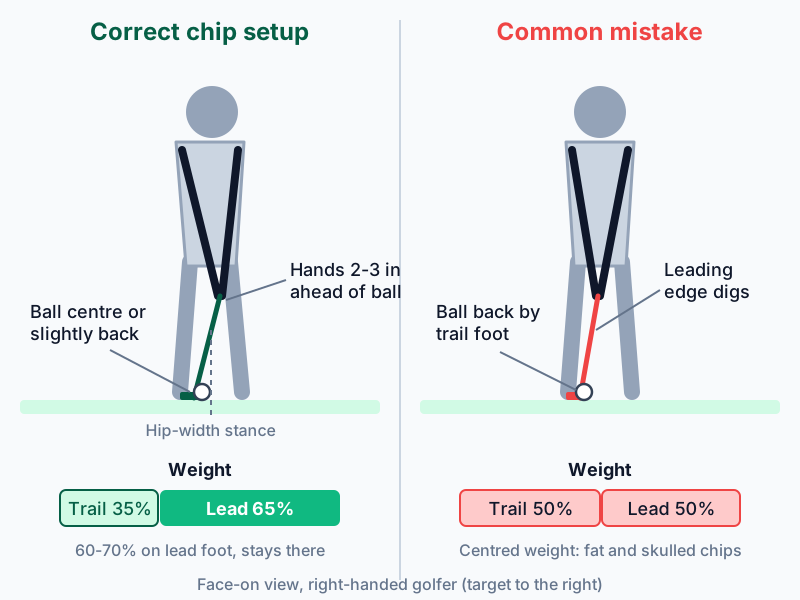
Put the ball in the centre of your stance or slightly back of centre, an inch or two behind the middle at most. That helps the club meet the ball with a slight downward strike, catching ball first and turf second.
A common mistake is shoving the ball right back towards your trail foot. That takes too much loft off the club and makes the leading edge dig. You get a low, running shot that's hard to control.
Weight Distribution
Put 60-70% of your weight on your lead foot (the left foot for right-handed golfers) at address. Keep it there throughout the swing. This one isn't optional.
When your weight is forward, the low point of the swing moves forward too, so you catch the ball cleanly. When your weight stays centred or drifts back, the club bottoms out behind the ball. That's where fat and skulled chips come from.
Hands and Shaft
At address, your hands should be slightly ahead of the ball, with the shaft leaning a little towards the target. This isn't a dramatic press. Your hands only need to be 2-3 inches ahead of the ball.
This forward lean does two jobs. It reduces the club's effective loft, so the ball launches lower and rolls more. It also sets your wrists so they're less likely to flip at impact.
Stance Width and Grip
Narrow your stance to about hip width. A wide stance restricts your turn and encourages swaying. You want your body to turn through the shot, not slide.
Grip down the club by an inch or two. That shortens it, which gives you more control. Some golfers use their putting grip for chips, which is fine and often helps with feel.
| Setup Element | What to Do | Why | |---------------|-----------|-----| | Ball position | Centre or slightly back of centre | Ensures ball-first contact | | Weight | 60-70% on lead foot, stays there | Moves low point forward | | Hands | Slightly ahead of ball | Prevents flipping and scooping | | Stance | Hip width | Allows rotation, limits sway | | Grip | Down 1-2 inches, light pressure | More control and feel |
The Putting Stroke Chip Technique
If you're new to chipping or struggle for consistency, start here. It's the simplest chipping method, and it works because it removes most of the things that cause bad chips.
The idea is to treat your chip like a long putt, with the same motion, the same tempo and very little wrist action.
How It Works
Set up as described above: weight forward, ball central, hands ahead. Now swing the club with your shoulders, just like a putting stroke. Your wrists stay firm while your arms and shoulders form a triangle that rocks back and through.
There's no wrist hinge and no hit at the ball. The club moves at an even pace, like a pendulum.
When to Use It
It works best when you have plenty of green to work with. Think flat lies and short grass around the green, where you want the ball to land a few feet on and roll to the hole like a putt.
It doesn't work as well from thick rough or steep downhill lies, or when you need the ball to stop quickly. For those, you need the hinge-and-hold technique below.
Why It Works
The putting stroke chip removes the two biggest amateur chipping faults: scooping and deceleration. With no wrist action, you can't scoop. And because the motion is a simple pendulum, slowing down feels unnatural, so the stroke flows through.
If a golfer asked me for one chipping tip, this would be it. It isn't fancy, but it works. After a single practice session, plenty of golfers are hitting cleaner chips than they have in months.
Building a short game habit? The free Green Streak app lets you log every chipping session and build a practice streak. Even 10 minutes counts.
The Hinge-and-Hold Technique
Once you're comfortable with the putting stroke chip, the hinge-and-hold opens up more shots. It lets you hit higher chips that land softer and stop faster.
The Concept
In the backswing, you let your wrists hinge naturally. Then, through impact and into the follow-through, you hold that wrist angle. You don't release the club or flip your hands. You hinge going back and hold going through.
Step-by-Step
Backswing: Take the club back with a slight wrist hinge. The amount of hinge controls height and distance: a small hinge for a short chip and a bigger one for a longer chip.
Downswing: Let your body turn towards the target, with your hands leading the clubhead through impact. The wrist angle you set in the backswing stays locked.
Follow-through: The clubface should point slightly towards the sky after impact. Your hands finish low, around hip height, and the shaft keeps leaning forward throughout.
When to Use It
The hinge-and-hold comes into its own when you need the ball to stop quickly. Use it for tight pins with little green to work with, and downhill chips where a running ball would race past the hole. It's also handy from light rough when you need a bit of extra loft.
The technique is closely linked with Phil Mickelson, and it's a natural next step for intermediate and better players. It needs more timing than the putting stroke chip, which is why I'd learn the simple method first.
Which Club Should I Use for Chipping?
This is where many amateurs go wrong. They grab the same club for every chip, usually a sand wedge or a 60-degree lob wedge. That's like hitting driver off every tee, par 3s included.
Different clubs launch at different heights and roll out different distances. The right club depends on how much green there is between your ball and the hole.
The Club Selection Chart
| Club | Carry-to-Roll Ratio | Best For | |------|---------------------|----------| | 7-iron | 1:5 (short carry, long roll) | Long chips across the green with lots of room | | 8-iron | 1:4 | Medium-long chips with moderate room | | 9-iron | 1:3 | Medium chips, decent green to work with | | PW | 1:2 (or 1:1 if counted as 11) | Versatile, moderate roll | | SW (56°) | Roughly 1:1 | Short chips needing height and quick stop | | LW (60°) | More carry than roll | Very short chips over bunkers, needs soft landing |
The ratios are approximate and change with green speed, slope and lie, but they give you a starting point.
How to Choose
Stand behind the ball and look at the green. Pick where you want the ball to land: a few feet onto the green, on a flat area if possible. Now estimate the distance from that landing spot to the hole.
If the landing spot is close to you and the hole is far away, you need plenty of roll, so choose a less-lofted club like a 7 or 8-iron. If the landing spot and the hole are close together, you need the ball to stop quickly, so choose a more-lofted club like a sand wedge.
It's a real change in thinking. Stop asking which club to chip with. Start asking where the ball should land, and which club gives you the right amount of roll from there.
The Rule of 12 Explained
The Rule of 12 is a shortcut that makes chipping club selection almost automatic. It's the most useful short-game formula I know.
How It Works
Take the number 12 and subtract the number of the club you're using. The result tells you roughly how many times further the ball will roll than it carries. The method is usually credited to Paul Runyan.
Example with a 7-iron: 12 − 7 = 5. So for every 1 part of carry, you get about 5 parts of roll. On a 12-pace chip, the ball carries about 2 paces and rolls about 10.
Example with a pitching wedge (counted as 10): 12 − 10 = 2. The ball rolls about twice as far as it carries. On a 12-pace chip, it carries about 4 paces and rolls about 8. Some teachers count the pitching wedge as 11, which gives equal carry and roll, so test your own wedges on the practice green.
Example with a 9-iron: 12 − 9 = 3. Roll is about three times the carry.
The Formula in Practice
Walk off the total distance from ball to hole and choose your landing spot (always a few feet onto the green). Count the paces from your ball to the landing spot, and from there to the hole. Then pick the club whose ratio matches.
Say you have 3 paces of carry to the landing spot and 9 paces from there to the hole. You need a 1:3 ratio, and 12 − 3 = 9, so that's a 9-iron.
The Rule of 12 isn't perfect. It assumes a fairly flat green of medium speed and a putting stroke chip. On faster greens, some golfers switch to a "Rule of 13" or "Rule of 14". It still gets you in the right postcode, which beats guessing with a lob wedge every time.
Want to see your chipping improve? Log your short game sessions and drill scores in the free Green Streak app. Then watch your personal bests go up over the 30 days.
When Should I Chip, Pitch, or Putt From Off the Green?
This decision costs amateur golfers more shots than they realise. The general rule is simple: use the least-lofted option that gets the ball onto the green and rolling.
The Decision Hierarchy
Putt first. If there's a clear path to the hole with no thick fringe, rough or obstacles in the way, putt it. A bad putt from off the green usually still finishes somewhere reasonable. A bad chip can go anywhere.
Chip second. If thick fringe or rough stops you putting, chip with the lowest-lofted club that clears it and lands on the green.
Pitch third. A pitch is a higher, longer shot with wrist hinge and more loft. Only play one when you need to carry a bunker, a big slope or a long stretch of rough.
Many amateurs default to the most-lofted option. They pull out the lob wedge when a 7-iron bump-and-run would be safer and more reliable. The ball behaves more predictably on the ground than in the air.
If you're working to break 100, I'd go further and putt from off the green whenever you physically can. A Texas wedge (putter from off the green) is the lowest-risk play in golf.
The 19th Hole: Ask on any golf forum what club people chip with and the most popular answer is a 56 or 60-degree wedge, for everything. It's easy to see why. The flop shot is what you see on television, and Phil Mickelson made the lob wedge look like a magic wand. But Shot Scope data has 20-handicappers getting up and down from inside 50 yards only 31% of the time. A lot of that gap comes down to decisions rather than technique. A high wedge shot from a tidy lie on the fringe asks for perfect contact, while a 9-iron bump-and-run asks for a putting stroke. Before you spend a month rebuilding your chipping technique, spend a week choosing a less-lofted club every time the Rule of 12 says you can. Boring works.
5 Chipping Drills That Actually Work
These five drills cover the fundamentals. Start with drills one and two, and add the others as your confidence grows. Each one includes setup, execution, what you should feel and how many reps to do.
Drill 1: The Towel Landing Drill
What it trains: Landing-spot accuracy, the most important skill in chipping.
Setup: Lay a towel flat on the green about 3 feet onto the putting surface. This is your landing zone. Set your balls 5-10 feet off the green.
Execution: Chip balls onto the towel, starting with a PW and then trying a 9-iron and an 8-iron. Your only goal is to land on the towel, so ignore where the ball finishes.
What to feel: A downward strike, with the ball coming off the face low. No scooping. Let the club's loft do the work.
Reps: 20 chips per session. Count how many land on the towel. Aim for 12 out of 20 as a first target, then try to beat your best.
Drill 2: The One-Club Distance Ladder
What it trains: Distance control with a single club.
Setup: Take your PW. Place targets (tees, coins or markers) at 10, 20 and 30 feet from your chipping spot.
Execution: Hit five chips to each target. Control distance with the length of your backswing, not your tempo: short for 10 feet, medium for 20 and longer for 30.
What to feel: The same smooth tempo on every chip, with backswing length the only thing that changes. This teaches your hands to judge distance by feel rather than force.
Reps: 15 chips in total (5 per distance). Count how many finish within a putter length of their target.
Drill 3: The Rule of 12 Club Rotation
What it trains: Matching your club to the landing spot and roll-out.
Setup: Pick a hole with at least 30 feet of green in front of it. Choose a landing spot 3 feet onto the green. Chip from the same position with a 7-iron, 9-iron, PW and SW.
Execution: Hit three chips with each club to the same landing spot and watch how far each one rolls out. This builds your mental picture of what each club does.
What to feel: The same swing with every club. Same setup, same stroke, and a different result because of the club in your hands. That's what makes the Rule of 12 work.
Reps: 12 chips in total (3 per club). After each set of four, note where each ball finished relative to the hole. You'll start to see the patterns quickly.
Drill 4: The Circle Drill
What it trains: Accuracy under pressure, and scrambling from all angles.
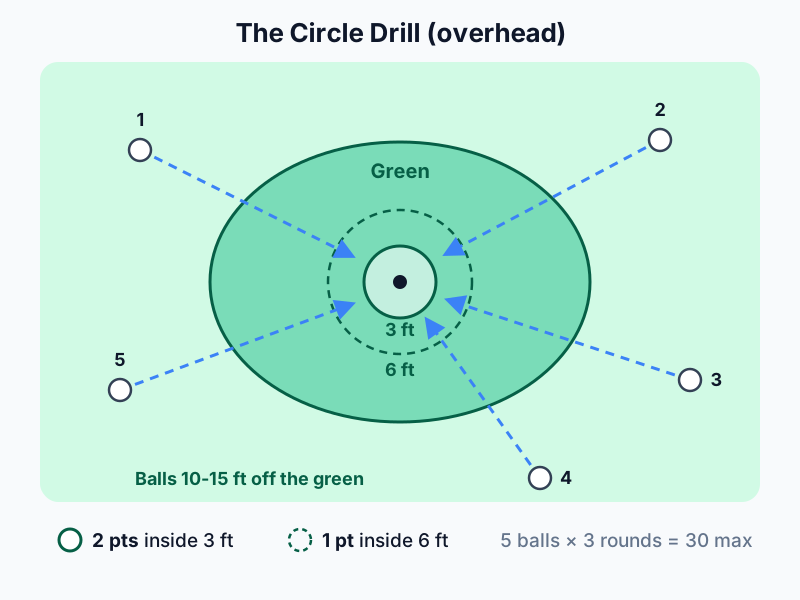
Setup: Place four or five balls around a hole, each about 10-15 feet off the green. Every ball has a different angle and possibly a different lie.
Execution: Chip each ball, trying to finish within 3 feet of the hole. Go through your full routine on every ball before you hit: read the chip, choose your club and pick your landing spot.
What to feel: The pressure of performing from different angles and lies. It's much closer to real on-course chipping than hitting 20 balls from the same spot.
Reps: 5 balls per rotation, 3 rotations per session. Score 2 points if the ball finishes inside 3 feet, 1 point inside 6 feet and 0 outside that. The maximum is 30, so track your score over time.
Drill 5: The Par-2 Game
What it trains: Getting up and down under scoring pressure.
Setup: Drop a ball in a random spot off the green. Your goal is to get down in 2 shots (a chip and one putt). Play 9 "holes" from 9 different positions around the green.
Execution: Chip the ball, then putt out. Down in 2 is par, a chip-in is a birdie and three shots is a bogey. Keep a running score over the 9 holes.
What to feel: Real scoring pressure. It makes you think about every chip the way you would on the course. Where's the safe miss? Which club gives you the best chance of a one-putt?
Reps: 9 holes per session, with par for the nine being 18. A beginner might shoot 25-27, while a solid chipper shoots 18-20. In Green Streak, log how many of the 9 holes you played in par or better.
If you want to build a broader practice routine at home, drills 1 and 2 adapt easily to a back garden. All you need is a chipping mat and a towel as your target.
How Do I Chip From Difficult Lies?
Standard chipping technique works from good lies. But the course also gives you tight lies, thick rough and sloping ground. Here's how to adjust.
Tight Lies (Bare or Closely Mown)
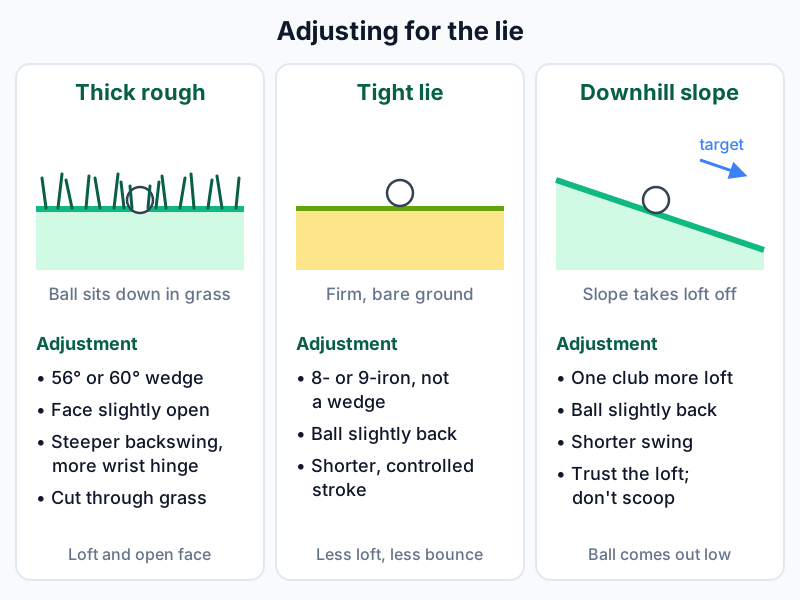
A tight lie is when the ball sits on firm ground with very little grass under it. It scares plenty of amateur chippers because there's no margin for error. Catch it a fraction heavy and the club bounces into the ball and skulls it.
The adjustment: Use a less-lofted club (an 8-iron or 9-iron instead of a wedge). Play the ball slightly back in your stance and make a shorter, more controlled stroke. The lower loft and smaller bounce help the club glide through instead of digging or bouncing off the hard ground.
Thick Rough
When the ball sits down in thick grass, the rough grabs the club and twists the face closed. A 7-iron bump-and-run won't work here.
The adjustment: Switch to your most-lofted wedge (56° or 60°). Open the face slightly at address and make a steeper backswing with more wrist hinge. The extra loft and open face help the club cut through the grass without getting trapped.
Uphill Chips
An uphill lie adds loft to the club, so your 9-iron will fly more like a PW.
The adjustment: Take one club less lofted than normal (an 8-iron where you'd normally use a 9-iron). Set your shoulders roughly parallel to the slope so the club can swing along it. Keep a little extra weight on your lead foot so you don't fall back.
Downhill Chips
A downhill lie takes loft off. Your PW will fly more like an 8-iron, so the ball comes out lower and runs more.
The adjustment: Take one club more lofted than normal, play the ball slightly back in your stance and make a shorter swing. Let the slope do the work and don't try to help the ball up. This is where many golfers scoop and skull it, so trust the loft. If you struggle here, the same contact fundamentals that fix topping apply to downhill chips.
Common Chipping Mistakes and How to Fix Them
Plenty of golfers have made every one of these mistakes, often for years before working out what was going wrong. Here are the most common chipping faults and the quickest fixes.
Scooping (Trying to Lift the Ball)
This is the number one chipping fault. The golfer tries to get under the ball and lift it by flipping the wrists at impact. The result is either a fat chip (the club hits the ground first) or a skulled one (the leading edge catches the middle of the ball).
The fix: The club has loft, and it doesn't need your help to get the ball airborne. Focus on hitting down and through. Forward shaft lean at address and weight on your lead foot make this much easier. Drill it with the Towel Landing Drill.
Deceleration
You take the club back a reasonable distance, then slow down as you approach the ball. The club either sticks in the turf (fat) or your hands flip to compensate (skull).
The fix: A shorter backswing with the same tempo through. If your follow-through is shorter than your backswing, you're decelerating. The One-Club Distance Ladder trains this, because you learn to control distance with backswing length rather than by slowing down.
Using the Wrong Club Every Time
Grabbing the lob wedge for everything is like using a sledgehammer to hang a picture. It works sometimes, but there are better options.
The fix: Learn the Rule of 12 and start using 3-4 different clubs around the green. The Rule of 12 Club Rotation drill builds the habit.
Ball Too Far Back in the Stance
Some golfers shove the ball back towards their trail foot, thinking it helps contact. It does make the strike steeper, but it also takes a lot of loft off. Your sand wedge starts behaving more like a 9-iron. The ball comes out low and running, and you lose control of your landing spot.
The fix: Play the ball in the centre of your stance or just behind it, no more than an inch or two back. Check it at every setup by laying a club on the ground pointing at the middle of your stance.
Looking Up Too Early
This one does matter in chipping, even though "keep your head down" is overrated for full shots. Looking up early pulls your chest and shoulders up, which lifts the low point of the swing. On a delicate shot with small margins, that's enough to skull it.
The fix: Keep your eyes on the spot where the ball was until it's well on its way. Some teachers say "listen for the ball to land before looking up", which is a good cue.
| Mistake | What Happens | The Fix | Best Drill | |---------|-------------|---------|------------| | Scooping | Fat or skulled chip | Hit down, trust the loft | Towel Landing Drill | | Deceleration | Fat or flipped chip | Shorter backswing, same tempo | One-Club Distance Ladder | | Wrong club always | Inconsistent distance control | Rule of 12, vary clubs | Club Rotation Drill | | Ball too far back | De-lofted, low running shot | Ball at centre of stance | Setup check with alignment stick | | Looking up early | Topped or thin chip | Eyes on the spot, listen for the landing | Par-2 Game (pressure practice) |
The 30-Day Chipping Challenge
This is a step-by-step plan to take you from uncomfortable around the greens to confident. It starts simple and builds, and each day takes 10-20 minutes.
The golden rule is to do something every day. Even five minutes of putting stroke chips into a cushion at home counts, because consistency matters more than duration. It's the same Seinfeld Strategy principle that works across all golf practice.
Week 1: Foundation (Days 1-7)
Focus: Setup and the putting stroke chip technique.
| Day | Activity | Duration | |-----|----------|----------| | 1 | Setup practice: ball position, weight, hands. No ball. | 10 min | | 2 | Putting stroke chip, PW only, flat lie. Towel Landing Drill. | 15 min | | 3 | Putting stroke chip, 9-iron and PW. Same landing spot. | 15 min | | 4 | Rest day. Watch a short game video or read chipping notes. | 5 min | | 5 | One-Club Distance Ladder with PW. | 15 min | | 6 | Putting stroke chip from fringe. 20 chips, count clean contacts. | 15 min | | 7 | Par-2 Game. 9 holes. Record score. | 20 min |
Week 2: Club Selection (Days 8-14)
Focus: Using multiple clubs and the Rule of 12.
| Day | Activity | Duration | |-----|----------|----------| | 8 | Rule of 12 Club Rotation: 7-iron, 9-iron, PW, SW. | 15 min | | 9 | Towel Landing Drill with three different clubs. | 15 min | | 10 | One-Club Distance Ladder with 8-iron instead of PW. | 15 min | | 11 | Rest day. Visualise chips from different distances. | 5 min | | 12 | Circle Drill: 5 balls, 3 rotations, multiple clubs. | 20 min | | 13 | On-course practice: 9 holes, note your up-and-down attempts. | 60 min | | 14 | Par-2 Game. 9 holes. Record score. Compare to Day 7. | 20 min |
Week 3: Technique Upgrade (Days 15-21)
Focus: Hinge-and-hold technique and difficult lies.
| Day | Activity | Duration | |-----|----------|----------| | 15 | Hinge-and-hold basics. SW only, 20 chips. | 15 min | | 16 | Hinge-and-hold vs putting stroke. Same distance, compare results. | 15 min | | 17 | Tight lie practice. 8-iron and 9-iron from bare ground. | 15 min | | 18 | Rest day. Review your scores from Days 7 and 14. | 5 min | | 19 | Thick rough practice. Open-faced SW, steeper swing. | 15 min | | 20 | Uphill and downhill chips. Adjust club and setup. | 15 min | | 21 | Par-2 Game from difficult spots. 9 holes. Record score. | 20 min |
Week 4: Pressure and Performance (Days 22-30)
Focus: Scoring under pressure and cementing the habit.
| Day | Activity | Duration | |-----|----------|----------| | 22 | Circle Drill with scoring. Beat your Week 2 score. | 20 min | | 23 | Par-2 Game. 18 holes this time. Full scoring. | 30 min | | 24 | Rule of 12 test: hit 3 chips per club, predict where each finishes. | 15 min | | 25 | Rest day. Review all your logged scores in Green Streak. | 5 min | | 26 | On-course practice: 9 holes, focused on getting up and down. | 60 min | | 27 | Mixed drill session: 5 min Towel Landing, 5 min Ladder, 5 min Circle. | 15 min | | 28 | Hinge-and-hold from rough and tight lies. | 15 min | | 29 | Par-2 Game. 18 holes. Final score comparison. | 30 min | | 30 | Full round. Note every up-and-down attempt. Compare with Day 13. | 4 hrs |
By Day 30, your drill scores should give you a clear picture of how far you've come. For many golfers, the biggest jump comes in Week 2, when the Rule of 12 clicks and they stop using the same club for every chip.
Log every session in Green Streak. Once you've built some momentum, the streak becomes its own motivation, and missing a day starts to feel wrong. That's the whole point of building a consistent practice habit.
Sources & Further Reading
- Shot Scope: How Many Greens Do Amateur Golfers Hit?: Greens in regulation by handicap level
- Golf Monthly: How Often Do Amateur Golfers Get Up and Down From Inside 50 Yards?: Shot Scope up-and-down rates by handicap
- The Left Rough: The Truth About Greens in Regulation: PGA Tour GIR benchmarks
- CBS Sports: PGA Tour Scrambling Stats: Tour players' up-and-down rates
- Golf Sidekick: The Rule of 12: How the Rule of 12 works and its origins with Paul Runyan
- Dave Pelz, Short Game Bible (sample chapter, Library of Congress): Summary of Pelz's research on shots played within 100 yards
- PGA of America Teaching Resources: Professional instruction methodology for short game techniques
- Golf Digest: Short Game Instruction: Evidence-based chipping and pitching technique guides
- Dave Pelz's Short Game Bible: Research-backed short game strategies
- Golf Monthly: Chipping Tips: Drill libraries and technique breakdowns for all skill levels
Related Articles
- How to Stop Topping the Golf Ball: 5 Drills That Fix It Fast
- How to Break 100 in Golf: The Strategy Guide for High Handicappers
- The Complete Guide to Practicing Golf at Home
- How to Break 90 in Golf: A Step-by-Step Practice Plan
- Golf Putting Drills: 10 Drills to Eliminate Three-Putts
Frequently Asked Questions
What is the most important golf chipping tip for beginners?
Start with the putting stroke chip. Keep your weight on your lead foot, the ball in the centre of your stance and your hands slightly ahead. Then make a simple pendulum motion with your shoulders and no wrist action. This removes scooping and deceleration, the two most common beginner faults. Get comfortable with it before adding anything more complicated.
How often should I practise chipping to see improvement?
Ten to fifteen minutes a day is a good target. Short, frequent sessions tend to work better than cramming everything into one long session a week. Even chipping five balls at a towel in your garden counts. Consistency matters far more than volume.
Should I use a sand wedge for every chip shot?
No. Using one club for every chip is like driving in one gear. A pitching wedge, 9-iron, 8-iron and even a 7-iron all have roles around the green. Use the Rule of 12 to match your club to the carry-to-roll ratio you need: less loft for more roll, more loft for less. Varying your club is one of the simplest ways to get up and down more often.
What is the Rule of 12 in chipping?
The Rule of 12 is a simple formula for choosing a chipping club. Subtract the club number from 12 to get the approximate roll-to-carry ratio. A 7-iron gives roughly 1 part carry to 5 parts roll. A PW (counted as 10) gives roughly 1 part carry to 2 parts roll. It isn't exact, but it gets you close and takes out the guesswork.
How do I stop skulling my chip shots?
Skulled chips have two main causes: scooping (flipping the wrists to lift the ball) and looking up too early. Keep your weight on your lead foot and your shaft leaning forward through impact. Keep your eyes on the spot until the ball has gone. The Towel Landing Drill is a good way to groove solid contact.
What is the difference between a chip and a pitch?
A chip is a low, running shot from close to the green, with little time in the air and plenty of roll. A pitch is a higher shot with more air time and less roll, usually played from further away or over something. Chips use a putting-style stroke with little wrist action, while pitches use more wrist hinge and a fuller swing. Chip when you can and pitch only when you must.
Can I practise chipping at home without a garden?
Yes. You can practise the setup and stroke indoors on carpet, chipping foam or practice balls into a towel or cushion. Focus on the motion, the feel of weight on your lead foot and keeping the wrists quiet. Indoor reps still build the movement, even without real turf. A home practice setup makes this even easier.
How do I chip from a tight lie without skulling it?
Tight lies call for a less-lofted club and a ball-first strike. Switch from your wedge to a 9-iron or 8-iron, play the ball slightly back of centre and make a shorter, firmer stroke. The smaller bounce on a lower-lofted iron helps the club glide across firm ground instead of bouncing up into the middle of the ball.
Disclaimer: This article is for informational purposes only and does not replace professional golf instruction. Individual results will vary based on ability, practice consistency, and physical condition. Consult a PGA professional for personalised swing advice.
Ready to build your practice streak?
Track your sessions, set goals, and improve with Green Streak — completely free.
Get Started Free