Golf Practice Schedule Template: Your Free Weekly Plan
Stop winging it at the range. Free golf practice schedule templates for every time budget and handicap, so every practice session finally counts.
Quick Summary
- Plenty of golfers waste range time hitting driver after driver. A written weekly schedule points your practice at the shots that cost you strokes
- Three ready-to-use templates: The 2-Hour Week (busy golfer), The 5-Hour Week (committed improver) and The 10-Hour Week (serious competitor)
- The 70/20/10 rule is the guideline behind every template: 70% short game, 20% full swing, 10% course play and strategy
- Log what you practise: the free Green Streak app records each session and your streak, so you can see whether you stuck to the plan
You've probably heard it before: "You need to practise more." Grand advice, that. About as useful as telling someone who can't cook to "just make better food."
The useful question is what you should practise, when and for how long. That's where a golf practice schedule template comes in. Instead of a vague intention to "hit the range this week", you get a written, day-by-day plan that tells you what to work on and for how many minutes.
The gap between structured practice and aimless ball-bashing is bigger than many golfers expect, because structure pushes your time towards the shots that cost you strokes. That's the heart of what psychologist Anders Ericsson called deliberate practice: working on specific weaknesses with a clear goal, rather than doing what feels good. You don't need to live at the course, either. Two hours a week, well spent, is enough to make a start.
Below, you'll find free templates for every time budget and handicap level. Print them, save them, stick them on your fridge. Just stop turning up to the range without a plan.
Quick Answer: A golf practice schedule template divides your weekly practice time across short game (putting, chipping, pitching), full swing (irons, woods, driver) and course play or strategy. My recommended starting split is the 70/20/10 rule: 70% short game, 20% full swing, 10% on-course or mental game work. Below are templates for 2, 5 and 10 hours per week. Pick the one that fits your life and start this week.
Table of Contents
- Why You Need a Practice Schedule (Not Just "Go Hit Balls")
- The 70/20/10 Rule Explained
- Template 1: The 2-Hour Week (Busy Golfer)
- Template 2: The 5-Hour Week (Committed Improver)
- Template 3: The 10-Hour Week (Serious Competitor)
- Templates by Handicap Level
- How to Adjust Your Template Seasonally
- How to Track What You Practise
- What to Do When You Miss a Day
- Monthly Review and Adjustment Process
- FAQ
Why You Need a Practice Schedule (Not Just "Go Hit Balls")
Here's what the typical golfer's "practice session" looks like: drive to the range, buy a large bucket, smash drivers for 40 minutes, hit a few wedges to cool down, leave feeling satisfied but having improved precisely nothing.
Sound familiar? You're not alone. Plenty of amateurs spend most of their practice time on full swings, mostly driver and long irons. Yet short-game coach Dave Pelz found 60-65% of all golf shots occur inside 100 yards of the hole.
A golf practice schedule template solves this by forcing you to allocate time based on where strokes are actually gained and lost. It removes the decision-making from each session (which is half the battle when you're tired after work) and replaces it with a simple instruction: "Today is putting day. Here's what you're doing for 40 minutes."
The benefits of structured practice include:
- Balanced skill development: you work on weaknesses as well as the fun stuff.
- Measurable progress: you can track improvements week over week.
- Time efficiency: every minute has a purpose.
- Accountability: a written schedule is harder to ignore than a vague plan.
- Less frustration: even a bad session was time well spent, because it was targeted.
If you want a deeper look at how to practise as well as when, read my guide on how to practise golf effectively. For now, here is the framework behind every template on this page.
The 70/20/10 Rule Explained
The 70/20/10 rule is the guideline I use for splitting practice time. It isn't a formula from a study. It's a rule of thumb built around where so many shots are played, and it's simple:
- 70% of your practice time goes to short game (putting, chipping, pitching, bunker play).
- 20% of your practice time goes to full swing (irons, hybrids, fairway woods, driver).
- 10% of your practice time goes to course play and strategy (playing holes, visualisation, course management drills).
Why such a heavy emphasis on short game? Because that's where so many of your shots happen. Pelz found that about 80% of the shots golfers lose to par occur inside 100 yards. A 20-handicapper who cuts down their three-putts saves strokes without changing a single thing about their swing.
The percentages aren't rigid; they're a starting framework. As your handicap drops, you might shift towards 60/25/15 or even 50/30/20. The handicap-specific templates below cover those adjustments. But if you're currently spending most of your time on the range smashing 7-irons, the 70/20/10 rule is your wake-up call.
Here's how the rule breaks down in actual minutes for each time budget:
| Time Budget | Short Game (70%) | Full Swing (20%) | Course Play/Strategy (10%) | |---|---|---|---| | 2 hrs/week | 84 min | 24 min | 12 min | | 5 hrs/week | 210 min | 60 min | 30 min | | 10 hrs/week | 420 min | 120 min | 60 min |
Now let's put those minutes into actual weekly schedules.
Template 1: The 2-Hour Week (Busy Golfer)
This is for the golfer who works full-time, has a family, and can realistically squeeze in three 40-minute sessions per week. That might be a lunch break, an early morning before work, or 40 minutes after the kids are in bed with a putting mat at home.
With limited time, you need ruthless prioritisation. You're not trying to rebuild your swing. You're maintaining fundamentals and sharpening the shots that save the most strokes.
The 2-Hour Week Schedule
| Day | Focus | Duration | Specific Drills | |---|---|---|---| | Monday | Putting | 40 min | Gate drill (10 min), lag putting from 20-40 ft (10 min), 3-ft circle drill (10 min), pressure putting: make 10 in a row from 4 ft (10 min) | | Wednesday | Chipping & Pitching | 40 min | Bump-and-run with 8-iron (10 min), lob wedge to targets at 20/30/40 yards (15 min), up-and-down challenge from 3 spots around the green (15 min) | | Friday | Full Swing | 40 min | Warm-up wedges (5 min), mid-irons to targets (10 min), driver with alignment sticks (10 min), simulated on-course holes: pick a target, choose a club, one ball only (15 min) |
Total: 2 hours/week Split: 67% short game / 21% full swing / 12% course simulation
This schedule sits close to the 70/20/10 split, with the short game taking two of the three sessions. When you only have two hours, that emphasis matters most. If you play a round at the weekend, that covers your course play allocation and then some.
Tip: If you can only do two sessions instead of three, drop the Friday full-swing session. Your short game work will save you more strokes than anything you'll do on the range.
For more ideas on making the most of limited practice time, see my guide to practising golf at home.
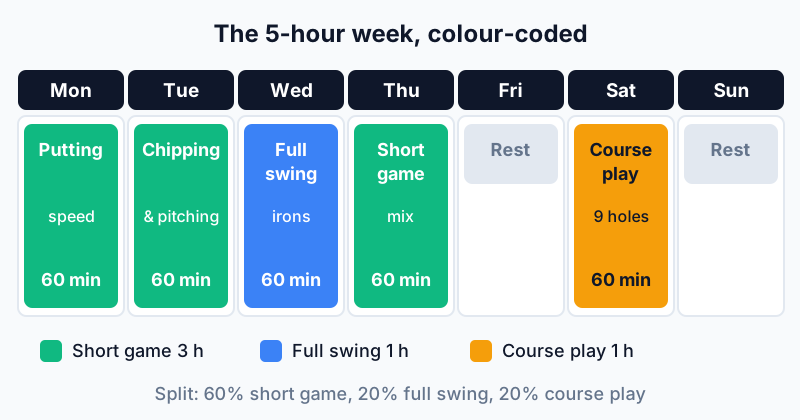
Template 2: The 5-Hour Week (Committed Improver)
Five hours per week is the sweet spot for golfers serious about dropping their handicap. That's five sessions of one hour each, or you can combine some into longer sessions if your schedule allows. If you stick with it, this is enough time to see real change.
The 5-Hour Week Schedule
| Day | Focus | Duration | Specific Drills | |---|---|---|---| | Monday | Putting: Speed Control | 60 min | Ladder drill: putt to 10, 20, 30, 40, 50 ft and back (15 min), gate drill from 6 ft (15 min), breaking putts: 10 balls from each side (15 min), pressure finish: make 5 in a row from 5 ft to end session (15 min) | | Tuesday | Chipping & Pitching | 60 min | Bump-and-run with 3 different clubs (15 min), pitch shots to specific yardages: 30, 50, 70 yards (20 min), bunker play: basic greenside explosion (15 min), up-and-down game: 10 different lies, score yourself (10 min) | | Wednesday | Full Swing: Irons | 60 min | Warm-up with half swings (10 min), stock shot with 7-iron: focus on one swing thought only (15 min), work through the bag: 9-iron, 7-iron, 5-iron, hybrid (20 min), shot shaping: intentional draws and fades (15 min) | | Thursday | Short Game Mix | 60 min | Putting from 10-15 ft: the "scoring range" (20 min), flop shots and high lobs (10 min), awkward lies: downhill, uphill, sidehill chips (15 min), 9-hole short game course: chip and putt from 9 spots (15 min) | | Saturday | Course Play & Strategy | 60 min | Play 9 holes focused on course management (45 min), post-round review: note 3 shots that cost you strokes (15 min) |
Total: 5 hours/week Split: 60% short game / 20% full swing / 20% course play
Notice that Saturday combines actual play with strategic review. That post-round 15 minutes is valuable, because it tells you what to focus on the following week. If you three-putted four times, next week's putting sessions get an extra emphasis on lag putting.
Alternative 5-Hour Layout (Three Longer Sessions)
If you can't get to the course five days a week, here's the same content compressed:
| Day | Focus | Duration | |---|---|---| | Tuesday | Putting (45 min) + Chipping (45 min) + Pitching (30 min) | 120 min | | Thursday | Full Swing (60 min) + Short Game Mix (60 min) | 120 min | | Saturday | Course Play 9 holes (45 min) + Post-round review (15 min) | 60 min |
Same total time, fewer trips. The drills stay the same; you just bundle them together.
Template 3: The 10-Hour Week (Serious Competitor)
This is for the golfer who's chasing a single-digit handicap, competing in club championships, or simply obsessed enough to dedicate proper time. Ten hours per week is a serious commitment, and it gives you room to work on every part of your game.
The 10-Hour Week Schedule
| Day | Focus | Duration | Specific Drills | |---|---|---|---| | Monday | Putting: Technical | 90 min | Alignment and stroke path drill with putting mirror (20 min), gate drill at 4-8 ft (20 min), speed control: lag putting ladder (20 min), green reading walk: read 20 putts before hitting (15 min), pressure putting: make 20 from 6 ft (15 min) | | Tuesday | Full Swing: Irons & Wedges | 90 min | Warm-up (10 min), wedge distance control: 50, 75, 100 yards with 3 clubs (25 min), mid-iron stock shots (20 min), long irons and hybrids (20 min), trouble shots: punch, knockdown, high soft (15 min) | | Wednesday | Short Game: Chipping & Bunkers | 90 min | Bump-and-run from 3 lies (20 min), lob wedge finesse: land-and-stop shots (20 min), greenside bunkers: 30 balls (20 min), fairway bunker practice (15 min), up-and-down scoring game (15 min) | | Thursday | Full Swing: Woods & Driver | 80 min | Warm-up (10 min), fairway woods from the deck (20 min), driver with alignment focus (20 min), driver with shot shape targets (15 min), simulated tee shots: pick holes from your course (15 min) | | Friday | Putting: Scoring | 80 min | 10-15 ft putts: the scoring zone (25 min), breaking putts: left-to-right and right-to-left (20 min), downhill speed control (15 min), 18-hole putting course on the practice green (20 min) | | Saturday | Course Play | 120 min | 18 holes with specific focus areas (105 min), post-round analysis and note-taking (15 min) | | Sunday | Recovery & Review | 50 min | Light stretching and mobility (15 min), review week's practice notes (10 min), plan next week's focus areas based on data (10 min), visualisation: play your course mentally, hole by hole (15 min) |
Total: 10 hours/week Split: 48% short game (counting Tuesday's wedge work) / 24% full swing / 28% course play & review
At this level, the 70/20/10 ratio shifts because your short game is already reasonably solid. You need more full-swing refinement and course management to continue improving. Sunday's "recovery and review" session is intentionally light. Rest matters, and the mental review work is still useful.
Important: Ten hours of structured practice beats twenty hours of aimless hitting. If you're going to commit this much time, commit to the structure too. Every session should have a clear objective written down before you start.
For more detail on structuring practice around your skill level, see my best practice routines by handicap guide.
Templates by Handicap Level
The templates above give you a time-based framework. But what you focus on within those sessions should change based on your current handicap. Here's how to adjust.
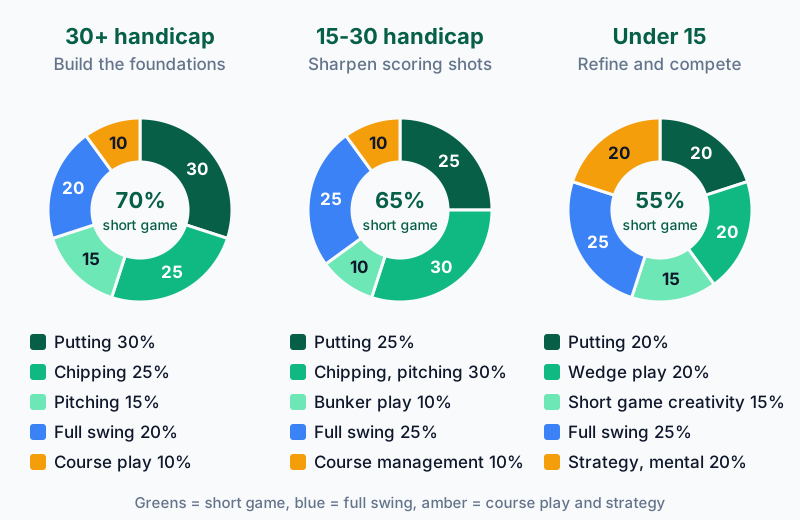
30+ Handicap: Build the Foundations
If you're a beginner or high-handicapper, your biggest gains come from basic contact and getting the ball airborne consistently. The 70/20/10 rule still applies, but the type of short game work shifts.
Priority areas:
- Putting (30%): Focus on distance control, not line. Three-putts at this level usually start with a first putt that finishes well short or long.
- Chipping (25%): One simple bump-and-run technique with an 8-iron. Don't complicate it with lob wedges yet.
- Pitching (15%): Basic pitch shot with a sand wedge to 30 and 50 yards. Consistent contact is the goal.
- Full swing (20%): 7-iron only for the first month. Develop one reliable club before spreading across the bag.
- Course play (10%): Play par-3 courses or just 9 holes. Focus on finishing every hole, with no picking up.
| Session Type | Key Drill | Success Metric | |---|---|---| | Putting | Lag putt to a towel from 30 ft | 8 out of 10 within 3 ft | | Chipping | Bump-and-run to a circle from 10 yards | 6 out of 10 on the green | | Full Swing | 7-iron to any target | 7 out of 10 solid contact |
If you're just starting out, my golf practice plan for beginners breaks this down in even more detail.
15-30 Handicap: Sharpen the Scoring Shots
You can get the ball around the course. Now it's about eliminating the blow-up holes and converting more pars. Your biggest leaks are often three-putts, duffed chips and poor course management.
Priority areas:
- Putting (25%): Shift focus to the 5-15 ft range. These are the par-saving putts.
- Chipping & pitching (30%): Multiple techniques: bump-and-run, standard chip, pitch with spin. Vary the lies.
- Bunker play (10%): Get out first time, every time. That alone saves shots every round.
- Full swing (25%): Work through the full bag. Develop a reliable pre-shot routine.
- Course management (10%): Learn to aim for the fat part of the green. Stop firing at tucked pins.
| Session Type | Key Drill | Success Metric | |---|---|---| | Putting | Make 5 in a row from 6 ft | Complete within 15 min | | Chipping | Up-and-down from 10 random spots | Save 5 out of 10 | | Bunker | Greenside explosion to a towel | 8 out of 10 on the green | | Full Swing | Hit 3 clubs to within 10% of target yardage | 6 out of 10 within range |
Under 15 Handicap: Refine and Compete
At this level, you're a decent golfer and improvements come in smaller increments. The focus shifts to shot shaping, distance control with wedges, pressure putting, and mental game.
Priority areas:
- Putting (20%): Pressure drills. Make 50 in a row from 3 ft. Simulate tournament situations.
- Wedge play (20%): Precise distance control. You should know your carry yardage for every wedge at every swing length.
- Short game creativity (15%): Different trajectories, spin rates, landing spots. Own the area within 50 yards.
- Full swing (25%): Shot shaping on demand. Working the ball both ways with mid-irons.
- Course strategy & mental game (20%): Pre-shot routines, course management simulations, on-course practice rounds with specific goals.
| Session Type | Key Drill | Success Metric | |---|---|---| | Putting | Pressure circle: make 3 from 3 ft, 3 from 4 ft, 3 from 5 ft | Complete without missing | | Wedges | 10 shots each to 50, 75, 100 yards | Average dispersion under 10 ft | | Full Swing | Hit draw and fade on command | 7 out of 10 correct shape | | Course Strategy | Play 9 holes aiming only at safe targets | No double bogeys |
How to Adjust Your Template Seasonally
Your practice schedule shouldn't be static across all twelve months. Here's how to adapt based on the season (Northern Hemisphere assumed; flip it if you're down under).
Winter (December - February):
- Shift heavily towards indoor work: putting mats, chipping nets, fitness.
- Use this as your "technical" season for grip changes, stance adjustments and swing mechanics.
- Increase putting allocation to 40%+ since it's the easiest skill to practise indoors.
- Add flexibility and strength work (see my guide on golf stretches and exercises).
Spring (March - May):
- Transition back to outdoor practice. Rebuild confidence with full swing.
- Ease into course play, and don't expect to shoot your summer scores immediately.
- Focus on wedge distance recalibration (distances change as the weather warms).
Summer (June - August):
- Peak competition season. Shift more time to course play and scoring.
- Reduce technical tinkering. This is the time to trust what you've built.
- Increase course management focus: play practice rounds with strategic goals.
Autumn (September - November):
- Season wind-down. Great time to experiment with new techniques.
- Identify the weaknesses that cost you during summer and build a winter plan.
- Maintain short game sharpness as course conditions get trickier (wet, leafy lies).
| Season | Short Game | Full Swing | Course Play | Special Focus | |---|---|---|---|---| | Winter | 50% | 20% | 5% | 25% fitness & indoor | | Spring | 60% | 25% | 15% | Rebuilding confidence | | Summer | 55% | 20% | 25% | Scoring & competing | | Autumn | 60% | 20% | 10% | 10% weakness analysis |
For a detailed winter practice plan, have a look at my off-season golf practice plan.
How to Track What You Practise
Having a schedule is step one. Tracking whether you followed it, and what happened when you did, is step two. It's also the step many golfers skip entirely.
Tracking your practice does three things:
- Keeps you accountable. If you can see that you skipped putting three weeks in a row, you know exactly why your scorecard is bleeding strokes on the green.
- Reveals patterns. Maybe you always skip short game on Wednesdays because you're knackered after work. Knowing that lets you reschedule it to a morning slot.
- Shows progress over time. When you can see your 6-ft make rate in practice climb from 40% to 65% over three months, it keeps you going.
You can track practice with a simple notebook or spreadsheet, but this is exactly the kind of thing that the Green Streak app was built for. It lets you log each practice session, categorise it by type (putting, chipping, full swing, etc.), build streaks for consistency, and see your practice history at a glance. Watching a streak grow makes you not want to break it, which is the whole point.
Whatever method you use, record these three things after every session:
- What you worked on (drill names, focus area)
- How long you practised (actual minutes, not "about an hour")
- One observation or takeaway ("lag putting felt off today; check grip pressure next time")
That's it. Thirty seconds of note-taking. Over weeks and months, those notes become a goldmine for your monthly review.
What to Do When You Miss a Day
Life happens. You'll miss days. The important thing is how you respond.
Rule 1: Don't try to "make up" missed time in one mega-session. If you miss your 40-minute putting session on Monday, don't bolt on an extra 40 minutes to Wednesday's chipping session. That leads to fatigue, poor quality practice, and frustration. The session is gone. Let it go.
Rule 2: If you miss one session, carry on with the schedule as written. The templates are designed so that every skill gets regular attention across the week. Missing one session won't derail your progress.
Rule 3: If you miss three or more sessions in a week, do a "minimum effective dose" session. This is a single 20-minute session covering:
- 7 minutes putting (lag putting and short putts)
- 7 minutes chipping (bump-and-run from 3 spots)
- 6 minutes full swing (hit 20 balls with your favourite iron)
That's enough to keep the rust off and maintain your streak. Green Streak tracks that streak for you, which gives you extra motivation not to let it lapse.
Rule 4: Never miss twice in a row. One missed day is a blip. Two missed days is the start of a new (bad) habit. This is the single most important rule for building a consistent practice habit.
Monthly Review and Adjustment Process
At the end of each month, spend 20-30 minutes reviewing your practice data and adjusting the template for the following month. Here's a simple process:
Step 1: Audit Your Practice Log
Look at your actual practice hours vs. your planned hours. Where were the gaps? Which sessions did you skip most often?
Step 2: Review Your Scores
If you've played rounds during the month, look at where you gained and lost strokes. Common categories:
- Driving accuracy (fairways hit)
- Approach play (greens in regulation)
- Short game (up-and-down percentage)
- Putting (putts per round, three-putts)
Step 3: Identify One Area to Increase
Based on steps 1 and 2, pick one area that needs more attention next month. Maybe your three-putts have crept up, or your chipping has been poor. Increase that area's allocation by 10-15% and reduce something that's in good shape.
Step 4: Refresh Your Drills
Staleness kills practice quality. Swap in at least 2-3 new drills each month. Keep the fundamentals (gate drill, lag putting, etc.) but rotate the secondary drills to keep things engaging.
Step 5: Set One Measurable Goal
"Get better at putting" is not a goal. "Reduce three-putts from 4 per round to 2 per round" is. Write it down. Put it on the template. Review it in 30 days.
| Monthly Review Step | Time | Output | |---|---|---| | Audit practice log | 5 min | Gap analysis | | Review scores | 5 min | Stroke-loss areas | | Identify focus area | 5 min | Adjusted time allocation | | Refresh drills | 10 min | Updated drill list | | Set measurable goal | 5 min | One specific target |
This process takes half an hour and is arguably the highest-value 30 minutes you'll spend all month on your golf game. If you're using the Green Streak app to log your sessions, pulling up your practice data for this review takes seconds, because it's all there in your history.
The 19th Hole: I only started playing golf properly in the second half of 2022, and my first official World Handicap System index came in 2026: 14.5 in May. It didn't fall in a neat line. It went up to 15.5 in June and 16.5 in early July, then came down to 14.0 by late July, 13.0 in August and 12.7 in September. If I'd judged my golf on any single month, I'd have drawn the wrong conclusion twice. That's how you should judge a practice schedule too. Don't rip it up after one poor fortnight or declare victory after one good round. Run the monthly review, change one thing at a time and give it a full season. It's also why I built Green Streak around daily habits: a streak rewards the part you control, which is showing up.
Sources & Further Reading
- Ericsson, K. Anders, Krampe, R. T. & Tesch-Römer, C. "The Role of Deliberate Practice in the Acquisition of Expert Performance." Psychological Review, 100(3), 363-406, 1993.
- Broadie, Mark. Every Shot Counts: Using the Revolutionary Strokes Gained Approach to Improve Your Golf Performance. Avery, 2014.
- Rotella, Bob. Golf is Not a Game of Perfect. Simon & Schuster, 2007.
- Pelz, Dave. Dave Pelz's Short Game Bible. Broadway Books, 1999. Sample text via the Library of Congress.
Related Articles
- How to Practice Golf Effectively
- Best Practice Routines by Handicap
- How Often Should You Practice Golf?
- Building a Consistent Golf Practice Habit
- Driving Range Practice Routine
- Golf Practice Plan for Beginners
FAQ
How many hours a week should I practise golf to improve?
Many golfers can improve with 2-3 hours of structured practice per week. The important word is "structured": two hours following a proper schedule beats five hours of aimless range sessions. If you're serious about dropping your handicap by several strokes in a season, aim for 5+ hours. But even 40 minutes three times a week, focused on the right things, is a solid start.
What should I spend most of my golf practice time on?
Short game, specifically putting and chipping. The 70/20/10 rule suggests allocating 70% of practice to short game, 20% to full swing, and 10% to course play and strategy. This is the opposite of what many golfers do (which is mostly hit driver at the range), but Dave Pelz's research found that 60-65% of all golf shots occur inside 100 yards of the hole, so that's where your practice time should be concentrated. As your handicap drops below 15, you can start shifting more time to full swing and course management.
Can I follow a golf practice schedule without access to a practice facility?
Yes. Putting and chipping, which should make up the bulk of your practice, can be done at home with minimal equipment. A decent putting mat, a chipping net, and a few foam balls are all you need. My practising golf at home guide covers setup ideas in detail. Many of the drills in these templates can be adapted for indoor use, particularly the putting and short game sessions. The full-swing sessions are harder to replicate at home without a net or simulator, but they're only 20% of the plan.
How long does it take to see results from a structured practice schedule?
It varies from golfer to golfer, but give any schedule at least 4-6 weeks before judging it. Putting and short game work tend to show results soonest, while full-swing changes take longer to embed. Judge your handicap over a full season rather than a few rounds. As my own index in The 19th Hole shows, it rarely moves in a straight line. Consistency matters most: practising three times a week for 12 weeks beats practising six times a week for 3 weeks, then stopping.
Should I practise golf every day or take rest days?
For many amateurs, 4-5 sessions per week with 2-3 rest days is the sweet spot. Rest days allow for physical recovery (especially for older golfers or those with injury concerns) and mental freshness. If you do practise daily, vary the intensity: follow a hard putting session with a light stretching and visualisation day. The 10-Hour Week template above includes a deliberate "recovery and review" day on Sundays for exactly this reason. Burnout is a real risk for enthusiastic golfers, so treat rest as part of the plan. Green Streak lets you schedule rest days without breaking your streak.
How do I know if my golf practice schedule is working?
Track two things: practice consistency and on-course results. For consistency, log every session and aim for at least 80% adherence to your weekly plan (the Green Streak app helps here, showing your streak and practice stats at a glance). For results, track basic stats over your rounds in a notebook or scoring app: putts per round, greens in regulation, fairways hit and up-and-down percentage. Green Streak doesn't track rounds. Review these monthly. If your practice consistency is high but your scores aren't improving after 6-8 weeks, it's time to adjust what you're practising, not how much.
Disclaimer: The practice schedules and time allocations in this article are general recommendations based on coaching principles and performance research. Individual results will vary based on physical ability, current skill level, quality of practice, instruction, and many other factors. These templates are a starting point, not a substitute for personalised coaching from a qualified PGA professional. Always warm up properly before practice to avoid injury, and consult a medical professional if you have any physical concerns that may affect your ability to practise safely.
Ready to build your practice streak?
Track your sessions, set goals, and improve with Green Streak — completely free.
Get Started Free